
Trans Am Rapture
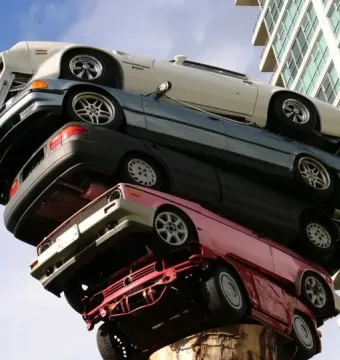
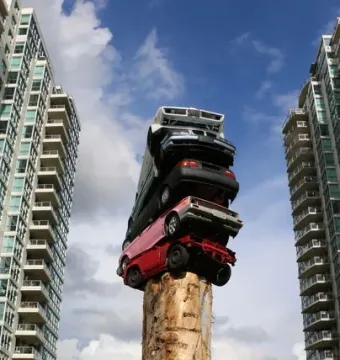
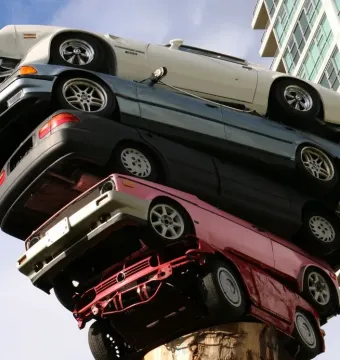
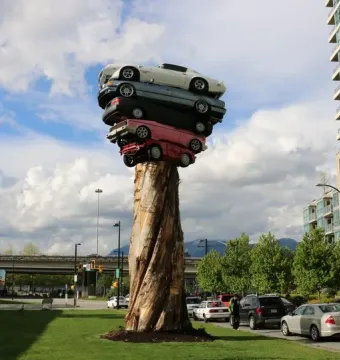
Trans Am Rapture, originally titled Trans Am Totem, was a public art installation in Vancouver, British Columbia, created by sculptor Marcus Bowcott for the Vancouver Biennale. Unveiled in April 2015, it stood at the intersection of Quebec Street and Milross Avenue near False Creek, east of downtown Vancouver. The sculpture featured stacked cars mounted on a base made from a tree trunk. Bowcott developed the work over two years with help from Helene Aspinall and structural engineer Eric Karsh. It was dismantled on August 15, 2021, and a new location was still being considered as of 2025.
March 2013 © The Interior · CC BY-SA 4.0
March 2013 © The Interior · CC BY-SA 4.0
March 2013 © The Interior · CC BY-SA 4.0
March 2013 © The Interior · CC BY-SA 4.0
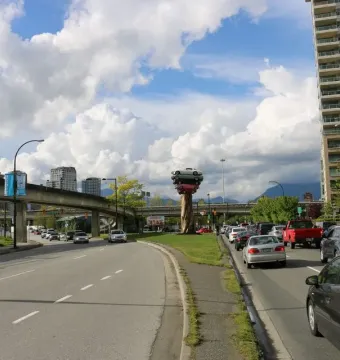
March 2013 © The Interior · CC BY-SA 4.0
Identification | |
| Title | Trans Am Totem |
| Alternative title | Trans Am Rapture |
| Type | Public art installation |
Historical context | |
| Event | Vancouver Biennale |
| Project period | 2014–2016 Vancouver Biennale |
Creator | |
| Artist | Marcus Bowcott |
| Collaborators | Helene Aspinall and structural engineer Eric Karsh |
| Creation period | 2014–2016, over two years |
| Professional background | Began work on the sculpture after 22 years teaching at Capilano University |
Discovery and provenance | |
| Inspiration | Decaying cars seen on the Fraser River in the 1980s, including vehicles used by farmers as breakwaters to prevent erosion |
| Earlier studies | He tried to depict the decayed vehicles in paintings but was dissatisfied with the results |
| Funding | The Vancouver Biennale contributed CAD 10,000 toward construction and installation costs; Bowcott covered the remaining costs |
| Post-installation fundraising | A crowdfunding campaign raised CAD 6,500 to recoup installation costs |
Physical characteristics | |
| Composition | Five cars mounted vertically on a wooden base |
| Weight | 11,340 kg |
| Height | 10 m |
Materials | |
| Materials | Automobiles, wood, and steel |
| Base material | Trunk of a giant arborvitae |
| Support structure | A steel column runs through the center of the sculpture |
Technique | |
| Vehicle modifications | Engines, transmissions, and drivetrains were removed to reduce weight, and the cars were repainted |
| Lighting | Solar-powered lights illuminate the cars' front and rear lights at night |
Appearance | |
| Vehicle arrangement | From bottom to top: shortened Mercedes-Benz W201 with a Volkswagen Golf Mk3 front end, Volkswagen Golf Mk1 Cabriolet, Honda Civic sedan, BMW 7 Series (E38), and 1981 Pontiac Trans Am |
| Base construction | The tree trunk was split lengthwise into two halves to accommodate the central steel column |
| Source of vehicles | Donated by a local scrapyard |
Iconography and meaning | |
| Meaning | A celebration of mobility and technology and a critique of throwaway consumer culture and environmental destruction |
Location and ownership | |
| Original location | Intersection of Quebec Street and Milross Avenue, Vancouver, British Columbia, Canada |
| Current status | Not currently installed; dismantled on August 15, 2021 |
| Current search status | The City of Vancouver is looking for a new site, and a relocation attempt to the south end of the Granville Street Bridge was abandoned after local residents protested |