
Broken Chair
Broken Chair is a monumental sculpture in Geneva. The work is a 12-meter-tall wooden chair with one broken fourth leg and was made from 5.5 tons of wood. It was created by sculptor Daniel Berset and built by carpenter Louis Genève. Installed in August 1997 on Geneva’s Place des Nations, in front of the Palais des Nations, it was intended to stand there for three months, until an international convention banning anti-personnel mines and cluster bombs was signed. Because the signing was delayed, the sculpture remained until 2005, was later removed during square reconstruction, and returned to its original site in 2007.
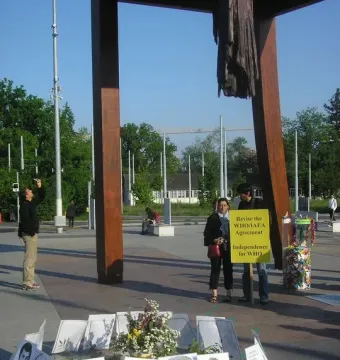
April 2011 © MHM55 · CC BY-SA 4.0
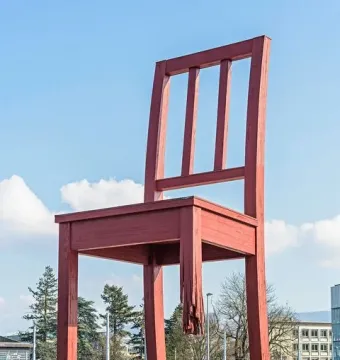
April 2019 © Markus Schweizer · CC BY-SA 4.0
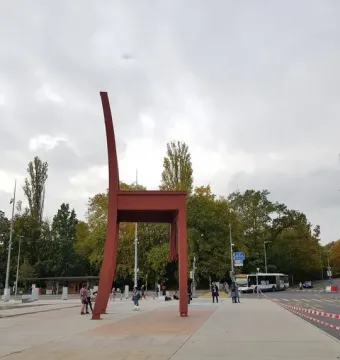
October 2019 © Armineaghayan · CC BY-SA 4.0
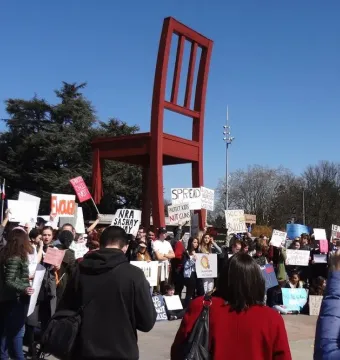
March 2018 © MHM55 · CC BY-SA 4.0
© atheep · CC BY 3.0
Identification | |
| Title | Broken Chair |
| Type | monumental sculpture |
| Alternative names | Three-legged chair; giant chair |
| Original title | Сломанный стул |
Creator | |
| Artist | Daniel Berset |
| Artist nationality | Swiss |
| Fabricator | Louis Genève, carpenter |
| Concept and project by | Paul Vermeulen, co-founder and director of Handicap International Switzerland |
| Commissioned by | Paul Vermeulen |
| Commission date | October 1996 |
Historical context | |
| Purpose of 7 October 2014 action | To mark Putin's birthday |
| Commission purpose | To be installed on Place des Nations and help get as many nations as possible to sign the Ottawa Treaty on landmines in December 1997 |
| Reason it remained longer | The treaty was delayed, many countries did not sign, and there was strong public support for the sculpture |
| Intended duration at site | Three months, until the signing of the Ottawa Treaty in December 1997 |
Discovery and provenance | |
| 2023 intervention | Saype painted a hand holding the missing piece onto the ground beneath the sculpture to draw attention to the bombardment of civilians |
| Vandalism motive | Protest against Russia's war against Ukraine and what they saw as the UN's failure to stop the conflict |
| Vandalism | Two Femen activists damaged the monument with a chainsaw |
| Reinstallation date | 26 February 2007 |
| Cluster munition treaty signed | Oslo, December 2008 |
| Reinstallation dedication | Officially dedicated by Handicap International in support of the new Oslo process and the signing of an international treaty banning cluster munitions |
| Vandalism date | 13 December 2024 |
| Reason for removal | Renovation works at Place des Nations |
| Installation date | 18 August 1997 |
| Installed by | Handicap International |
| Original owner | Daniel Berset |
| Ownership transferred to | Handicap International |
| Ownership until | 2004 |
| Removal date | 2005 |
Physical characteristics | |
| Height | 12 metres |
| Weight | 5.5 tonnes of wood |
| Form | A giant chair with a broken leg |
| Distinctive feature | The left front leg ends in a shattered stump that extends into the air |
Materials | |
| Material | Wood |
| Wood used | 5.5 tonnes of wood |
Appearance | |
| Description | Wooden chair with its fourth leg broken off |
Iconography and meaning | |
| Social message | A call by civil society to heads of state visiting Geneva |
| Interpretive statement | A witness to the ravages of explosive weapons and a protest against weapons that kill civilians |
| Dedication | Dedicated to the victims of anti-personnel mines |
| Symbolism of missing leg | Represents the amputation of a limb suffered by war victims |
| Purpose | Acts as a reminder to politicians and diplomats visiting Geneva |
| Symbolism | Opposition to anti-personnel mines, cluster bombs, and other explosive weapons |
Location and ownership | |
| Location | Place des Nations, in front of the main entrance to the Palais des Nations, Geneva, Switzerland |
History and restoration | |
| Temporary removal period | 2005 to 2007 |
| Reason it remained in place after intended removal | The signing of the Ottawa Convention was delayed and faced significant difficulties |
| Inscription | An inscription in nine languages was installed at the base of the sculpture |
| Temporary prosthesis | A temporary prosthesis was added in 2015 for World Day of Persons with Disabilities |
| Renovation | Renovated in 2016 |
| Lighting | Night lighting was added in 2016 |
| Aftermath of vandalism | The sculpture kept traces of the damage |