
Salvation Mountain
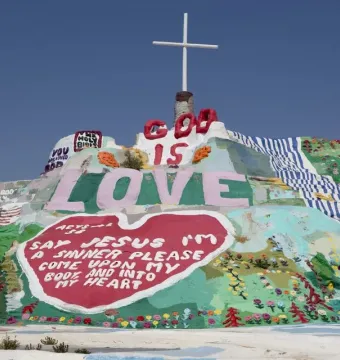
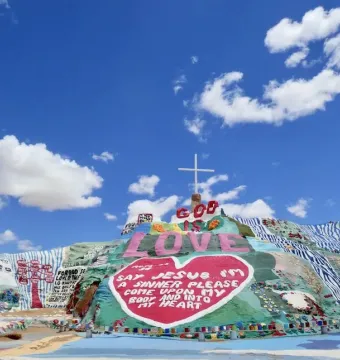
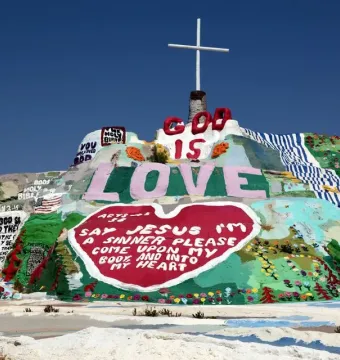
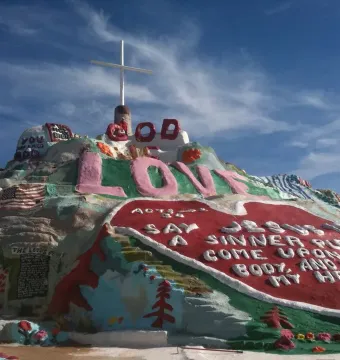
Salvation Mountain is a colorful artificial mountain in Slab City, south of the California desert and north of Calipatria. Created by Leonard Knight, it was built from straw, bricks, discarded tires, car parts, and thousands of liters of paint. The surface is decorated with flowers, hearts, and religious symbols, reflecting Knight’s devotion to God, Love, and Jesus. Knight lived at the foot of the mountain and welcomed visitors from around the world. The site has been recognized as a significant folk art landmark and has required ongoing maintenance because of the harsh desert environment. A charitable foundation was established to support its preservation, and the site was temporarily closed during the COVID-19 pandemic.
© Carol M. Highsmith · Public domain
© Aculp · CC BY-SA 4.0
© Carol M. Highsmith · Public domain
December 2010 © Brian · CC BY 2.0
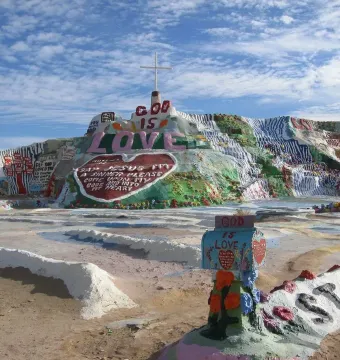
December 2009 © taylorandayumi · CC BY 2.0
Identification | |
| Title | Salvation Mountain |
| Alternative names | Monte della salvezza; La Montagne du Salut; Góra Zbawienia; Гора Спасения; Гора спасения |
| Type | Religious folk-art installation and mountain sculpture |
Historical context | |
| Construction started | 1984 |
| Construction period | nearly 30 years |
| Current structure | the current Salvation Mountain is the second structure on the site |
| First structure collapse | collapsed in 1989 after a rainstorm caused a crack; the earlier version was built with unstable methods |
| Expansion | expanded in 1998 |
| Expansion inspiration | Navajo people and Navajo pueblitos in the area |
Creator | |
| Artist lifespan | 1931–2014 |
| Birth date | 1 November 1931 |
| Birth place | outside Burlington, Vermont |
| Military service | served in the Korean War |
| Artist | Leonard Knight |
Discovery and provenance | |
| Visitor history | visited by thousands of tourists from around the world |
| Assistance | Bill Ammon ('Builder Bill') of Slab City helped for a long period |
| Volunteer support | volunteers helped protect and maintain the site |
| Visitor support | visitors donated paint to the project |
| Main message | God is love; God loves everyone |
| Public access | Knight gave free tours to visitors |
| Artist's intent | to dedicate his life to God and spread an evangelical message of love and Jesus |
| Initial plan | to paint the Sinner's Prayer on a hot-air balloon |
| Earlier related work | in the 1970s he built a hot-air balloon from patchwork materials and a stove and painted "GOD IS LOVE" on it |
| Origin of concept | after a failed hot-air balloon project and prayer, Knight felt God told him to build a mountain |
Physical characteristics | |
| Form | a colorful artificial hill/mountain built by hand |
| Size | several stories high and about 100 yards wide |
| Reported height | 50 feet |
| Notable features | stairs cut into the hillside lead to the summit |
| Summit feature | a cross on top |
| Additional structures | painted cars and trucks; a semicupola structure called "the museum"; a traditional Navajo dwelling (hogan) |
| Decorative features | many murals and painted surfaces with flowers, hearts, and religious symbols |
| Text content | Christian sayings and Bible verses, including the inscription "God is Love" |
| Museum contents | small donated objects with individual meanings; visitors often leave an object as a symbol of giving themselves to God |
Materials | |
| Museum materials | clay and straw, with parts of cars and tree roots/branches inside the dome |
| Paint | thousands of liters of lead-free paint |
| Primary materials | adobe bricks, straw, clay, discarded tires, automobile parts, windows, and paint |
Technique | |
| Protective coating | several layers of paint were applied to protect the structure |
| Maintenance | requires constant maintenance because of the harsh desert environment |
| Maintenance plan | Knight planned to repaint it twice a year in his last ten years of life to keep the paint layer thick |
| Maintenance interrupted | he could not continue repainting after an injury in 2011 |
| Construction method | built with improved materials and engineering on the second attempt |
Location and ownership | |
| Residence of artist | Knight lived at the base of the mountain in a customized 1930 Chevrolet truck / pickup truck or car, without running water or electricity |
| Current care | residents of Slab City care for the work |
| Living arrangement | he preferred to live in a shack on the back of his truck for 27 years |
| Access to artist | he could only be reached by post |
| Nearby place | Niland and the Salton Sea |
| Landscape | Colorado Desert in southeastern California |
| Nearby city | Calipatria |
| Nearby community | Slab City |
| Setting | near Slab City, several miles from the Salton Sea |
| Location | Slab City, Imperial County, California, United States, on a hill in the Colorado Desert near Calipatria, northeast of Niland, east of the Salton Sea |
History and restoration | |
| Environmental concern | there were concerns the site might be closed because of environmental contamination |
| Death of creator | died on 10 February 2014 in El Cajon, aged 82 |
| Health of creator | in December 2011 Knight was hospitalized with dementia and placed in a long-term care facility in El Cajon |
| Last visit by creator | Knight visited Salvation Mountain for the last time in May 2013; the visit was recorded by KPBS (TV) |
| Reconstruction | Knight rebuilt the mountain after the collapse and said he worked "with more smarts" |
| Organization type | public charity |
| Government attempts to close | in the mid-1990s, the Governor of California repeatedly attempted to close Slab City and Salvation Mountain |
| Closure during COVID-19 | the site was closed for several months during the COVID-19 pandemic |
| Board composition | run by nine volunteer board members |
| Donation | $32,000 from the Annenberg Foundation in 2013 for materials and equipment to improve safety and strengthen operations |
| Established | February 2011 |
| Support organization | Salvation Mountain, Inc. |
Significance | |
| Recognition | in 2000 the Folk Art Society of America declared it a folk art site worthy of preservation and protection |
| Recognition | in 2002 Barbara Boxer described it in Congress as a national treasure and a visionary sculpture worthy of international recognition |
| Description of artist | visionary American folk artist |
| Artistic interpretation | a work of high folk religious art expressing unconditional love for humankind |
| Community significance | an unofficial focal point for Slab City and its anarchic creative identity |
| Film appearance | Leonard Knight appeared in Sean Penn's Into the Wild (2007) |