
Memoria Urbana Berlin
Memoria Urbana is a urban sculpture by Spanish artist Juan Garaizabal, installed in June 2012 in the center of Bethlehem Church Square in Berlin’s Mitte district. It marks the exact site and original dimensions of the vanished Bethlehem Church, recreating its outline in the air with 800 meters of steel tubing and 300 meters of LED lighting. The work measures 25 meters east to west, 15 meters north to south, and 31 meters high, and weighs 40 tons. Originally intended as a temporary installation, it became permanent in 2013, with the decision confirmed by a district vote in 2014. The memorial honors freedom of conscience, immigration, and Berlin’s tradition of tolerance.
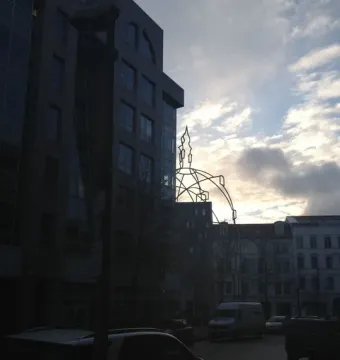
February 2013 © Sebastian Wallroth · CC BY 3.0
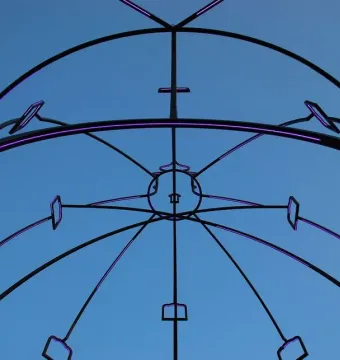
July 2012 © Wolfsraum · CC BY-SA 3.0
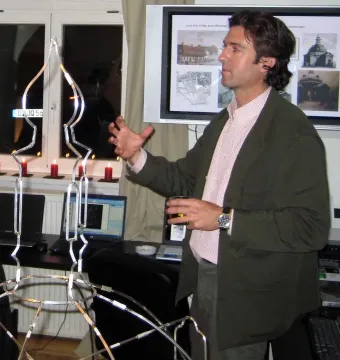
April 2009 © Teralonso · Public domain
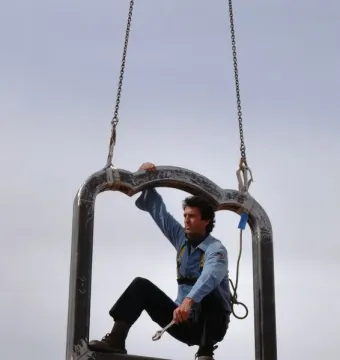
June 2012 © Elena Weisz · CC BY-SA 4.0
February 2015 © OTFW · CC BY-SA 3.0
Identification | |
| Title | Memoria Urbana Berlin |
| Alternative name in German | Rekonstruktion der Böhmischen Bethlehemskirche |
| Type | Public sculpture / monumental sculpture / monument |
| Alternative name | Memoria Urbana |
Creator | |
| Artist | Juan Garaizabal |
| Artist nationality | Spanish |
Location and ownership | |
| Location | Bethlehemkirchplatz, Mitte district, Berlin, Germany |
| Position | At the center of Bethlehemkirchplatz |
History and restoration | |
| Maintenance funding | Supported by various charitable donations; the foundation guarantees maintenance |
| Demolition of referenced church | Demolished in 1963 |
| Damage to referenced church | Severely damaged by bombing in 1943 |
| Later site use | The site was incorporated into the Checkpoint Charlie facilities |
| Permanent status | Declared permanent by local authorities in December 2013 and confirmed by the Mitte district parliament on 14 October 2014 |
| Maintaining organization | Lux-Bethlehem Foundation (also referred to as Lux-Bethlehem e.V.) |
| Originally planned duration | About 4 months, later extended to one year |
| Installed | June 2012 |
Discovery and provenance | |
| Built over | A mosaic marking the exact location and original dimensions of the vanished Bethlehem Church |
Historical context | |
| Commemorated subject | The demolished Bohemian Bethlehem Church |
| Original church construction | Built between 1733 and 1735 in Friedrichstadt, now part of Mitte, Berlin |
| Historical significance | A major chapter in relations between Prussia and Bohemia; a symbol of tolerance and openness in the Prussian state |
| Related historical context | Bohemian refugees fleeing religious persecution were welcomed in Berlin by Frederick William I of Prussia, along with other immigrants such as French Huguenots |
Physical characteristics | |
| Steel tube length used | 800 meters (2,600 linear feet) |
| Weight | 40 tons (44 short tons) |
| Dimensions | 25 meters west to east x 15 meters north to south x 31 meters high (82 x 49 x 101 feet) |
| LED system length used | 300 meters (984 linear feet) |
| Form | An open structure that traces the silhouette of the vanished church in the air and recreates its original volume as a sketch-like outline |
Materials | |
| Lighting material | LED lighting system |
| Material dimensions | 12 x 12 cm (4.7 x 4.7 in) |
| Main material | Square-section steel tube |
Appearance | |
| Night appearance | Illuminated at night, with light lines highlighting the parts where light once entered the church |
Iconography and meaning | |
| Dedication | Freedom of conscience and immigration |
| Meaning | A tribute to the courage of the Bohemian settlers and to immigrants in general, including the artist himself, and to the generosity and openness of historical Prussia and modern Berliners |
| Interpretation | A monument to Berlin as a city of welcome and tolerance with a European spirit |
| Symbolic meaning | Represents the city's ability to draw the best from its past and project it confidently into the present |
| Functional role | Restores the Bethlehem Church's presence in the square and serves as a place for meetings, reflection, and reconciliation |
Other | |
| Artist self-description | Garaizabal describes himself as a Spanish immigrant in Berlin |
| Artist's motivation | He says Berlin gave him freedom to create and the chance to realize his artistic ideas |
| Artist statement | To understand my works, one does not need to be an erudite, but contact with my work creates a strong desire to visit a library and start studying archives! |
| Conceptual character | A contemporary technical and aesthetic innovation built on a heroic historical past |
| Urban concept | Synthesizes Berlin's ability to draw the positive essence of the past and project it into the future |
| Quoted artist statement | One does not need to be learned to approach my work; however, contact with it generates a strong desire to plunder libraries and archives |