
Tomb of Francis II, Duke of Brittany
The Tomb of Francis II, Duke of Brittany is a monument in the Cathedral of St. Peter in Nantes. Commissioned by Anne of Brittany, Queen of France, it was originally intended for the Carmelites’ chapel in Nantes, where Francis II had wished to be buried. Executed in Carrara marble in the early sixteenth century, it was sculpted by Michel Colombe from a design by Jean Perréal. The tomb is regarded as the first major work in the Renaissance style in Brittany and is considered a masterpiece of French sculpture. It contains the bodies of Francis II and both of his wives, and depicts Francis alongside his second wife, Margaret of Foix.
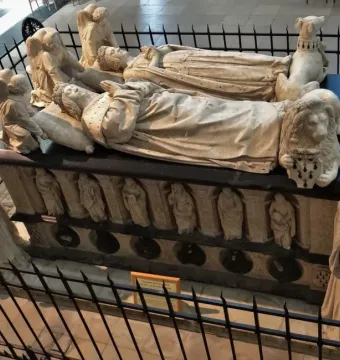
October 2019 © Ibex73 · CC BY-SA 4.0
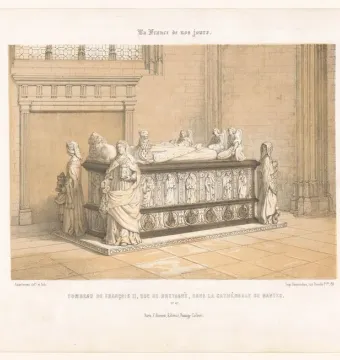
© Rijksmuseum · CC0
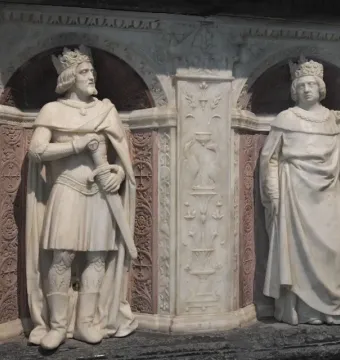
August 2015 © GFreihalter · CC BY-SA 3.0
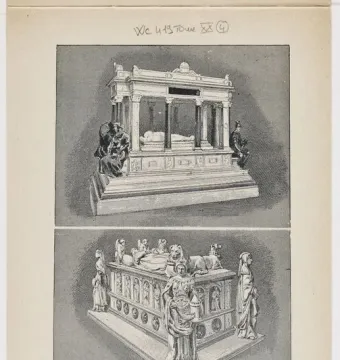
· Public domain
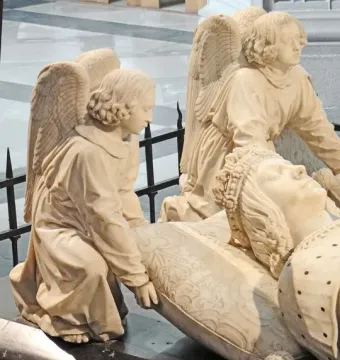
July 2013 © Jean-Pierre Dalbéra · CC BY 2.0
Identification | |
| Title | Tomb of Francis II, Duke of Brittany |
| Type | Funerary monument; tomb; mausoleum |
| Alternative names | Tombeau des Carmes; Tomb of the Carmelites |
Historical context | |
| Date | 1502–1507 |
| Style | Renaissance |
Creator | |
| Sculptor | Michel Colombe |
| Designer | Jean Perréal |
| Designer role | Architect and painter; royal artist |
Discovery and provenance | |
| Original name | Named after its original location |
| Burials and remains | Francis II and his two wives were buried in the tomb; Margaret of Foix's remains were transferred there in 1507 after papal authorization; Anne of Brittany's heart was placed there in a golden reliquary; bones believed to be those of Arthur III, Duke of Brittany, were also reinterred there |
| Burial intention | Francis II wished to be buried in the Carmelite chapel in Nantes beside the remains of his first wife, Margaret of Brittany |
| Current location | Nantes Cathedral (Cathedral of Saints Peter and Paul / Cathedral of Saint Peter and Saint Paul), Nantes, France |
| Original location | Carmelite chapel (Chapel of the Carmelites), Nantes |
| Commemorated people | Francis II, Duke of Brittany; Margaret of Foix; and, more broadly, the Montfort dynasty |
| Purpose | To honor the memory of Anne of Brittany's parents |
| Commissioned by | Anne of Brittany, Duchess of Brittany and Queen of France |
Physical characteristics | |
| Head supports | Thick square parade cushions held by three kneeling angels |
| Stylistic character | Combination of Gothic and Renaissance elements; late medieval funerary iconography with Renaissance ornament |
| Lower register decoration | Half-figures of mourners (pleurants), variously described as women in black or as figures with alabaster faces and hands in dark hooded garments, set in small shell-shaped medallions |
| Upper register decoration | Small niches with delicate sculptures, framed by low-relief pilasters and arcades; the niches are red marble in some descriptions |
| Corner figures | Four full-length female statues at the corners of the tomb |
| Foot figures | A greyhound at the duchess's feet and a lion at the duke's feet |
| Side structure | The sarcophagus sides are divided into two superposed registers by a dark serpentine or black marble band/cornice |
| Duke's insignia | Badge or collar of the Order of the Ermine and the Ear of Grain/Ear of Corn |
| Overall form | Massive rectangular sarcophagus |
| Main effigies | Two recumbent effigies of Francis II and Margaret of Foix lying side by side with hands clasped in prayer and eyes closed |
| Cover slab | Black limestone from Liège |
| Base | Set on a dark green serpentine plinth/base |
| Effigy dress | Ceremonial dress with large ermine-lined mantles and fleur-de-lis crowns |
| Dimensions | 3.90 m long, 2.33 m wide, and 1.27 m high |
Materials | |
| Other materials | Black limestone from Liège; black marble; dark green serpentine; white marble; red marble; alabaster |
| Primary material | Carrara marble |
Iconography and meaning | |
| Virtue of Justice meaning | The sword punishes crime, the balance weighs the gravity of the crime or arguments, and the crown recalls the prince as judge and arbiter |
| Virtue of Fortitude | Armor-clad figure with a warrior helmet, extirpating a dragon from a crenellated tower or keep; lion-skin headdress alludes to Hercules and the Nemean lion |
| Virtue of Fortitude meaning | Represents moral strength triumphing over vice and temptation and a Christian knight defending the faith |
| Virtue of Temperance meaning | Represents measured conduct, respect for time, avoidance of excess, and restraint of the passions |
| Virtue of Temperance | Holding a horse bit in one hand and a clock in the other; wearing almost monastic dress |
| Virtue of Prudence | Holding a compass in one hand and a mirror in the other, with a double-faced elder/young woman motif; simple dress with cape, rope belt, veil, and a serpent at her feet |
| Virtue of Prudence meaning | Represents measure in action, self-knowledge, foresight based on experience, truth, and correction of conduct; the serpent recalls Matthew 10:16 |
| Greyhound heraldry | Carries the impaled arms of Brittany and Foix-Béarn-Navarre; wears an ermine collar with the Order of the Cordelière attached; represents loyalty and inherited arms from Gaston IV of Foix-Béarn and Eleanor I of Navarre |
| Virtue of Justice | May be modeled on Anne of Brittany; holds a book representing the law and a sword; wears a crown |
| Lion heraldry | Carries a lozenge-shaped shield with the arms of Brittany surmounted by a crown; a classic support in Breton heraldry |
| Foot animal symbolism | The greyhound symbolizes fidelity; the lion symbolizes strength |
| Corner figures | The cardinal virtues: Justice, Fortitude, Temperance, and Prudence |
| Upper register figures | Saint Francis of Assisi, Saint Margaret, Charlemagne, Saint Louis, and the Twelve Apostles |
| Apostles arrangement | Six apostles on each long side |
Significance | |
| Interpretation | Seen as a symbolic monument to Breton history and the Montfort dynasty, especially in a Romantic reading of the tomb |
| Temporary exhibition | The recumbent effigies were exhibited in 2025 at Tours Cathedral (Cathedral of Saint Gatien) in homage to Michel Colombe |
| Historical significance | First major work of art in the Renaissance style in Brittany |
| Artistic significance | Considered a masterpiece of French sculpture and French Renaissance sculpture |
Location and ownership | |
| Historic designation | Classified as a historic monument in 1862 |
History and restoration | |
| Rescue attribution | The rescue is sometimes attributed to Jean-Baptiste Ogée and sometimes to Mathurin Crucy |
| Rediscovery | Found again in 1800 |
| French Revolution history | In 1791 the Carmelites of Nantes were dispersed and furnishings were sold; in 1792 the Carmelite convent buildings were sold as national property |
| Research findings | A study of the tomb revealed a box containing bones belonging to three individuals |
| Restoration | Completely dismantled for a major restoration; the serpentine base and first course of white marble needed treatment because of salt damage |
| Relocation | Moved to Nantes Cathedral in 1817 and reassembled there in the early 19th century |
| Proposed reuse | Mathurin Crucy proposed reusing the tomb as the base of a commemorative column, but Prefect Le Tourneur rejected the idea |
| Preservation during the Revolution | The tomb was dismantled, hidden, and buried to prevent its destruction; the three coffins were moved to the cathedral crypt |