
Tomb of Countess Matilda of Tuscany
The Tomb of Countess Matilda of Tuscany, also known as the Monument to Matilda of Canossa, is a large sculptural memorial in St. Peter’s Basilica in Rome. Designed by Gianlorenzo Bernini and executed by Bernini with other sculptors, it commemorates Matilda of Tuscany, the noblewoman who ruled the March of Tuscany from 1055 to 1115. Commissioned by Pope Urban VIII in 1633, it took about a decade to complete, with final parts finished in 1644. The monument features a sarcophagus carved with the Submission of Emperor Henry IV to Pope Gregory VII at Canossa, supported by two cherubs, and topped by a statue of Matilda holding the keys of St. Peter, the papal crown, and a sword.
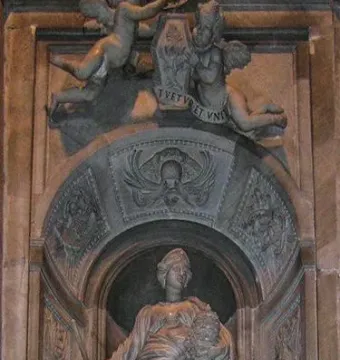
2005 © Torvindus · CC BY-SA 3.0
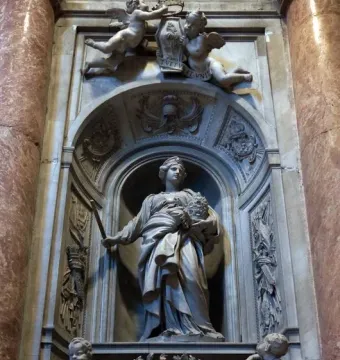
© Bede735 · CC BY-SA 3.0
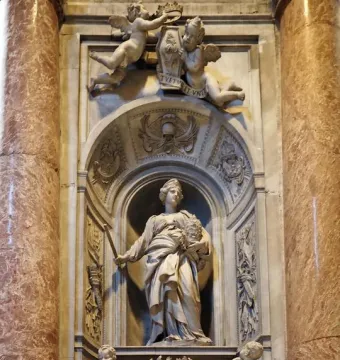
April 2017 © Peter1936F · CC BY-SA 4.0
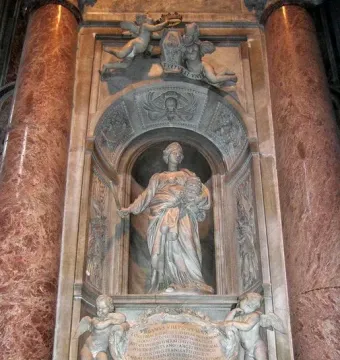
June 2004 © Torvindus · CC BY-SA 3.0
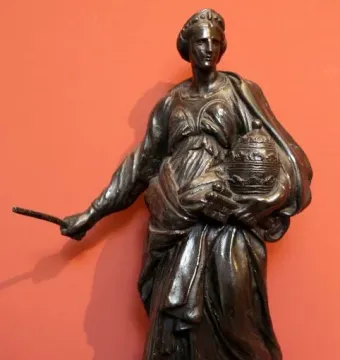
February 2018 © Sailko · CC BY 3.0
Identification | |
| Title | Tomb of Countess Matilda of Tuscany |
| Original-language title | A Tumba da Condessa Matilde da Toscana |
| Original Italian title | Il sepolcro di Matilde di Canossa |
| Type | Funerary monument |
| Dedicated to | Matilda of Tuscany |
| Alternative title | Monument to Matilda of Canossa |
Historical context | |
| Original burial place of the body | Abbey of San Benedetto in Polirone, San Benedetto Po |
| Commemorated person | Matilda of Tuscany (Matilda of Canossa), Italian noblewoman who ruled the March of Tuscany from 1055 to 1115 |
| Purpose | Memorial commemorating Matilda as a defender of the Church against the Holy Roman Emperor's forces |
Creator | |
| Designer / artist | Gian Lorenzo Bernini |
| Executed by | Bernini with assistance from other sculptors, including Agostino Radi and Alessandro Loreti |
Discovery and provenance | |
| Other surviving model | The Bode Museum in Berlin also holds a model |
| Harvard Museums model | A well-finished bronze statuette cast from Bernini's clay model, likely intended as a model and possibly as a gift for the pope |
| Preparatory model | Bernini prepared a clay model; a small bronze preparatory model survives |
| Evidence from model | Bernini's tool marks on the back of the bronze model indicate the design was intended to be placed in a niche at Saint Peter's |
| Commissioned by | Pope Urban VIII |
| Commissioned in | 1633 |
History and restoration | |
| Burial history | Initially buried in a sarcophagus in the Abbey of San Benedetto in Polirone, where her tomb was later desecrated several times |
| Transfer of remains | In 1632, by order of Pope Urban VIII, her body was moved to Castel Sant'Angelo in Rome; in 1634, it was given its final placement in St. Peter's Basilica |
| Possible reason for transfer | Possibly to celebrate Pope Urban VIII's Tuscan roots and Matilda's support for the pope |
| Completed in | 1644 |
Location and ownership | |
| Part of | Matilda of Tuscany's tomb in St. Peter's Basilica |
| Intended location | St. Peter's Basilica, Rome |
| Current location | St. Peter's Basilica, Rome, Vatican |
Physical characteristics | |
| Sarcophagus | Roman-style sarcophagus |
| Main composition | A marble statue of Matilda standing in a niche above a Roman-style sarcophagus |
| Sarcophagus relief | Bas-relief of the Humiliation of Canossa, showing Emperor Henry IV submitting to Pope Gregory VII at Canossa Castle |
| Setting | Niche decorated with friezes of weapon trophies |
| Supporting figures | Two winged putti above and two kneeling putti below |
Appearance | |
| Pose | Standing in a niche |
| Lower support | The kneeling putti hold the inscription at her feet |
| Clothing | Rich dress or tunic wrapped in a mantle or cloak |
| Gesture | Threatening and protective at the same time |
| Motto meaning | Protects and keeps united |
| Motto | Tuetur et unit |
| Upper emblem | A heraldic shield with a pomegranate, held by the winged putti |
| Attributes | A staff of command in one hand and the papal tiara with the Keys of Saint Peter in the other |
| Headwear | Tiara |
Iconography and meaning | |
| Qualities attributed to Matilda in inscription | A woman of virile spirit, protector of the Apostolic See, famous for piety, and distinguished for charity |
| Historical event depicted | The Humiliation of Canossa (also called the Road to Canossa or Walk to Canossa), in 1077 |
| Historical event description | Henry IV traveled to Canossa Castle and ritually submitted to Pope Gregory VII seeking absolution and revocation of his excommunication |
| Canossa Castle connection | Canossa Castle was owned by Matilda of Tuscany, who was hosting Pope Gregory VII |
| Main inscription | An inscription stating that Pope Urban VIII, in gratitude to Matilda, a woman of virile spirit and protector of the Apostolic See, famous for her piety and distinguished for her charity, had her remains transferred from the Mantuan monastery of San Benedetto to St. Peter's Basilica |