
Memorial to Homosexuals Persecuted Under Nazism in Berlin
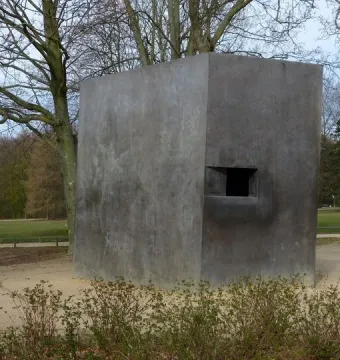
The Memorial to Homosexuals Persecuted Under Nazism in Berlin is a monument opened on 27 May 2008 in the Great Tiergarten, south of the Brandenburg Gate and opposite the Memorial to the Murdered Jews of Europe. Designed by Scandinavian artists Michael Elmgreen and Ingar Dragset, it is a concrete rectangular block, 3.6 meters high and 1.9 meters wide, slightly tilted to one side, with a window on its front face. Through it, visitors can watch a short film of two men kissing, directed by Thomas Vinterberg and shot by Robby Müller. The memorial was created to commemorate homosexuals persecuted in Nazi Germany and became the third such monument in Germany.
March 2020 © Agentakt · CC BY-SA 4.0
May 2008 © User:PDD · CC BY-SA 3.0
August 2008 © Nicor · CC BY-SA 3.0
June 2011 © Fraktion DIE LINKE. im Bundestag · CC BY 2.0
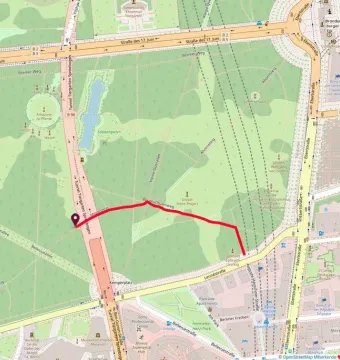
July 2026 © Schmarrnintelligenz · CC BY-SA 2.0
Identification | |
| Title | Memorial to Homosexuals Persecuted Under Nazism in Berlin |
| Type | Memorial sculpture / memorial monument |
| Original name | Denkmal für die im Nationalsozialismus verfolgten Homosexuellen |
Historical context | |
| Approval year | 2003 |
| Postwar legal continuity | Persecution continued under Section 175 after the fall of the Third Reich, with the law amended in 1969, attenuated in 1973, and finally repealed in 1994 |
| Estimated arrests | More than 50,000 homosexuals were arrested, according to some estimates |
| Third memorial of its kind in Germany | The third memorial of its kind in Germany, after the Frankfurt Angel (1994) and the Pink Triangle in Cologne (1995) |
| Estimated deaths | 10,000 to 15,000 homosexuals are estimated to have been killed in concentration camps |
| Approval body | The German Bundestag |
| Decision to erect | The German Bundestag decided in 2003 to erect the memorial in Berlin during debate on the Memorial to the Murdered Jews of Europe |
| Activist advocacy | LGBT activists and the initiative Der homosexuellen NS-Opfer gedenken campaigned for a federal memorial from 1993 |
| Public remembrance background | The reassessment of remembrance began in 1985 with Federal President Richard von Weizsäcker's speech, in which gays were first named among the victim groups |
| Subject | Homosexuals persecuted under Nazism |
| Historical context | Homosexuals were not officially recognized as victims of Nazism after 1945, and their persecution continued for several decades afterward |
Creator | |
| Designers | Michael Elmgreen and Ingar Dragset |
| Designers' nationalities | Michael Elmgreen is Danish and Ingar Dragset is Norwegian |
Discovery and provenance | |
| Commissioned by | The German parliament |
| Advocacy recognition | Albert Eckert received the Federal Cross of Merit on 27 January 2012 for his commitment to the initiative |
| Opening ceremony date | 7 May 2008 |
| Inauguration date | 27 May 2008 |
Physical characteristics | |
| Orientation | Slightly tilted to one side |
| Height | 3.6 metres |
| Width | 1.9 metres |
| Length | 4.7 metres |
| Front feature | A small window cut into the front face |
| Interior feature | A screen is visible through the window |
| Form | Rectangular cuboid |
Materials | |
| Material note | Made of the same concrete as the 2,711 stelae of the Memorial to the Murdered Jews of Europe |
| Material | Concrete |
Appearance | |
| First film creators | Directed by Thomas Vinterberg and filmed by Robby Müller |
| Second film creators | Filmed by Gerald Backhaus together with Bernd Fischer and Ibrahim Gülnar |
| Film presentation | The film is projected in an endless loop |
| Original replacement plan | The film was originally intended to be replaced periodically, with a new film selected every two years by competition and jury |
| Second film title | Kuss ohne Ende |
| Displayed film | A short film showing kissing couples |
| Displayed film version history | The first film showed two men kissing; later versions included footage of two women kissing and then kissing female and male couples of different ages |
Iconography and meaning | |
| Purpose | Memorial to homosexual victims of the Holocaust |
| Interpretive plaque | A plaque in German and English explains the Nazi persecution of homosexuals and its continuation after the war under Section 175 of the German Criminal Code, which was finally repealed in 1994 |
Location and ownership | |
| Location | Großer Tiergarten, Berlin, Germany |
| Specific site | South of the Brandenburg Gate, opposite the Memorial to the Murdered Jews of Europe |
| Nearby plaque | A German- and English-language plaque is present near the memorial |
History and restoration | |
| Film replacement date | 26 January 2012 |
| Return to original film | The original film was shown again from 7 October 2014 to 10 January 2017, after which the Backhaus film was shown again |
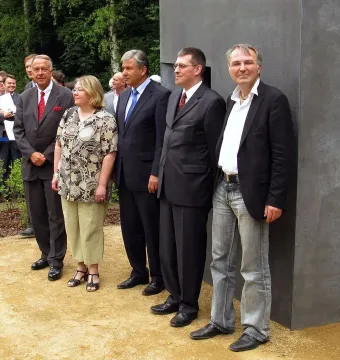
| Opening remarks | Klaus Wowereit said the memorial is important for remembering the victims and for showing that discrimination still exists today; he also emphasized that persecuted homosexuals were not rehabilitated in the postwar years |
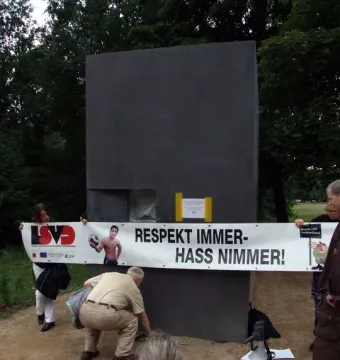
| Vandalism | The memorial was vandalized three times, on 17 August 2008, 16 December 2008, and 5 April 2009 |
| Content change | It was decided that footage of two men kissing would periodically be replaced by footage of two women kissing |
| Reason for controversy | Lesbian women were not formally persecuted by the Nazis, but were de facto harassed under the pretext of immoral behavior |
| Controversy | The memorial was criticized for commemorating only male homosexuals |
| Opening attendees | Bernd Neumann, Klaus Wowereit, Volker Beck, and Renate Künast |
Significance | |
| Public reception | The inauguration attracted great media interest |
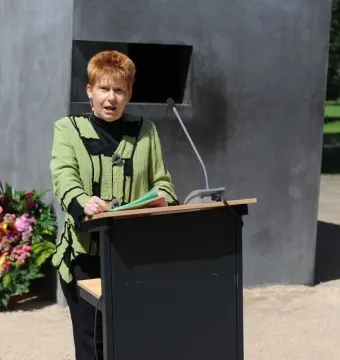
| 2018 anniversary speech | On 3 June 2018, Frank-Walter Steinmeier spoke at the memorial on the 10th anniversary of its opening and became the first German president to directly ask forgiveness from the homosexual victims of the Nazi regime; he also stated that the dignity of gays, lesbians, bisexuals, queer, trans, and intersex people is inviolable and protected by the German state |