
Fountain of Cybele
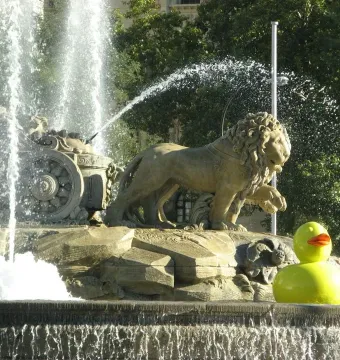
Fountain of Cybele is a monumental fountain in Madrid, located in the square of the same name in the city center. Conceived during an 18th-century urban redevelopment plan promoted by King Charles III, it was part of a neoclassical project that also included other mythological fountains and major civic works. The fountain depicts Cybele, the mother goddess identified with Rhea, riding a chariot drawn by lions. It was designed by Ventura Rodríguez and executed by Francisco Gutiérrez, Roberto Michel, and Miguel Ximénez. The goddess and lions were carved in red marble from Montesclaros, while the rest was made of stone from Redueña. Today it remains one of Madrid’s best-known symbols.
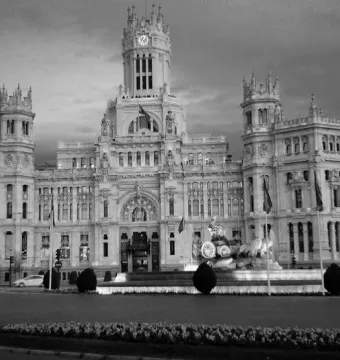
September 2016 © Javier Elices · CC0
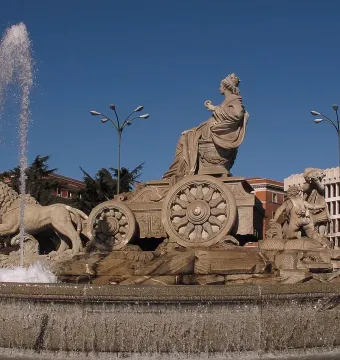
January 2015 © jacinta lluch valero · CC BY-SA 2.0
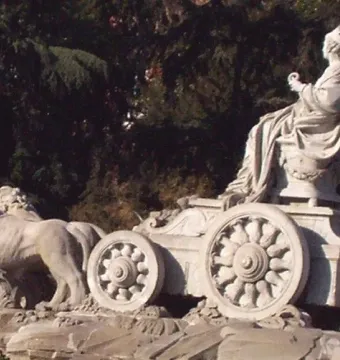
© Maduixa · CC BY-SA 3.0
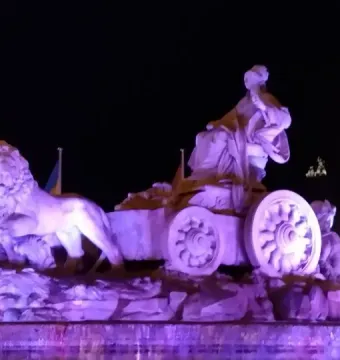
March 2022 © Artistosteles · CC BY-SA 4.0
September 2008 © Tnarik Innael · CC BY-SA 2.0
Identification | |
| Title | Fountain of Cybele |
| Common name | La Cibeles |
| Type | Monumental neoclassical fountain |
| Replica | An exact replica was installed in Mexico City in 1980, on the square of the same name |
| Spanish name | Fuente de Cibeles |
Historical context | |
| Historical context | Created as part of King Charles III's Enlightenment-influenced urban reforms in Madrid and the Salón del Prado project |
| Associated projects | Conceived alongside the Fountain of Neptune and the Fountain of Apollo, and within the same plan as the Prado Museum, the Royal Botanic Garden, and the Puerta de Alcalá |
Creator | |
| Decorator | Miguel Ximénez |
| Additional artist | Alfonso Bergaz (son) was proposed as artist of the dragon and bear sculptures |
| Decorator of chariot frame | Miguel Jiménez |
| Date commissioned | 1780 |
| Sculptor of lions | Roberto Michel |
| Sculptor of goddess and chariot | Francisco Gutiérrez Arribas |
| Date designed | 1777 |
| Designer role | Chief urban planner of Madrid's city council, fountains, and waterworks |
| Designer | Ventura Rodríguez |
Discovery and provenance | |
| Original site | Paseo del Prado, in front of the Buenavista Palace |
| Relocation | Moved to the centre of Plaza de Cibeles |
| Relocation date | 1895 |
| Construction period | 1777–1782 |
| Later square name | Plaza de Castelar (from 1900) |
| Original square name | Plaza de Madrid |
| Initial location | Paseo de Recoletos, near the Buenavista Palace |
| Initial installation date | 1782 |
| Completion date | 1782 |
| Proposed additions | In 1791, Juan de Villanueva proposed two stone sculptures of a dragon and a bear for public use |
Physical characteristics | |
| Composition | Cybele standing on a chariot drawn by two lions |
| Subject | Cybele, the Phrygian mother goddess of fertility and abundance, identified with Rhea in Greek mythology |
| Mythological interpretation of lions | The lions represent Hippomenes and Atalanta transformed as punishment to pull the chariot forever |
| Additional iconography | A child-like figure carrying a jar was intended to provide drinking water |
Materials | |
| Original material | Stone |
| Material quantity | An unspecified amount of stone was required for construction |
| Material of rest of fountain | Stone from Redueña, north of Madrid, near the Sierra de La Cabrera |
| Material of goddess and lions | Marble from Montesclaros, Toledo |
Technique | |
| Sculptural execution | The goddess and chariot were executed by Francisco Gutiérrez, the lions by Roberto Michel, and the ornamentation by Miguel Ximénez |
| Carving material provenance | The goddess and lions were carved from Montesclaros marble; the remaining parts were made from Redueña stone |
Appearance | |
| Crowned figure | The goddess is crowned with a mural crown |
Location and ownership | |
| Replica donor | Donated by the community of recent Spanish immigrants in Mexico |
| Former location | In front of the Buenavista Palace on Paseo de Recoletos |
| Adjacent landmarks | Palace of Communications, Bank of Spain, Palacio de Linares, Palacio de Buenavista, Museo del Prado, Calle Alcalá, Villahermosa Palace, and the Palace Hotel |
| Country | Spain |
| City | Madrid |
| Current site | Centre of Plaza de Cibeles, on Paseo del Prado, next to the Palace of Communications |
| Current location | Plaza de Cibeles, Madrid, Spain |
History and restoration | |
| Maximum water capacity | 278 m3 |
| Removal of proposed dragon and bear sculptures | They were removed in 1862 |
| Purpose of proposed bear sculpture | To fill the barrels of the 50 water carriers assigned to the fountain |
| Purpose of proposed dragon sculpture | To spout water through a pipe in its mouth |
| Alteration at relocation | The basin's appearance was somewhat changed when the fountain was moved in 1895 |
| Water supply feature | The large reservoir feeding the fountain was half-buried during renovation of the surrounding buildings |
| Damage events | The goddess lost one hand in 1994 during a Spanish national team victory celebration and another on 21 September 2002 |
| Current location of removed figures | They are kept in one of Madrid's museums |
| Additional figures removed | The griffin and bear figures were removed in 1862 |
| Additional figures added | In 1792, griffin and bear figures were added to the fountain rims, with water spouting from their mouths |
| Water feature operation date | 1792 |
Significance | |
| Historical significance | It became one of the most popular places in Madrid immediately after completion |
| Symbolic status | One of Madrid's best-known symbols and city icons worldwide |
| Cultural use | A traditional gathering place for Real Madrid supporters and players to celebrate victories and trophies, and for Spain national football team celebrations |
| Contextual importance | Its central location and lively history have made it a major landmark in Madrid |
| Replica significance | Installed as a symbol of sister-city friendship between Madrid and Mexico City |