
Goethe-Denkmal
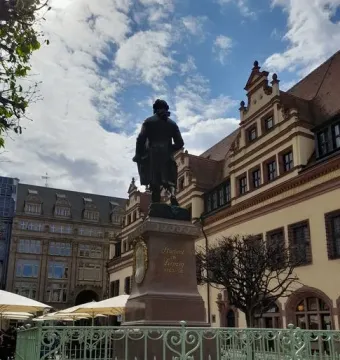
Goethe-Denkmal in Leipzig, Germany, is a bronze statue by Carl Seffner depicting the young Johann Wolfgang von Goethe. It stands on a tall red granite pedestal on the Naschmarkt, facing the Old Stock Exchange. The 2.65-meter bronze figure shows Goethe as a student, walking outdoors in a Rococo-style costume with a book in his right hand. The pedestal bears the inscription “Johann Wolfgang Goethe” on the front and “Student in Leipzig 1765–68” on the back. Its sides feature relief portraits of Friederike Oeser and Anna Katharina Schönkopf, linking the monument to Goethe’s Leipzig years and local history.
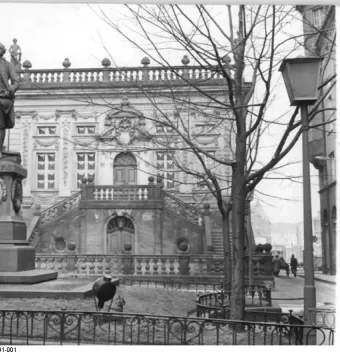
© Heinz Koch · CC BY-SA 3.0 de
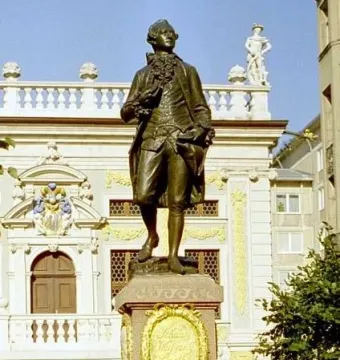
August 2003 © Carl Seffner · CC BY-SA 3.0
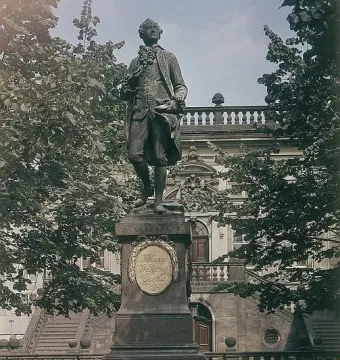
© Richard Peter · CC BY-SA 3.0 de
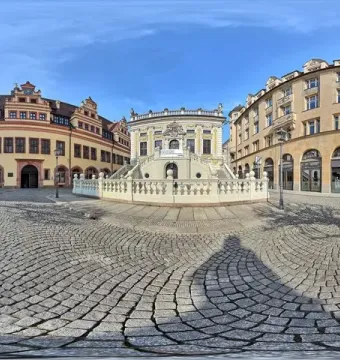
March 2025 © Joachim Köhler · CC BY-SA 4.0
April 2025 © Aagnverglaser · CC BY 4.0
Identification | |
| Title | Goethe-Denkmal |
| Alternative names | Goethedenkmal; The Goethe Monument in Leipzig |
Historical context | |
| Date erected | 1903 |
| Model trial installation | 23 May 1901 |
| Unveiled | 28 June 1903 |
| Total cost | 44,000 marks |
| Casting date | 1902 |
| City contribution | 10,000 marks from the bequest of Franz Dominic Grassi and 10,000 marks from the foundation of Ferdinand Rhode |
| Site chosen | May 1901 |
| Bronze design presented | 1897 |
| Initial design date | Around 1895 |
| Fundraising appeal | March 1898 |
| Concept developed | In the 1890s, relatively late compared with other cities connected to Goethe |
Creator | |
| Plinth designer | Max Bischoff, Berlin architect |
| Key promoter | Gustav Wustmann (1844–1910), municipal archivist |
| Artist dates | 1861–1932 |
| Artist | Carl Seffner |
Discovery and provenance | |
| Initial intended material | Marble |
| Initial intended setting | A green area |
| Model used | A 28-year-old Leipzig gymnastics teacher in a matching theater costume |
| Source for facial features | Images of Goethe from later periods of his life, because Seffner had no image of Goethe from his Leipzig period |
Materials | |
| Statue material | Bronze |
| Pedestal material | Red granite |
Physical characteristics | |
| Pose | Standing in a strolling posture |
| Object held | Book in the right hand |
| Costume | Rococo costume |
| Pedestal height | 2.5 meters |
| Type | Bronze statue on a tall pedestal |
| Statue height | 2.65 meters |
Appearance | |
| West side relief identity | Daughter of Goethe's Leipzig drawing teacher Adam Friedrich Oeser (1717–1799) |
| East side relationship to Goethe | Goethe's first great love |
| East side relief identity | Daughter of the innkeeper of the guesthouse where Goethe ate lunch during his Leipzig studies |
| East side relief | Anna Katharina (Käthchen) Schönkopf (1746–1810) in frontal view |
| West side relationship to Goethe | Goethe maintained a friendly relationship with her |
| West side relief | Friederike Oeser (1748–1829) in profile |
| Side reliefs | Two girls' portraits in relief on the sides of the pedestal |
| Front decoration | Laurel-wreathed gold medallion |
| Back inscription | Student in Leipzig 1765–68 |
| Front inscription | Johann Wolfgang Goethe |
| Movement motif | A step motif suggests natural, unforced activity |
Iconography and meaning | |
| Literary reference | Auerbachs Keller in Faust, Part One |
| Decorative reference | The laurel wreaths on the portraits, together with the front medallion, relate to the decoration system of the stock exchange façade behind the monument |
| Local references | The portraits give the monument strong local references |
| Subject | Johann Wolfgang von Goethe as a young man |
| Associated person | Ernst Wolfgang Behrisch (1738–1809), Goethe's friend |
| Associated place | Auerbachs Hof |
| Interpretation of movement | Goethe is often interpreted as coming from a walk through the Rosental and heading across the Naschmarkt toward Auerbachs Hof |
| Interpretive reference | Refers to Goethe's nearly three years of study in Leipzig |
Location and ownership | |
| Location | Naschmarkt, Leipzig, Germany, in front of the Alte Handelsbörse (Old Stock Exchange) |
History and restoration | |
| Initial concept | A statue of the young Goethe |
| Chosen location | Naschmarkt |
| Site selection date | May 1901 |
| Foundry | Noack & Brückner |
| Type of inauguration | Unspecified in the input |
Significance | |
| Purpose | Commemorates Johann Wolfgang von Goethe |