
Mother Patroness Monument
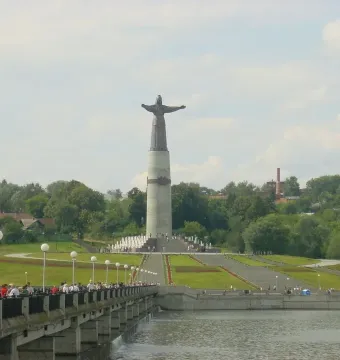
Mother Patroness Monument is one of the landmarks of Cheboksary, in the Chuvash Republic, and is regarded as a symbol of the city and the country as a whole. It also represents the revival of the spiritual values of the Chuvash people. The monument is located in the restored historic part of Cheboksary, on an ancient hill beside the western waterfront of Cheboksary Bay. Together with its pedestal, it reaches a height of 46 meters, making it larger than any monument previously created in Chuvashia. At the base of the basin, a bilingual inscription in Russian and Chuvash reads: “Blessed are my children, living in peace and love.”
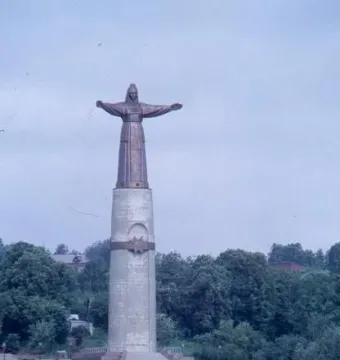
July 2003 © Aloxe · FAL
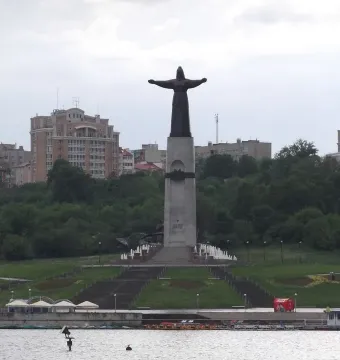
© karel291 · CC BY 3.0
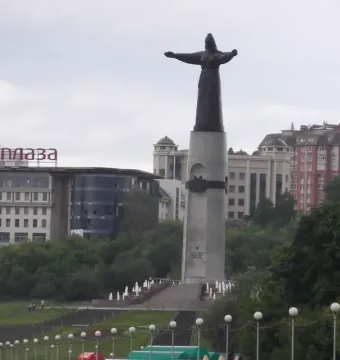
© karel291 · CC BY 3.0
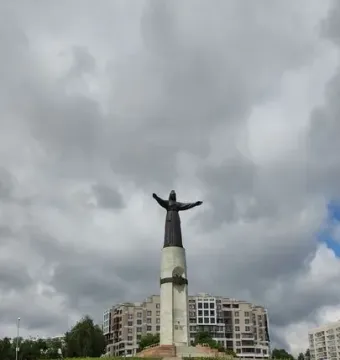
May 2023 © Mihalz · CC BY-SA 4.0
© Verdlanco · Public domain
Identification | |
| Title | Mother Patroness Monument |
| Alternative names | Mother Monument; Mother-Patroness Monument; Monument to the Mother Protector of Cheboksary; Chuvash: "Анне-Пирĕшти" palăkĕ |
| Type | Monument |
| Subject | Mother figure |
Iconography and meaning | |
| Dedication | Dedicated to the mother figure; according to Nikolay Fyodorov's idea, to all mothers and the mother of Chuvashia |
| Concept | A monument to an idea |
Historical context | |
| Initiator | Nikolay Vasilyevich Fyodorov, first President of Chuvashia |
| Design concept | Developed from Fyodorov's idea and project |
Creator | |
| Sculptor | Vladimir Nagornov |
| Architects | V. Filatov; Yu. Novoselov; A. Oreshnikov |
| Scientific consultant | A. Trofimov |
Discovery and provenance | |
| Funding | A charitable foundation was established for construction, on the initiative of the creative intelligentsia, the public, and several organizations of the Chuvash Republic |
| Construction participation | Cadets of the military department of Chuvash State University participated in the final stage of construction |
Physical characteristics | |
| Size | Largest monument created in Chuvashia before its construction |
| Height | 46 meters including the pedestal |
Appearance | |
| Inscription | At the lower part of the pedestal, in Russian and Chuvash: "Blessed are my children, living in peace and love." |
Location and ownership | |
| Location | Cheboksary, Chuvash Republic, Russia |
| Site | Historical part of Cheboksary, on an ancient hill adjacent to the western waterfront of Cheboksary Bay |
| Access | Reached by 99 steps |
| Nearby landmark | Cheboksary Bay; the Cathedral of the Presentation (used in comparison) |
History and restoration | |
| Opening date | 9 May 2003 |
| Opening and blessing | Opened and consecrated by Metropolitan Barnava (Barnabas) of Cheboksary and Chuvashia |
Significance | |
| City significance | One of the dominant landmarks of Cheboksary and a symbol of the capital of the Chuvash Republic and of the republic as a whole; also described as a symbol of the country |
| Cultural significance | A symbol of the revival of the spiritual values of the Chuvash people |
Other | |
| Critical reception | Atner Khuzangay described the monument as somewhat rough in appearance, with the woman's arms strangely spread apart, and said that standing next to it gives an unpleasant impression; he considered the basic idea good and suggested it should have been raised by about 15 meters |
| Religious criticism | Former priest Andrey Berman of the Church of the Dormition of the Blessed Virgin Mary in Cheboksary criticized Metropolitan Barnava for idolatry for blessing the monument |
| Height limitation note | According to the account, the Church opposed making it higher because it was not supposed to be taller than the Cathedral of the Presentation |
| Attributed promotion | Khuzangay thought art historian Alexey Alexandrovich Trofimov promoted the idea |