
Sarcophagus of Laris Pulenas
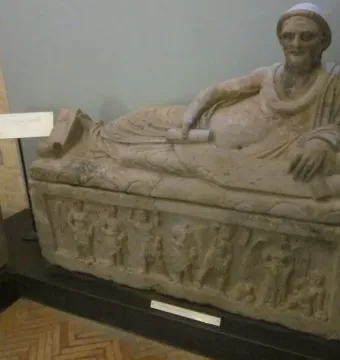
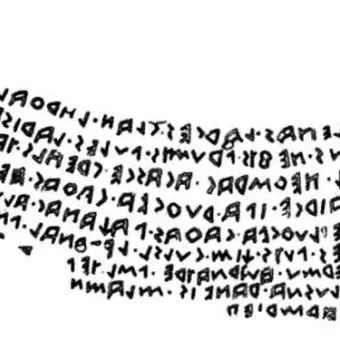
The Sarcophagus of Laris Pulenas, also known as “The Magistrate,” was discovered in Tarquinia, Italy, and is now kept in the National Archaeological Museum of Tarquinia. It shows Laris Pulenas in a semi-reclining position beside a carved stone strip of cloth, or volumen, that is partly unrolled. The monument is notable for carrying one of the longest surviving Etruscan inscriptions, about 60 words long. The text names the deceased and several of his ancestors, then lists his accomplishments, including writing on divination, serving as a priest of Catha and Pacha, and apparently governing Tarquinia as a creal, a high public office.
September 2012 © Robin Iversen Rönnlund · CC BY-SA 3.0
© Unknown authorUnknown author · Public domain
© Unknown authorUnknown author · Public domain
© Unknown authorUnknown author · Public domain
© Unknown authorUnknown author · Public domain
Identification | |
| Title | Sarcophagus of Laris Pulenas |
| Alternative names | Le Magistrat; The Magistrate; Magistrate; Laris Pulena; Laris Pulenas or Laris Pulena |
| Object type | Sarcophagus |
| Identifiers | CIE 5430; TLE 131; ET Ta 1.17 |
Historical context | |
| Date | Late 3rd century BC; another view dates it to around 200 BC |
| Cultural context | Etruscan; Hellenistic period of Etruscan art |
Creator | |
| Text attribution | Albert Grünwedel |
Discovery and provenance | |
| Discovery place | Tarquinia, Italy |
| Current location | National Archaeological Museum of Tarquinia |
Physical characteristics | |
| Surface treatment | Originally painted, with traces of color preserved, especially on the front |
| Dimensions | 1.98 m long, 62 cm wide, 63 cm high |
| Material | Nenfro, a soft but compact tuff stone used in southern Etruria |
Appearance | |
| Depicted figure | Laris Pulenas, shown reclining semi-reclining on the lid |
| Pose | Leaning on two cushions with the left arm; left leg bent and right leg nearly extended |
| Headgear | A semicircular cap associated with diviners or haruspices |
| Upper body | Bare torso with a cloth collar over the chest and shoulders |
| Clothing | A mantle wrapped around the hips and legs and draped over the left shoulder and arm |
| Feet | Right foot bare and visible; the other foot is covered by the mantle |
| Object held | A partially unrolled scroll or linen book held in both hands |
| Ring | A ring on the ring finger of the right hand |
| Front relief | A bas-relief on the front showing the deceased with winged beings and hammer-bearing figures |
Iconography and meaning | |
| Scroll interpretation | The scroll may represent one of the linen books used to record texts in Etruria |
| Recurring motif | The journey to the underworld is a recurring theme in Etruscan sarcophagus reliefs and tomb paintings |
| Front relief meaning | The winged beings and hammer-bearing figures accompany the deceased to the underworld |
Inscription | |
| Interpretive uncertainty | The detailed meaning, sequence, and position of many priestly offices, functions, and ceremonies remain unclear |
| Deities mentioned | Catha, Pacha, and Culsu; Hermes is sometimes suggested as a possible fourth deity |
| Other religious duties | The inscription may also refer to rites connected with Culsu, ancestor cult rites, libation offerings, and possibly other sacred duties |
| Possible rulership | The text may imply that he ruled Tarquinia as a king or lord |
| Political office | He appears to have governed Tarquinia as a creal, a high public office |
| Religious office | He served as priest of Catha and Pacha |
| Literary achievement | He wrote a text on divination or auspices |
| Biographical content | The rest of the inscription appears to describe the deceased's achievements during his life |
| Possible great-grandfather identity | Pule Laris Creice, described as "the Greek," is possibly Pollus, a Greek seer who lived around 400 BC and settled in Cerveteri |
| Family name interpretation | The family name Pulenas may refer either to Laris Pulenas himself or, possibly, to his father |
| Opening genealogy | The inscription opens with the deceased and names his father Larce, grandfather Larth, uncle Velthuru, and great-grandfather Pule Laris Creice |
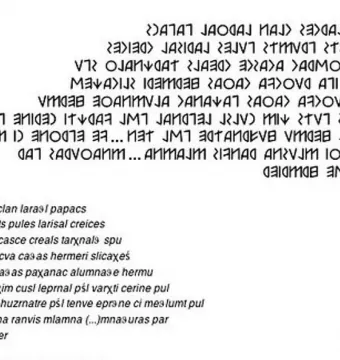
| Transcription status | A modern accepted transcription is given |
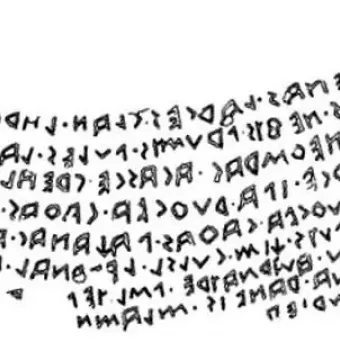
| Damaged text | A small portion is missing in lines 7 and 8 where the front edge of the scroll broke off |
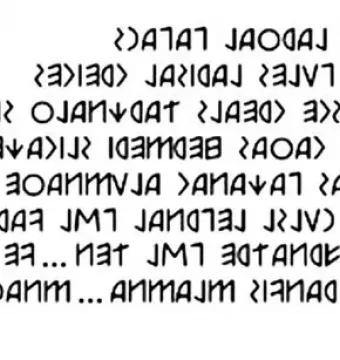
| Word division | Most words are separated by dots, with some exceptions and uncertain divisions |
| Writing direction | Right to left, with mirror-written letters |
| Legibility | Mostly readable, but some individual readings are disputed |
| Significance | One of the longest continuous Etruscan inscriptions, of particular linguistic value |
| Length | 9 lines; about 60 words |
| Medium and technique | Engraved on the scroll; letters were originally painted red |
| Placement | On the scroll held by the deceased |
| Language | Etruscan |
Significance | |
| Importance | Considered one of the most important finds from the late Etruscan period |