
The Little Mermaid
The Little Mermaid is a bronze sculpture of a mermaid in Copenhagen, Denmark. Created by Danish sculptor Edvard Eriksen, it stands on the Langelinie promenade by the harbour, on rocks extending into the sea near Amalienborg Palace. Inspired by Hans Christian Andersen’s 1837 fairy tale of the same name, it was inaugurated in 1913 and has since become one of Copenhagen’s most recognizable symbols and a major tourist attraction. In recent decades, the statue has also been the target of vandalism and political activism.
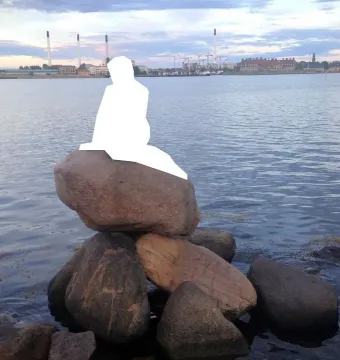
June 2014 © Benoît Prieur · CC0
© Public Domain Images · Public domain
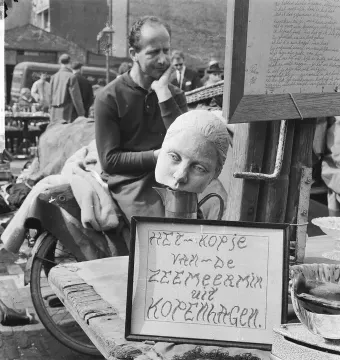
April 1964 © Harry Pot · CC0
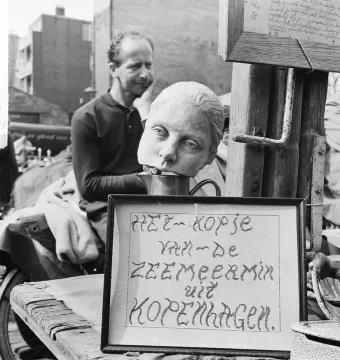
April 1964 © Harry Pot · CC0
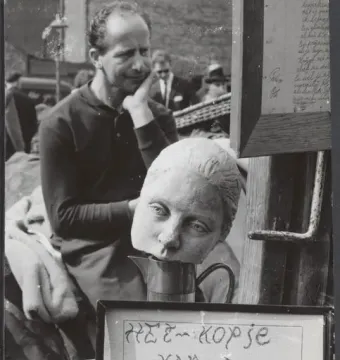
April 1964 © Harry Pot · CC0
Identification | |
| Title | The Little Mermaid |
| Alternative original titles | Русалонька; Die Kleine Meerjungfrau; Mała Syrenka |
| Type | Bronze statue |
| Original title | Den lille havfrue |
Historical context | |
| Based on | Hans Christian Andersen's 1837 fairy tale The Little Mermaid |
| Commissioned by | Carl Jacobsen, son of the founder of the Carlsberg brewery |
| Commission date | 1909 |
| Inspiration for commission | A ballet adaptation of The Little Mermaid at the Royal Danish Theatre in Copenhagen |
| Unveiling date | 23 August 1913 |
Creator | |
| Modeling note | Ellen Price refused to pose nude, so the statue was modeled on Eline Eriksen instead |
| Sculptor | Edvard Eriksen (1876–1959) |
| Models | Ellen Price for the head; Eline Eriksen, the sculptor's wife, for the body |
| Country of sculptor | Denmark |
Discovery and provenance | |
| Gift to | Copenhagen |
| Donor | Carl Jacobsen |
Physical characteristics | |
| Height | 1.25 m |
| Weight | 175 kg |
| Appearance | Small and unimposing; a seated nude female mermaid figure, half woman and half fish |
Materials | |
| Material | Bronze |
Location and ownership | |
| Harbour context | Copenhagen Harbour flows into the Baltic Sea |
| Setting | On a rock at the shoreline, overlooking Copenhagen Harbour |
| Current location | Langelinie promenade, Copenhagen, Denmark |
History and restoration | |
| Other display | In 2009, Survival of the Fattest was installed next to it for the duration of the 15th UN Climate Conference |
| Planned relocation | Copenhagen officials considered moving the statue several meters farther out into the harbour to discourage vandalism and climbing |
| Replica during relocation | An authorized copy was displayed on a rock in a lake in Copenhagen's Tivoli Gardens |
| Temporary relocation | Moved to the Danish Pavilion at Expo 2010 in Shanghai from May to October 2010; this was the first official move from its perch since installation |
| 2023 vandalism | A Russian flag was painted on the stone about a year later |
| 2022 vandalism | In March 2022 'Z = svastika' was written on the stone base |
| 2020 vandalism | On 13 January 2020 'Free Hong Kong' was painted on the stone; on 3 June 2020 'racist fish' was scrawled on the stone base |
| 2017 vandalism | On 30 May 2017 it was drenched in red paint with the message 'Danmark defend the whales of the Faroe Islands'; about two weeks later, on 14 June, it was drenched in blue and white paint and 'Befri Abdulle' ('Free Abdulle') was written in front of it |
| 2006 vandalism | On 8 March 2006, a dildo was attached to the statue's hand, green paint was dumped over it, and 'March 8' was written on it |
| Paint vandalism | Paint poured on the statue several times, including in 1963 and in March and May 2007 |
| 2003 vandalism | Knocked off its base with explosives on the night of 10 September 2003; holes were blasted in the wrist and knee, and it was later found in the harbour waters |
| 1998 vandalism | Decapitated on 6 January 1998; the head was returned anonymously to a nearby television station and reattached on 4 February |
| 1990 vandalism | Attempt to sever the head left a deep cut in the neck |
| 1984 vandalism | Right arm sawn off on 22 July 1984 and returned two days later |
| 1964 vandalism | Head sawn off and stolen on 24 April 1964 by politically oriented artists of the Situationist movement, including Jørgen Nash; the head was never recovered and a new head was made and placed on the statue |
| Damage history | Target of vandalism and political activism in recent decades; repeatedly damaged and defaced since the mid-1960s, but restored each time |
| Status | An iconic symbol of Copenhagen and one of the city's best-known symbols; a major tourist attraction since 1913 |
Significance | |
| Cultural significance | A symbol of Copenhagen and one of the most iconic statues representing cities |
| Tourist significance | A well-known tourist attraction since its unveiling in 1913 |
| Comparative note | Often compared with other iconic city statues such as Pania of the Reef, Manneken Pis, the Statue of Liberty, and Christ the Redeemer |
Other | |
| Alternative current locations mentioned | Copenhagen Harbour entrance; Langelinie waterfront promenade; on dry land at the waterside; shoreline promenade of Langelinie |