
Dewey Monument
Dewey Monument is an empire-style memorial in Union Square, San Francisco, California. It was erected in honor of American naval commander George Dewey, the only person in the history of the U.S. Navy to receive its highest rank, admiral of the navy. The monument was ceremonially unveiled on May 14, 1903, in the presence of President Theodore Roosevelt. It also serves as a tribute to all U.S. Navy sailors. Designed by sculptor Robert Ingersoll Aitken and architect Newton Tharp, the monument consists of a 25.9-meter column topped by a bronze statue of Nike, the Greek goddess of victory.
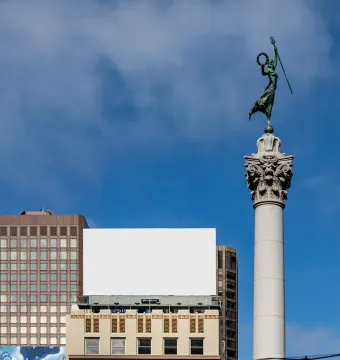
© Dietmar Rabich · CC BY-SA 4.0
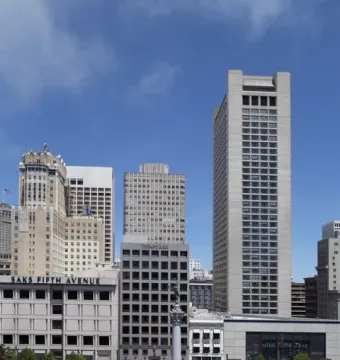
© Carol M. Highsmith · Public domain
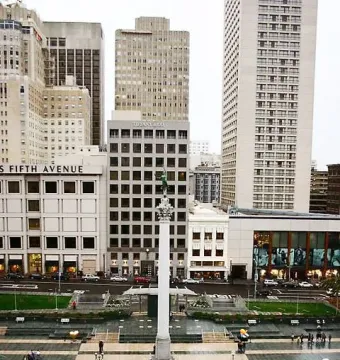
© Alraune · CC BY-SA 3.0
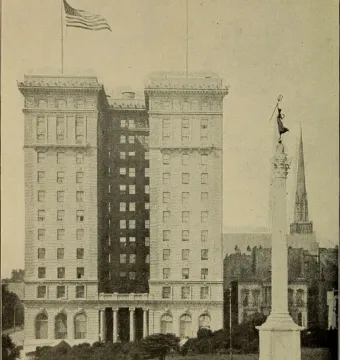
1906 © Banks, Charles Eugene, 1852-1932; Read, Opie Percival, 1852-1939 · No restrictions
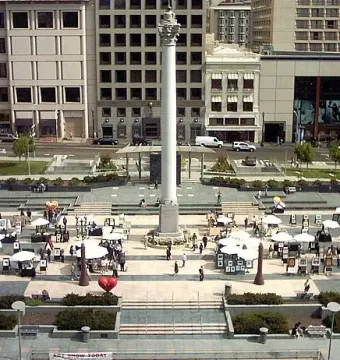
© Coolcaesar · CC BY-SA 3.0
Identification | |
| Title | Dewey Monument |
| Original language name | Monumento a Dewey |
| Alternative names | Monument to George Dewey; Monumento a Dewey; Das Dewey-Denkmal |
| Type | Monument |
| Style | Empire style |
Historical context | |
| Subject | Commemorates George Dewey and the U.S. victory in the Battle of Manila Bay during the Spanish-American War, with tribute also to U.S. Navy sailors |
| Honoree | Admiral George Dewey |
| Honoree's distinction | The only person in history to have received the highest military rank of the U.S. Navy: admiral of the navy |
| Commemorated event | The U.S. naval victory at Manila Bay, Philippines, on May 1, 1898 |
Creator | |
| Designer | Robert Ingersoll Aitken and Newton Tharp |
| Model for the statue | Disputed: Alma de Bretteville Spreckels is said to have modeled for it; a 1902 San Francisco Chronicle article named Clara Petzold or Petzoldt |
| Architect | Newton Tharp |
| Sculptor | Robert Ingersoll Aitken |
Discovery and provenance | |
| Erected by | The citizens of San Francisco |
| Initiated by | President William McKinley |
| Dedicated by | President Theodore Roosevelt |
| Dedication date | May 14, 1903 |
| Completion year | 1903 |
| Budget | $45,000 |
| Model subject | Alma de Bretteville Spreckels is said to have served as the model for Winged Victory |
| Work began | May 23, 1901 |
Location and ownership | |
| Location | Union Square, San Francisco, California, United States |
| Site description | Center of Union Square, bounded by Geary, Powell, Post, and Stockton streets |
Physical characteristics | |
| Column diameter | more than 1.5 m |
| Base shape | Square base |
| Column height | about 24 meters |
| Top figure height | 2.7 m (9 ft) |
| Height | 25.9 m |
| Overall form | Column topped by a bronze figure of Nike (Winged Victory) |
Materials | |
| Column material | Granite |
| Top figure material | Bronze |
Technique | |
| Construction support | Timbers shipped from Oregon were used to support the block-and-tackle system during construction |
| Column construction | Assembled from separate granite blocks weighing 18,144 kg |
Appearance | |
| Attributes held by figure | A trident and a laurel wreath |
Iconography and meaning | |
| Figure symbolism | The trident represents Dewey; the laurel wreath represents victory and, according to some accounts, President McKinley |
| Trident meaning | Symbolizes Poseidon (Neptune) and the naval victory |
| Crown meaning | Represents McKinley |
| Figure subject | Nike, the ancient Greek goddess of victory |
History and restoration | |
| Groundbreaking date | May 23, 1901 |
| Earthquake survival | The monument survived the 1906 San Francisco earthquake despite its slender, tall construction |
| Historical note | Six months after the 1901 groundbreaking ceremony, President McKinley was assassinated |
| Groundbreaking officiated by | President William McKinley |
| Historical inscription content | The pedestal contains several English inscriptions explaining the monument's historical background |
| Inscription about Manila Bay battle | On the night of April 30, 1898, Dewey's squadron entered Manila Bay and reached Manila at daybreak on May 1, 1898, undeterred by the danger of sea mines; the Spanish fleet of ten warships was attacked and destroyed; Dewey held the city until American troops arrived |
| Inscription quoting John D. Long | Navy Secretary John D. Long to Commodore George Dewey, April 24, 1898: 'Between the United States and Spain war has begun.' Proceed at once to the Philippine Islands and capture or destroy the Spanish fleet. |
| Inscription about dedication | The monument was dedicated by President Theodore Roosevelt on May 14, 1903 |
| Inscription about U.S. squadron at Manila Bay | American squadron in Manila Bay: Olympia (flagship), Baltimore, Raleigh, Boston, Concord, Petrel, McColloch |
Significance | |
| Later reinterpretation | In 2012, the monument was reinterpreted through the temporary anti-war art action 'Bitter Melon' |