
Development of a Bottle in Space
Development of a Bottle in Space is a 1912 sculpture by the Italian artist Umberto Boccioni. It is a Futurist ronde-bosse depicting a bottle that seems to break apart in space. The original plaster version was bought from Benedetta Cappa in 1956 and is now kept at the Museum of Contemporary Art of the University of São Paulo in São Paulo, Brazil. Bronze examples are held at the Museo del Novecento in Milan and the Kunsthaus Zürich in Zurich. Two more are in New York, at the Metropolitan Museum of Art and the Museum of Modern Art.
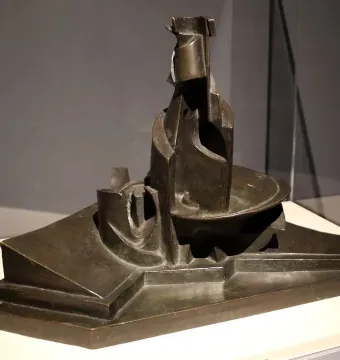
December 2019 © Sailko · CC BY 3.0
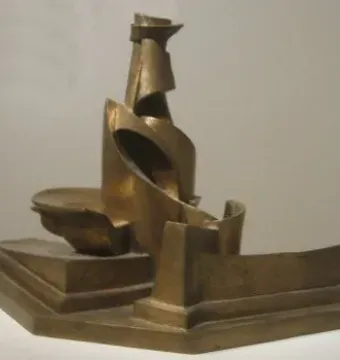
1913 © wmpearl · Public domain
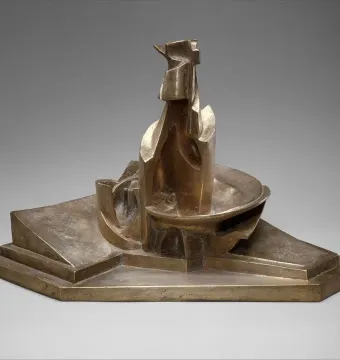
© Umberto Boccioni · CC0
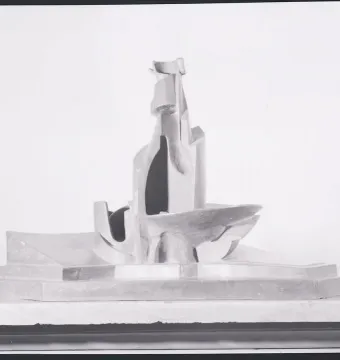
© Paolo Monti · CC BY-SA 4.0
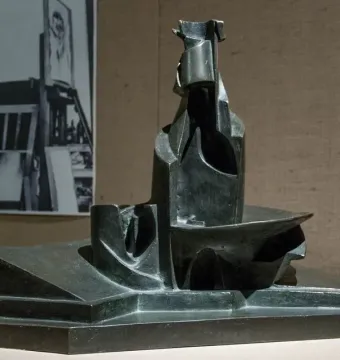
June 2016 © Léna · CC BY 3.0
Identification | |
| Title | Development of a Bottle in Space |
| Original Italian title | Sviluppo di una bottiglia nello spazio |
| Artist | Umberto Boccioni |
| Type | Sculpture |
Historical context | |
| Movement | Futurism |
| Year created | 1912 |
| Year cast | 1913 |
| Exhibition | First Exhibit of Futurist Sculpture in Paris, 1913 |
| Exhibition | Panama–Pacific International Exposition, San Francisco, 1915 |
| Historical context | Mass production of glass bottles was expanding rapidly in the late 19th century around the time Boccioni formulated the work |
| Inspirational context | Influenced by Filippo Tommaso Marinetti's Futurist Manifesto (1909) and Boccioni's own Technical Manifesto of Futurist Sculpture |
Creator | |
| Manifesto authorship note | Written with the aid of other leading futurists |
| Quoted manifesto | Technical Manifesto of Futurist Painting (1910) |
| Casting | Later cast into bronze by Boccioni himself |
| Initial conception | Originally sketched in Boccioni's Technical Manifesto of Futurist Sculpture |
Materials | |
| One cast material | Silvery bronze |
| Bronze version material | Bronze |
| Original material | Plaster |
Physical characteristics | |
| Base shape | Quadrilateral |
| Subject | A bottle that seems to come apart in space |
| Height | 15 1/2 inches (39.4 cm) |
| Base dimensions | 23 3/4 inches long and 15 1/2 inches wide (60.3 x 39.4 cm) |
Discovery and provenance | |
| Original cast acquisition | Purchased from Benedetta Cappa in 1956 |
Location and ownership | |
| Additional cast ownership | Private collection |
| Number of bronze versions in New York museums | Two |
| Bronze version locations | Museo del Novecento, Milan; Kunsthaus Zürich, Zurich, Switzerland; Metropolitan Museum of Art, New York, United States; Museum of Modern Art, New York, United States |
| Original bronze cast location | Museo del Novecento, Milan |
| Current collection | Museum of Modern Art, New York City |
| Original location | Museum of Contemporary Art of the University of São Paulo, São Paulo, Brazil |
History and restoration | |
| Known casts | At least five in total, including the 1935 cast from the original plaster and four other casts made at different times |
| 1935 cast | Cast from the original plaster; displayed at Museo del Novecento in Milan |
| Public exhibition of additional cast | Shown publicly in 2009 at the Peggy Guggenheim Collection, Venice, for the centenary of Marinetti's Manifesto of Futurism |
| Additional cast date | Cast in the 2000s |
Iconography and meaning | |
| Conceptual focus | Deconstructs the three-dimensional space in and around the object; fuses the object with its environment and abolishes finite lines and the contained statue |
| Boccioni's stated desire | To proclaim the absolute and complete abolition of finite lines and the contained statue |
| Boccioni's stated intention | To open the figure like a window and include it in the milieu in which it lives |
| Setting or support | Shown on a much larger base, possibly machinery used in the production of glass bottles |
| Composition | A bottle resting on a plate, forming a still life with a rare subject in Boccioni's Futurist poetics |
| Associated element | A smaller hollowed-out cylindrical mass next to the bottle, resembling an empty container on a conveyor belt |
| Depicted object | A bottle |
Appearance | |
| Stylistic features | Chaotic, twisting, and dynamic; intended to embody dynamism |
| State represented | Shown prior to completion, while still being molded |
| Visual representation | Three-quarter cross section |
Technique | |
| Construction technique | Broken into winding sections and combined absolute and relative motion to create a rotary appearance |
| Process | Originally cast as a bottle, then intentionally stripped open and sculpted |
Style | |
| Style | Futurist sculpture |
Significance | |
| Interpretation | May embody dynamism |
| Conceptual relation | Consistent with many of the themes in Boccioni's manifestos |
| Interpretation by Donald Kuspit | The sculpture's rhythmic movement suggests a sexual connotation inherent rather than imposed; compared with Duchamp's Nude Descending a Staircase, No. 2 (1912) |
| Interpretation by Marjorie Perloff | The sculpture does not represent a single bottle, but a series of bottle-shaped shells hollowed out and fit into each other; supports Boccioni's theory of a center within the object itself |
| Interpretation by Rosalind Krauss | A symbol of invariance in conflict with Boccioni's concept of dynamism; dramatizes the conflict between a single view of the object and the totality of vision needed to know it |
| Artistic significance | Described as Boccioni's first successful attempt at creating a sculpture that molds and encloses space within itself |
| Related artwork | Dynamism of a Football Player (same year) |
Philosophical idea | |
| Philosophical idea | Things do not exist in isolation but derive their fundamental properties from their surroundings |
| Movement principle | All things move; moving objects multiply in perception due to persistence of an image on the retina |
| Example from manifesto | A running horse has not four legs, but twenty, and their movements are triangular |
| Related imagery | Bodies and sofas, motor buses and houses are described as penetrating and blending with one another |
| Futurist view on isolated objects | Isolating an individual object was seen as ridiculous and non-representational |