
Tadeusz Kościuszko Monument
The Tadeusz Kościuszko Monument is an equestrian bronze sculpture in Kraków, placed on Wawel in 1921. It portrays Tadeusz Kościuszko seated on horseback, wearing a sukmanа and holding a rogatywka aloft. The monument was a joint work by Leonard Marconi and Antoni Popiel; the original design was prepared by Marconi, and the full-size model was completed after his death. Funded by public donations, it was later destroyed by the Germans in 1940. After the war, it was reconstructed from documentation and a small model and reassembled in 1960. A plaque on the bastion records its return as a gift from the people of Dresden to Kraków.
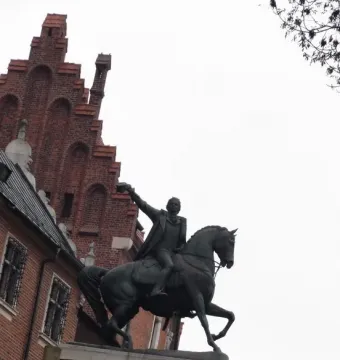
© Guillaume Speurt · CC BY-SA 2.0
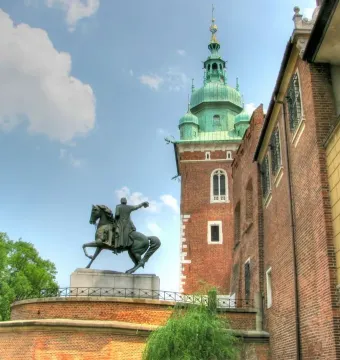
September 2016 © Damir-zg · CC BY-SA 4.0
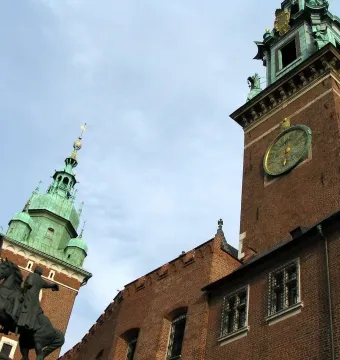
August 2010 © Scotch Mist · CC BY-SA 3.0
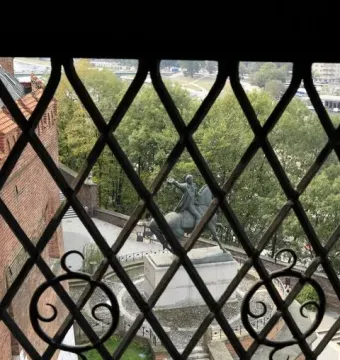
September 2012 © Falk2 · CC BY-SA 4.0
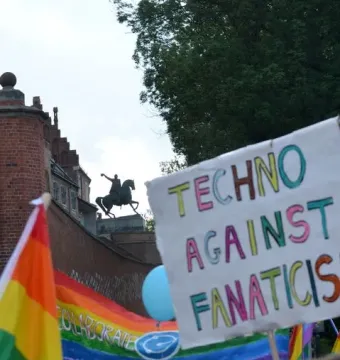
May 2018 © Silar · CC BY-SA 4.0
Identification | |
| Title | Tadeusz Kościuszko Monument |
| Type | equestrian monument |
| Form | equestrian statue |
| Subject | Tadeusz Kościuszko |
| Original title | Pomnik Tadeusza Kościuszki |
Historical context | |
| Historical context | Kościuszko initiated the 1794 insurrection in Kraków's Main Square; after his Battle of Racławice and the third partition of Poland, Kraków became part of Austrian Galicia for over a century. |
Creator | |
| Artists | Leonard Marconi and Antoni Popiel |
| Additional contributor | Giovanni Giovanetti |
| Leonard Marconi note | Warsaw-born professor of Lviv University |
Discovery and provenance | |
| Cast by | Władysław Dedrzeński i Spółka of Podgórze; after the foundry was destroyed by flooding, founders from the Czech firm Serpeck were brought to Kraków to finish the casting |
| Permission status | The Austrian administration of Galicia did not grant permission for the intended installation |
| Initial intended location | Main Market Square in Kraków, at the spot where Kościuszko took the oath in 1794, from the side of Szewska Street |
| Initiative | initiated by the Tadeusz Kościuszko Society, under the leadership of Jan Skirliński |
| Cast date | 1900, though another source gives 1903 |
| Natural-size model | prepared by Antoni Popiel with Giovanni Giovanetti after Marconi's death in 1899 |
| Project scale | 1/4-size model designed by Leonard Marconi |
| Funding | financed by public contributions and by the Tadeusz Kościuszko Society |
| Early storage | first kept in a warehouse in Podgórze, then for several years in the courtyard of a fire brigade building on Westerplatte Street |
Location and ownership | |
| Installed location | Bastion of Władysław IV on Wawel Hill in Kraków, near the western entrance to Wawel Castle and next to St. Leonard's Crypt at the Wawel Cathedral |
| Installation date | 20 December 1921 |
Physical characteristics | |
| Depicted clothing | sukmana and a rogatywka hat held in a raised hand |
| Material | bronze |
| Material of figure | bronze |
| Material of pedestal | bronze |
| Depicted figure | Tadeusz Kościuszko seated on a horse |
Iconography and meaning | |
| Depicted as | hero of the Polish and American wars of national independence |
History and restoration | |
| Reconstruction patronage | reconstructed by the German side and returned as a gift from the residents of Dresden to Kraków |
| Replica in Detroit | A copy was made in 1978 and gifted to the Polish diaspora in Detroit, Michigan, in celebration of the United States Bicentennial |
| Commemorative plaque | A plaque on the brick wall of the bastion records the return; its text reads: 'Tadeusz Kościuszko Monument, destroyed by the Hitlerites in 1940 and restored by the public of Dresden in 1960' |
| Post-destruction remains | placed in the Barbican, then at the Academy of Mining scrap yard |
| Reassembled | 1960 |
| Reconstruction place | Lauchhammer near Dresden, at the Lauchhammer metallurgical works |
| Reconstruction basis | rebuilt after the war based on documentation and a small model designed by Rudolf Löhner |
| Destruction | destroyed by the Germans on 17 February 1940 during World War II |
Significance | |
| Significance | One of the best-known bronze monuments in Poland |
Other | |
| Relationship to original | The modern monument is a replica of the lost original |