
Monument to the Fallen and Murdered in the East
The Monument to the Fallen and Murdered in the East is a memorial in Warsaw, Poland, commemorating the victims of the Soviet invasion of Poland during World War II and the subsequent repressions. It was unveiled on 17 September 1995, the 56th anniversary of the 1939 Soviet invasion. The monument includes a railway flatcar and inscriptions dedicated to the victims. Its details also reference religious symbols, the Polish eagle, Gulag outposts such as Archangielsk, and NKVD mass murder sites like Katyn. The site has received additions over time, including a stone placed after Pope John Paul II prayed there in 1999.
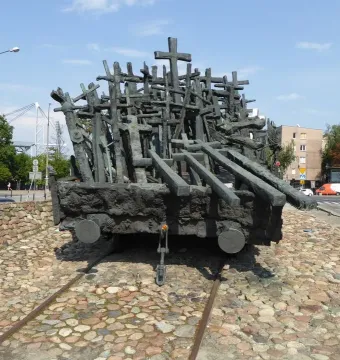
July 2014 © Jake · CC BY 2.0
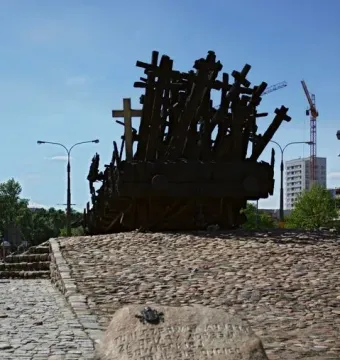
© Rafał Klisowski · CC BY-SA 3.0
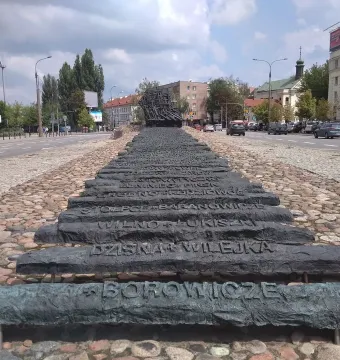
July 2018 © Cybularny · CC0
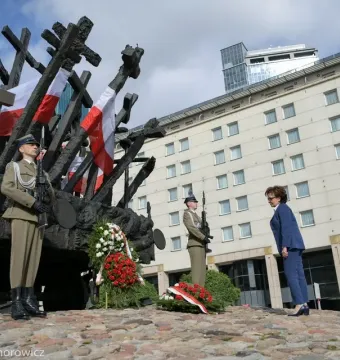
September 2020 © Kancelaria Sejmu / Andrzej Hrechorowicz · CC BY 2.0
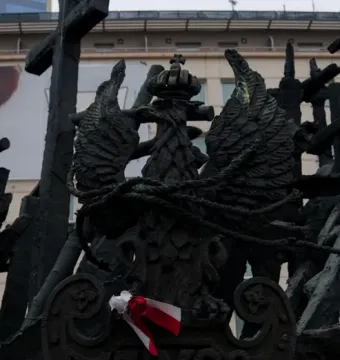
© Guillaume Speurt · CC BY-SA 2.0
Identification | |
| Title | Monument to the Fallen and Murdered in the East |
| Type | Monument |
Historical context | |
| Commemorated events | The Soviet invasion of Poland in 1939; repressions during the Soviet occupation of 1939–1941; subsequent repressions after the Soviet takeover of Poland in 1944–1945; and the Katyn massacre of 1940 |
| Political context | Created after the fall of communism in Poland, as part of a post-1989 project to commemorate events censored during the Polish People's Republic, when communist authorities suppressed information about these events and denied Soviet responsibility for the Katyn massacre |
Creator | |
| Designer | Maksymilian Biskupski |
Discovery and provenance | |
| Project presentation date | 1991 |
| Main initiator | Wojciech Ziembiński |
| Funding | Financed by the Polish government, non-governmental organizations, and private individuals |
| Construction start date | 18 August 1995 |
| Unveiling date | 17 September 1995 |
| Unveiling anniversary | 56th anniversary of the Soviet invasion of Poland in 1939 |
| Unveiling attendees | Primate of Poland Józef Glemp; Chief of the General Staff of the Polish Army Tadeusz Wilecki; President/Mayor of Warsaw Marcin Święcicki; Prime Minister of Poland Józef Oleksy; President of Poland Lech Wałęsa |
| Caretakers | Members of the Federation of Katyn Families and veteran organizations |
Physical characteristics | |
| Base/support | Railway platform mounted on tracks |
| Additional elements | 41 railway sleepers in front of the platform; a stone added after Pope John Paul II prayed at the site in 1999; a plaque; the Polish Cross of Valour; a Polish eagle with a rope around it; a date inscription below the eagle |
| Height | About 7 meters |
| Main sculptural element | Railway flatcar |
Materials | |
| Material | Bronze |
Iconography and meaning | |
| Depicted symbols | Catholic and Orthodox crosses, a Jewish matzevah, and Muslim gravestone symbols |
| Inscription on sleepers | The sleepers bear the names of battlefields from September 1939 in eastern Poland and of places of martyrdom, deportation, camps, collective farms, exile villages, Gulag outposts, and NKVD mass-murder sites |
| Inscriptions | "For those fallen in the East"; "For the victims of Soviet aggression 17.IX.1939. The Polish nation 17.IX.1995" |
| Commemorated persons | Poles who died and were murdered in the East, especially deportees to labour camps in Siberia, victims of the Katyn massacre, deported Polish forced labourers in the USSR, and deported mothers; one cross commemorates priest Stefan Niedzielak, a Katyn activist murdered in mysterious circumstances in 1989 |
| Historical references | Soviet invasion, Soviet aggression, deportations, Gulag outposts, NKVD mass killings, and Katyn |
Location and ownership | |
| Location | Intersection of Muranowska Street and General Władysław Anders Street, Warsaw, Poland |
| Annual memorial ceremony | Held every year on 17 September |
History and restoration | |
| Papal visits | Pope John Paul II prayed at the monument in 1999; Pope Benedict XVI passed by the monument in his papamobile in 2006 |
Other | |
| Viewpoints shown in captions | Viewed from the west; viewed from the south |