
Equestrian Statue of Simón Bolívar
The Equestrian Statue of Simón Bolívar is a public artwork by American artist Felix de Weldon. It depicts Venezuelan military and political leader Simón Bolívar mounted on horseback, with his right arm raised overhead holding a sword. Bolívar wears a detailed military uniform, including a gold medal once awarded to him in 1825 by George Washington Parke Custis in recognition of his struggle for independence. The sculpture stands on a granite or marble base and measures 142 cm × 72 cm × 184 cm, weighing 8 tons. It is located on Virginia Avenue, NW 18th Street, and C Street NW, near the U.S. Department of the Interior and the Pan American Union building of the Organization of American States.
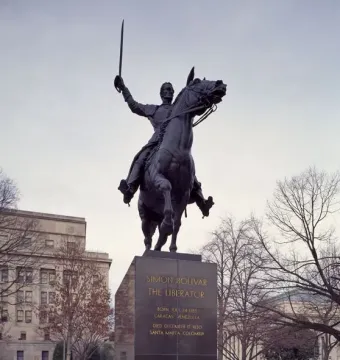
© Carol M. Highsmith · Public domain
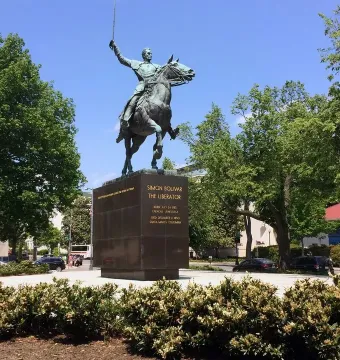
May 2018 © P. Hughes · CC BY-SA 4.0
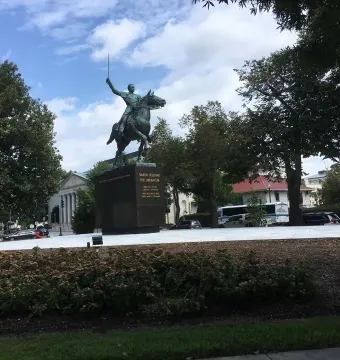
© NPS Photo · Public domain
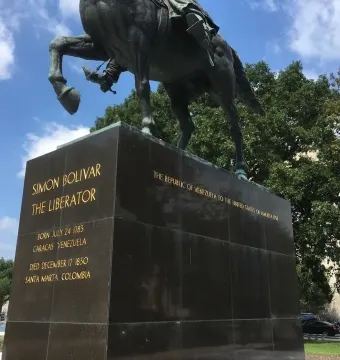
© NPS Photo · Public domain
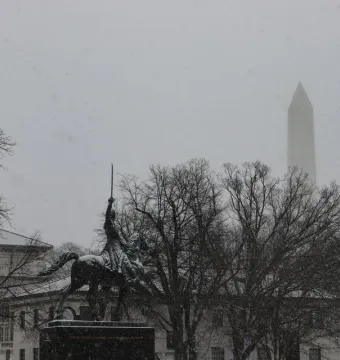
© Victoria Stauffenberg · Public domain
Identification | |
| Title | Equestrian statue of Simón Bolívar |
| Type | Equestrian bronze statue and monument |
| Alternative title | Equestrian monument of Simón Bolívar; Equestrian of Simón Bolívar |
| Original-language title | Estatua ecuestre de Simón Bolívar; Кінна статуя Сімона Болівара |
Historical context | |
| Military campaign | Joined forces with Francisco Santander and others by 1818; crossed the Andes; won the Battle of Várz on 25 July 1819 and later battles including Boyacá, Carabobo, Pichincha, Junín, and Ayacucho |
| Military career | Participated in more than 200 battles in the war of independence |
| Life summary | Born in Caracas in 1783, studied in Madrid, married in 1802, traveled in Europe and the United States, returned to his homeland in 1807, and died in Santa Marta in 1830 |
| Burial | Heart in Colombia; body in Venezuela |
| Context | After Napoleon's invasion of the Iberian Peninsula in 1808, South American revolutionaries began declaring independence from Spain, leading to war |
| Date | 1959 |
Creator | |
| Artist | Félix de Weldon |
| Artist nationality | American |
| Pedestal architect | Luis Malaussena |
Discovery and provenance | |
| Unveiled by | U.S. President Dwight Eisenhower |
| Survey year | 1993 |
| Surveyed by | Smithsonian Save Outdoor Sculpture! survey |
| Planned unveiling | Originally planned for 22 May 1958 with Vice President Richard Nixon; delayed by the January 1958 uprising in Venezuela |
| Transport | Moved to Washington by highway; the neck, head, and rider figure were detached for transport |
| Unveiling date | 27 February 1959 |
| Installation date | December 1957 |
| Casting time | 10 weeks |
| Site allocated | 1957 |
| Federal land grant date | 29 June 1955 |
| Paid for by | Government of Venezuela |
| Donor | Government of Venezuela |
| Authorized by | Act of the U.S. Congress dated 5 July 1949 |
| Foundry | Bedi-Rassy Art Foundry, Brooklyn, New York |
Location and ownership | |
| Other statues in series | Four |
| Site | Triangular plot of land on Virginia Avenue with a park around it |
| Location | Bolívar Park, on Virginia Avenue near 18th Street NW and C Street NW, Foggy Bottom, Washington, D.C., United States, near the headquarters of the Organization of American States and the U.S. Department of the Interior |
| Current setting | Center of a stone plaza with landscaped pedestrian paths and a pool with six jet fountains |
| Series | Statues of the Liberators |
Physical characteristics | |
| Base material | Brazilian black granite and Swedish black marble |
| Base form | Rectangular pedestal |
| Total height | 36 feet |
| Statue height | 24 feet |
| Pedestal height | 12 feet |
| Weight | 8 tons |
| Base dimensions | 142 cm × 72 cm × 184 cm |
| Material | Bronze |
Appearance | |
| Fountain symbolism | The six jet fountains represent the nations liberated by Bolívar |
| Clothing | Military uniform with elaborate detail |
| Medal depicted | A gold medallion with a lock of George Washington's hair |
| Attribute held | A sword raised upward in his right hand |
| Pose | Mounted on a horse with his right arm raised |
| Depicted figure | Simón Bolívar |
Iconography and meaning | |
| Subject significance | Simón Bolívar, Venezuelan military leader and founder of new states, known as the "Liberator" and the "George Washington and Abraham Lincoln of South America" |
| Historical significance of depicted person | Liberator of Venezuela, Colombia, Ecuador, Bolivia, Panama, and Peru |
| Office held | President of Gran Colombia |
| Inscription text | SIMÓN BOLÍVAR / LIBERATOR / BORN 24 JULY 1783 / CARACAS VENEZUELA / DIED 17 DECEMBER 1830 / SANTA MARTA COLOMBIA; REPUBLIC OF VENEZUELA TO THE UNITED STATES OF AMERICA; LIBERATED VENEZUELA COLOMBIA ECUADOR PERU BOLIVIA AND PANAMA |
| Eisenhower description | Described the monument as a symbol of the will of the United States and Venezuela to live and work together |
Significance | |
| Current significance | Largest equestrian monument to Bolívar in the Western Hemisphere |