
Marian Column, Košice
Marian Column in Košice is a traditional Central European Baroque monument located on Main Street in the historic center of the city, beside Main Square, a park, and the State Theatre. It was erected in gratitude after the plague epidemic of 1709–1710, with the first stone laid after two years of fundraising. The project was designed by Tomas Tornyosi, with sculpture by Šimon Grimming, and gilded copper reliefs by Juraj Immerwohl. The 14-meter column is crowned by a statue of the Virgin Mary, surrounded by figures including Saint Joseph, Saint Sebastian, Saint Ladislaus, and Saint Valentine. The monument has been repeatedly repaired and reconstructed, most recently in 2000.
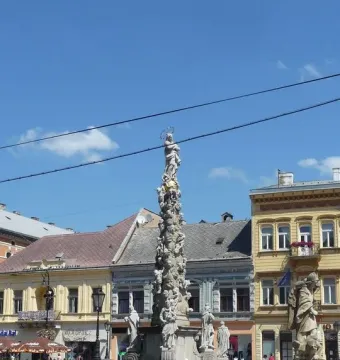
© Kohanluc · CC BY-SA 3.0
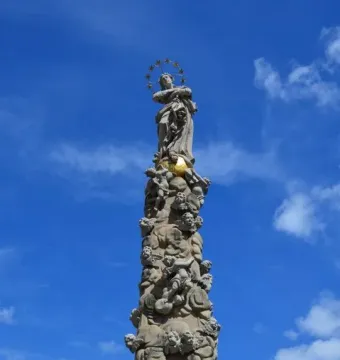
July 2016 © Scotch Mist · CC BY-SA 4.0
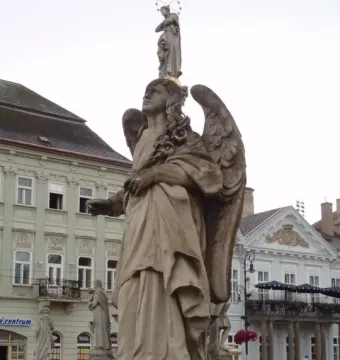
July 2009 © ZemplinTemplar · CC BY-SA 4.0
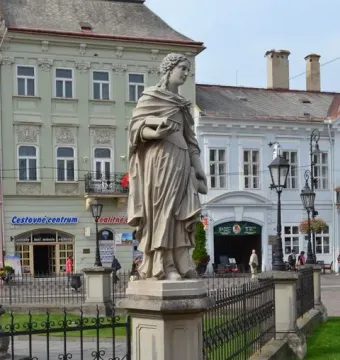
September 2015 © Ladislav Luppa · CC BY-SA 4.0
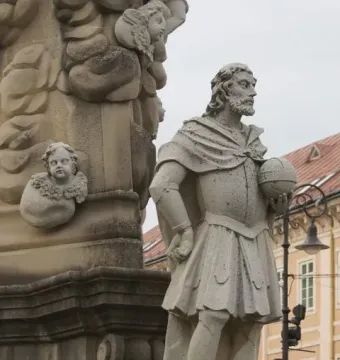
October 2017 © IDD5000 · CC BY-SA 4.0
Identification | |
| Title | Marian Column, Košice |
| Slovak name | Morový stĺp |
| Type | Baroque Marian column and plague column |
| Alternative names | Plague Column; Column of the Immaculate Virgin Mary; Immaculata; Immacolata |
Historical context | |
| Commemorated event | The plague epidemic in Košice of 1709–1710 |
| Purpose | Erected in gratitude to the Virgin Mary for the end of the plague epidemic and for protection from poverty, misery, and suffering |
| Built on the site of | The medieval gallows, formerly the execution site / military gallows |
Creator | |
| 1909 fence sculptor | Leopold Hild |
| 2000 copy sculptor | Stanislav Kožela |
| Restoration sculptor | Vojtech Löffler |
| Goldsmith / relief maker | Juraj Immerwoll |
| Sculptor | Šimon Grimming |
| Architect | Tomáš Tornyosi of Košice |
| Initiator | Victorin Flachenfeld, postal administrator |
Discovery and provenance | |
| Fundraising period | Two years before the first stone was laid |
| Erected | 1723 |
Physical characteristics | |
| Height | 14 metres |
| Structure | Column on a stone basement |
| Location | Hlavná Street, Old Town, historic centre of Košice, Slovakia |
| Setting | In a small park at the northern part of Hlavná Street and Hlavná Square, a short distance from the State Theatre |
Materials | |
| Reliefs material | Gilded copper-sheet / gilded bronze reliefs |
Appearance | |
| Stylistic features | Baroque style with draped garments, full-bodied figures, and cloud forms with curves and scrolls |
| Reliefs subject | Allegories of Plague, War, and Famine |
| Fence-pillar sculptures | Saint Elizabeth of Hungary, Saint Margaret, Saint Barbara, Saint Elizabeth of Portugal, Saint Gabriel, and Saint Michael the Archangel |
| Halo | Halo with twelve stars above the Virgin Mary’s head |
| Associated figures | Saint Joseph, Saint Sebastian, Saint Ladislaus, and Saint Valentine |
| Top figure installation date | 3 October 1723 |
| Top figure | Virgin Mary, or the Immaculate Conception, at the top of the column |
| Top figure height above ground | 14 metres |
Iconography and meaning | |
| Religious conflict | The column caused disputes between Protestants and Catholics in the city |
| Urban legend | A Calvinist pastor allegedly wrote an insulting inscription on the statue at night and was later imprisoned; the city council reportedly sought the death penalty, but the ruler changed it to exile |
| Symbolic meaning | The Madonna expresses fidelity, love, and kindness |
| Base inscription / legend | A plaque or legend says that relics of Saint Valentine are hidden beneath the structure |
| Notable unusual feature | Saint Valentine is included among the saints, as patron of lovers |
Location and ownership | |
| Original location | The site of the former medieval gallows / parade square at Fő utca (now Hlavná ulica), Košice |
| Current location | Košice, Slovakia |
| Protection measures | Night illumination, several lamps, night patrols, and a guard post were organized to prevent desecration |
History and restoration | |
| Damage | Damaged during World War II |
| 2000 reconstruction support | Completed with support from a grant from the VÚB Banka foundation |
| 2000 reconstruction | Completed in summer 2000; the historical weathered statues were replaced with exact copies |
| Last restoration | 1996–1998 |
| Post-war repairs | 1954–1957 and 1971–1972 under the direction of Vojtech Löffler |
| First restoration | 1757 |
| 1909 added sculptures | Statues of Saint Elizabeth of Hungary, Saint Margaret, Saint Barbara, Saint Elizabeth of Portugal, and the angels Gabriel and Michael were placed on the fence posts |
| Fence reconstruction | 1909 |
| 19th-century restoration outcome | The pedestal reliefs were removed and first kept in the city archive, later added to the collections of the Eastern Slovak Museum |
| 1829 restoration funding | Voluntary donations at the instruction of Bishop Ignác Fábri |
| Subsequent restorations | 1776, 1829, 1856, and 1872 |
Significance | |
| Description | Described as the most beautiful Baroque statue in Košice |