
Fountain of Time
Fountain of Time is a 38.66-meter sculptural work by Lorado Taft located at the western end of Midway Plaisance in Washington Park, Chicago. Inspired by Henry Austin Dobson’s poem Paradox of Time, it shows one hundred figures passing before Father Time and was created to mark the first 100 years of peace between the United States and Great Britain after the Treaty of Ghent of 1814. The fountain began running in 1920 and was officially dedicated in 1922. Made with innovative steel-reinforced molded concrete, it was described as more economical and durable than earlier methods and is said to be the first artwork made in concrete. It is listed on the National Register of Historic Places and has undergone major restorations.
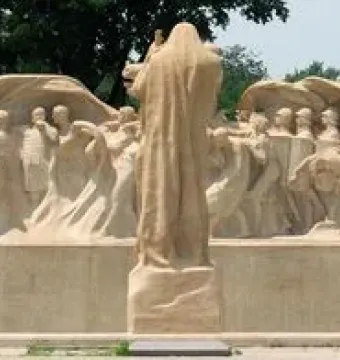
June 2007 © Conrad Lee · Public domain
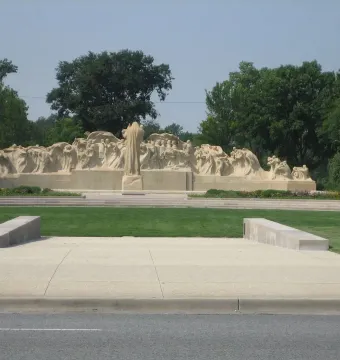
August 2007 © Lorado Taft · CC BY-SA 3.0
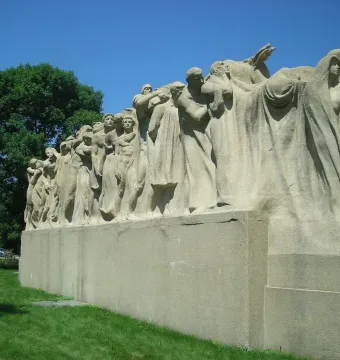
© Lorado Taft · Public domain
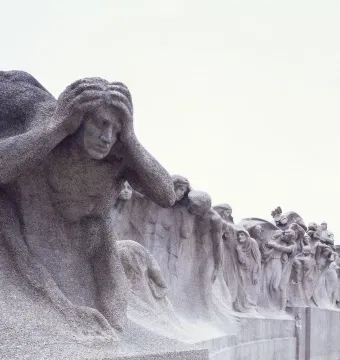
© Carol M. Highsmith · Public domain
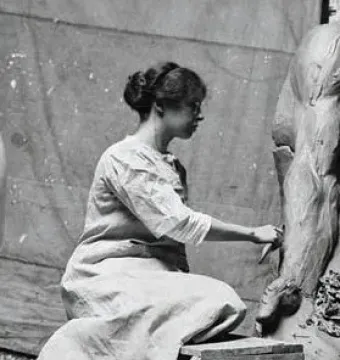
© Unknown photographer · Public domain
Identification | |
| Title | Fountain of Time |
| Type | Sculpture; fountain |
| Alternative names | Il Tempo; La fuente del Tiempo; La Fontaine du temps; fontana del Tempo; Tiempo |
Creator | |
| Artist | Lorado Taft |
Physical characteristics | |
| Material | Innovative molded concrete reinforced with steel and concrete framework |
| Completed companion pieces height | 5 to 7 feet (1.5 to 2.1 metres) |
| Material advantages claimed at the time | Cheaper and more durable than previous materials |
| Length | 38.66 meters |
Location and ownership | |
| Completed companion pieces location | Two outside the university's main library and two on the south side of Foellinger Auditorium |
| Completed companion pieces recipient | University of Illinois Urbana-Champaign |
| Historic designation | Included in the National Register of Historic Places as part of Washington Park |
| Part of | Washington Park; a historic district |
| Dedication date | 1922 |
| Water feature use began | 1920 |
| Location | Western end of the Midway Plaisance within Washington Park, Chicago, Illinois, United States |
| Neighborhood | Washington Park, South Side of Chicago |
Historical context | |
| Broader artistic ambition | Taft's vision of a Chicago school of sculpture comparable to the Chicago School of architecture |
| Completed companion pieces title | Sons and Daughters of Deucalion and Pyrrha |
| Completed companion pieces | Four finished figures from the Greek legend of repopulating the Earth after the Great Flood, considered Taft's last works |
| Companion work | The Fountain of Creation, intended for the opposite end of Midway Park, was started but never completed |
| Model dimensions | Full-scale model with a maximum width of 30.1 metres and a central figure height of 6.1 metres |
| Alternative commemorative theme considered | The memory of the 1893 World's Columbian Exposition in Jackson Park |
| Model scale | First a quarter-scale model, then a full-size plaster model |
| Commemorative purpose | To celebrate the first 100 years of peace between the United States and Great Britain following the Treaty of Ghent of 1814 |
| Style | Beaux-Arts |
| Initial commission | In 1907, Taft's first Ferguson Fund commission was the Fountain of the Great Lakes at the Art Institute of Chicago |
| Project context | Part of a larger plan to beautify the Midway Plaisance |
| Planned landscape features | A stream, lagoons, and a series of bridges |
| Chosen material | Concrete |
| Planned bridges | Bridge of Arts at Woodlawn Avenue; Bridge of Religion at Ellis Avenue; Bridge of Science at Dorchester Avenue (formerly Madison Avenue) |
| Planned canal connection | A canal linking the two ends of the Midway and connecting the Jackson Park and Washington Park lagoons |
| Funding | Funded by the Benjamin Ferguson Fund, from Benjamin Ferguson's 1905 $1 million gift to a charitable trust commemorating events in American history |
| Quarter-scale model approval | Approved by trustees in May 1915 |
| Original intended materials | Granite; Georgia marble; bronze |
| Formal presentation of plans | 1912, presented by Art Institute trustee Frank G. Logan at the Art Institute of Chicago |
| Contract date | February 6, 1913 |
| Contract terms | A five-year installment contract at $10,000 per year for a full-size plaster model |
Iconography and meaning | |
| Figures in the model | A mounted warrior and a robed Father Time |
| Inspiration | Henry Austin Dobson's poem "Paradox of Time" |
| Depicted figures | 100 figures passing before Father Time |
| Father Time | A central figure facing the 100 figures across a water basin |
Technique | |
| Technique | New modeling style |
Significance | |
| Former status | Before Millennium Park was completed in 2004, considered the most important art installation in the Chicago Park District |
| Claimed distinction | Sometimes described as the first work of art made of concrete |
History and restoration | |
| Delay cause | Taft's World War I service with the YMCA in France as a lecturer and entertainer |
| Major restoration completed | 2005 |
| Late-1990s to early-2000s repairs | Additional repairs in the late 1990s and early 21st century corrected many problems caused by earlier restorations |
| Completion of model | 1920 |
| First restoration campaign | After the 1978 article, the Chicago Park District sought funding for stabilization and initial restoration work |
| 1978 public attention | A Chicago Tribune Sunday Magazine article by Jerome M. O'Connor drew attention to the deteriorating condition of Lorado Taft's major works |
| Restoration history | Underwent restorations after deterioration caused by natural and human factors |
| Reinauguration | The first phase of recovery was celebrated with a new inauguration by Mayor Richard J. Daley |
Other | |
| Current advocacy | Supporters continue to seek greater lighting for the sculptural group |
| Preservation nomination | The National Trust for Historic Preservation nominated the sculpture as needing maintenance funds |