
The Prodigal Son
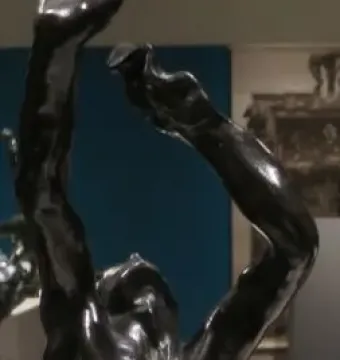
The Prodigal Son is a sculpture by Auguste Rodin, made between 1885 and 1887 as part of The Gates of Hell project. Several versions exist, including one at the Rodin Museum in Paris and another at the Victoria and Albert Museum in London. The work depicts the return of the prodigal son to his father and the exemplary son, focusing on the repentant figure as he begs for compassion. Rodin placed the man kneeling on a rock, with raised arms, an arched back, and an open mouth to emphasize sorrow, pain, guilt, and anguish. The gesture and posture convey a sense of defeat.
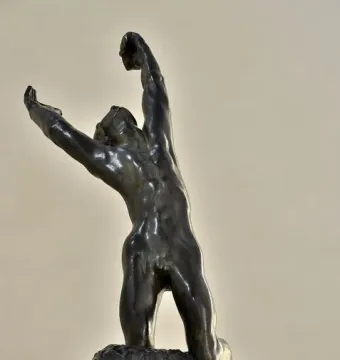
© Patrick · CC BY-SA 2.0
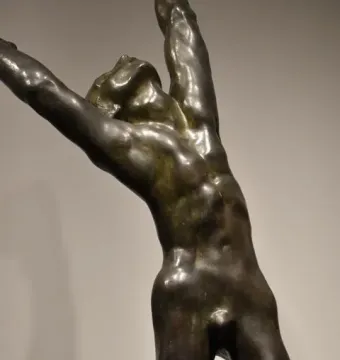
October 2019 © Tylwyth Eldar · Public domain
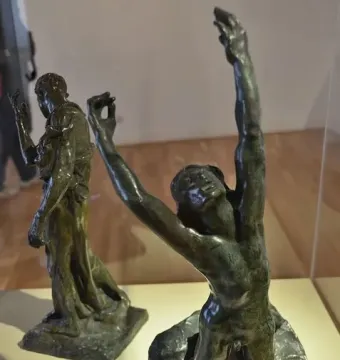
© Patrick · CC BY-SA 2.0
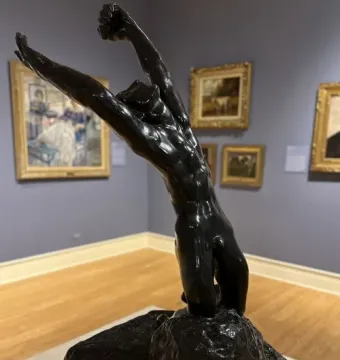
June 2026 © APK · CC BY 4.0
© Hiart · CC0
Identification | |
| Title | The Prodigal Son |
| Other titles | Il figliol prodigo; Le Fils prodigue; El hijo pródigo |
| Type | Sculpture |
Creator | |
| Artist | Auguste Rodin |
Historical context | |
| Date of creation | 1885–1887 |
| Context | Made as part of The Gates of Hell |
| Contemporary work | The second model of The Burghers of Calais |
| Related work | Young Man Desperate |
Discovery and provenance | |
| Related sources and reuse | Derived from the male figure of Fugit Amor; the head and torso were also used in Ugolino and His Sons; it also appears in sketches for the entrance of the Museum of Decorative Arts in Paris |
| Locations of versions | Rodin Museum, Paris; Victoria and Albert Museum, London; Musée Rodin, Paris |
| Versions | Several versions exist |
Iconography and meaning | |
| Subject | The prodigal son |
| Biblical source | The Gospel of Luke (Luke 15:1-3, 11-32) |
| Interpretation | Explores the feelings and attitudes in the parable of the prodigal son; the young man appears to have squandered his inheritance and abandoned his father, and the return of the prodigal son to his father is implied, with the exemplary son also present |
Appearance | |
| Pose | The man is kneeling on a rock with his arms raised and his back arched |
| Facial expression | His mouth is open, as if shouting |
| Mood | Sadness, pain, guilt, anguish, and defeat |
Significance | |
| Art-historical context | The parable has inspired many artists in the history of Western art |