
Sleeping Ariadne
Sleeping Ariadne, housed in the Vatican Museums in Vatican City, is a Roman Hadrianic copy of a Hellenistic sculpture from the Pergamene school of the 2nd century BC. It is one of the most renowned sculptures of Antiquity. The reclining figure wears a chiton bound under her breasts, half lying and half sitting, with extended legs crossed at the calves, her head resting on her left arm and her right arm thrown over her head. Purchased in 1512 by Pope Julius II from Angelo Maffei, it was placed in the Belvedere Courtyard alongside the Laocoön and the Belvedere Apollo. Once identified as Cleopatra, the sculpture became a major model for the pose of sleep in later art.
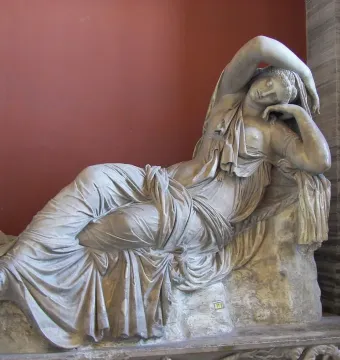
April 2008 © Wknight94 · CC BY-SA 3.0
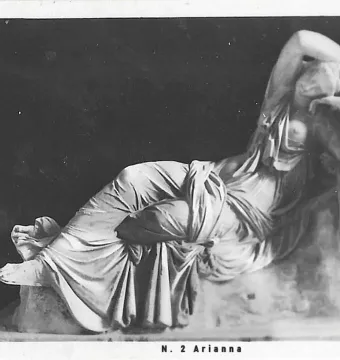
1920 © Text: Ed.Ris. E.G.D.V.Roma · Public domain
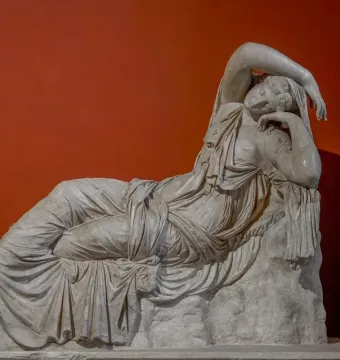
December 2022 © Fabrizio Garrisi · CC BY-SA 4.0
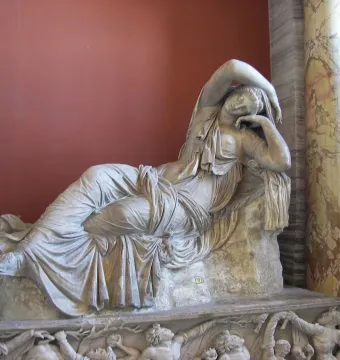
April 2008 © Wknight94 · CC BY-SA 3.0
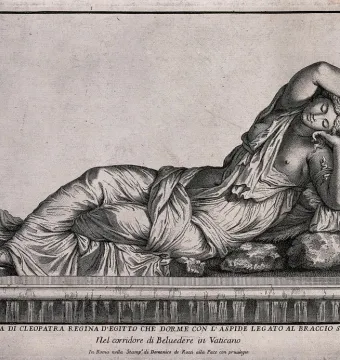
© Jean-Baptiste Poilly (French engraver, c.1669 - 1728) · Public domain
Identification | |
| Title | Sleeping Ariadne |
| Alternative names | Vatican Ariadne |
| Italian title | L'Arianna addormentata |
| Polish title | Śpiąca Ariadna |
| Former name | Cleopatra |
Historical context | |
| Type | Roman marble sculpture, a Hadrianic copy of a Hellenistic original |
| Date | Hadrianic era |
| Original date | 2nd century BC |
| Original school | Pergamene school |
Creator | |
| Attribution | Attributed to the sphere of the Pergamene school |
Discovery and provenance | |
| Acquired from | Angelo Maffei |
| Associated works at installation | Laocoön Group and Apollo of the Belvedere |
| Later locations | Transferred indoors in the mid-16th century to the adjoining Stanza della Cleopatra; moved to the Museo Pio-Clementino in 1770/1771; taken to Paris in 1798 during Napoleonic spoliations; returned to Rome after Napoleon's fall |
| Initial installation | Cortile del Belvedere of the Vatican Palace, on a Roman sarcophagus adapted as a fountain in a niche at the end of the uppermost terrace |
| Early ownership | Part of the antiquarian collection of Benedetto and Agostino Maffei before being acquired for Pope Julius II |
| Acquisition date | 1512 |
| Acquired by | Pope Julius II |
| Discovery context | Found during vineyard work; no precise discovery details are known |
| Discovery date | 1512 |
| Discovery place | Palestrina, Lazio, probably while working in vineyards near ancient Praeneste |
Physical characteristics | |
| Arm decoration | An armilla or serpent-shaped bracelet around the upper left arm |
| Sarcophagus decoration | Sarcophagus with reliefs of the Gigantomachy |
| Support and setting | Placed on a Roman sarcophagus and fitted as a fountain in a niche or grotto |
| Condition and expression | The pose has been described as collapsed or fainted, restless, uneasy, and caught between sleep and waking |
| Drapery | Wears a chiton tied under the breasts |
| Pose | Semi-reclining, half sitting and half lying, with legs extended and crossed at the calves, head resting on her left arm, and right arm thrown over her head |
| Subject depiction | Ariadne, a sleeping reclining female figure |
| Height | 161 cm |
Materials | |
| Primary material | Marble |
Technique | |
| Setting function | Fountain |
Appearance | |
| Iconographic identification | Originally identified as Cleopatra because the bracelet on the upper left arm was mistaken for Cleopatra's asp; later identified as Ariadne, and also interpreted as a nymph or Venus |
| Narrative subject | Ariadne asleep on Naxos after Theseus abandoned her |
Iconography and meaning | |
| Interpretation | Hellenistic innovation in the sleeping Ariadne motif, though the pose was already known from vase-painting |
| Literary allusion | May allude to Ariadne waking and threatening vengeance on Theseus, as in Catullus' Carmen 64 |
| Modern interpretations | Ulisse Aldrovandi thought the figure looked collapsed and fainted; Sheila McNally emphasized agitated uneasiness and torpor more oppressive than rest; Leonard Barkan interpreted the Cleopatra identification as a conflation of narratives |
| Art-historical context | The motif was long known from vase-painting and may have reflected a now-lost literary source, according to T.B.L. Webster |
Location and ownership | |
| Current display | Displayed in a niche, on a Roman sarcophagus, flanked by the Barberini Candelabra |
| Current location | Vatican Museums, Museo Pio-Clementino, Vatican City |
History and restoration | |
| Restorations | Restored by Gaspare Sibilla, including the rock bed, right arm, and part of the face |
| Gallery and room names | Stanza della Cleopatra; later called the Hall of Philosophers |
| Inscription | The statue was associated with the pseudo-Latin epigram beginning 'HUIUS NYMPHA LOCI'; later scholarship attributed it to Giovanni Antonio Campano and placed it in the Renaissance period |
| Related setting design | The indoor niche setting was designed by Daniele da Volterra and supervised by Giorgio Vasari |
| Later setting details | In the 1530s the niche was redecorated as a grotto; the gallery setting used a shallow grotto niche and a landscape with Egyptian pyramids, palms, and the Sphinx |
| Napoleonic removal and return | Removed to Paris as part of the Musée Napoléon spoils and later returned to Rome |
Significance | |
| Notability | One of the most renowned statues of antiquity |
| Influence | Influential as a model for the sleeping pose from Antiquity through the High Renaissance and later art; inspired Raphael, Marcantonio Raimondi, Michelangelo, and numerous Renaissance and later copies |
| Copies and variants | Other Roman copies include the Wilton House Ariadne and the Medici Ariadne; variants are in Madrid and the Louvre; two surviving statuettes attest to Roman reductions |
| Copying and reception | Selected by Primaticcio for plaster copies and bronze casts for Francis I at Fontainebleau; also copied by Nicolas Poussin, Pierre Julien, John Cheere, and for Thomas Jefferson |
| Cultural significance | A paradigm for sleeping nymph fountain sculptures and humanist recreations of loci amoeni through the 18th century |
Other | |
| Other notes | The Wilton House Ariadne is substantially unrestored; the Medici Ariadne was found in Rome and later seriously reworked in modern times according to Brunilde Sismondo Ridgway |