
Didarganj Yakshi
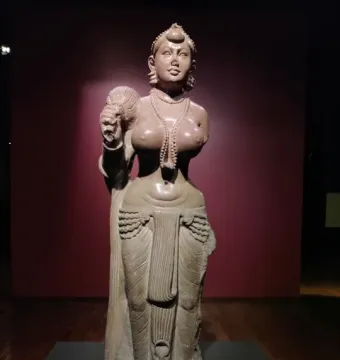
Didarganj Yakshi, also called the Didarganj Chauri Bearer, is one of the finest examples of very early Indian stone sculpture. The life-size standing figure is made of Chunar sandstone and highly finished to a mirror-like polish associated with Mauryan art, though it has also been dated later by some scholars. It shows a well-proportioned body, a transparent effect in the lower garment, and a fly-whisk held in the right hand, while the left hand is broken. The treatment of the forelock has been described as characteristically Kushan. Found in 1917 near Patna, the sculpture is now in the Bihar Museum in Patna, Bihar, India.
August 2022 © SuzanneDee · CC BY 3.0
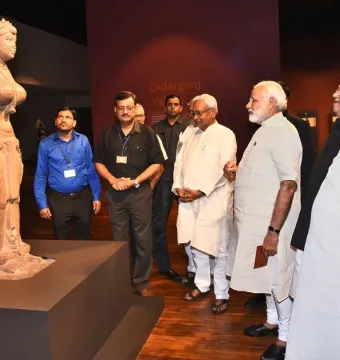
October 2017 © Prime Minister's Office · GODL-India
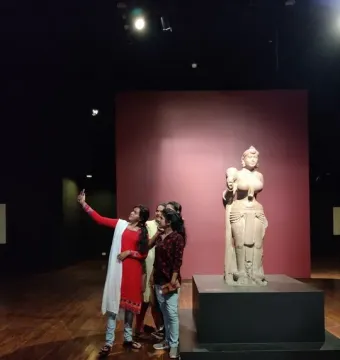
August 2022 © SuzanneDee · CC BY 3.0
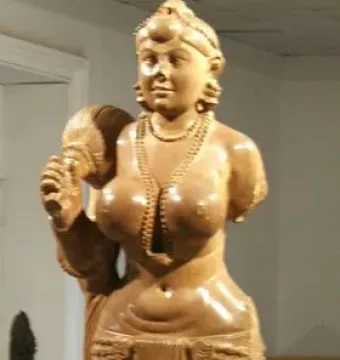
April 2006 © Neelsb · CC BY-SA 3.0
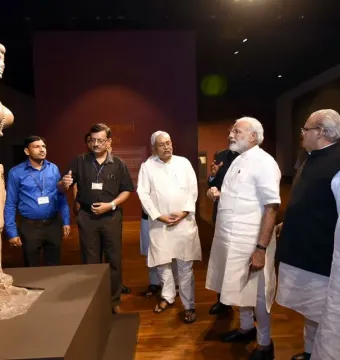
October 2017 © Prime Minister's Office · GODL-India
Identification | |
| Title | Didarganj Yakshi |
| Alternative name | Didarganj Chauri Bearer |
| Original name | Yakshini from Didarganj |
| Type | Ancient Indian stone sculpture |
| Subject | Yakshini, a female nature spirit or minor deity |
Historical context | |
| Date | 3rd–2nd century BCE; some sources revise this to 2nd century CE or possibly 1st century CE |
| Dating status | The date is disputed and uncertain |
| Historical style | Mauryan art |
| Possible later stylistic feature | The forelock treatment is said to be characteristically Kushan |
| Historical period | Mauryan period, especially the middle Mauryan period |
| Cultural background | Indian folk religion; later incorporated into Buddhism, Hinduism, and Jainism |
Creator | |
| Attribution basis | Dating is based on analysis of shape and ornamentation; a similar Yakshi is also found without polish |
Physical characteristics | |
| Height | 1.58 m |
| Pedestal height | 0.53 m |
| Size | Life-size, tall |
| Form | Standing, free-standing sculpture mounted on a pedestal |
| Body | Full-bodied female figure with pronounced breasts, broad hips, a narrow waist, and rounded forms |
| Anatomy | Only sketchy anatomical modeling, with a flattened back and perfunctory rear modelling |
Materials | |
| Material | Chunar sandstone |
| Stone source | Quarried near Chunar, Uttar Pradesh, India |
Technique | |
| Finish | Highly polished, with a mirror-like Mauryan polish |
| Carving | Carved from a single block of stone |
| Clothing effect | The carved folds create the effect of transparent clothing |
Appearance | |
| Face and posture | The figure appears to be attentively observing something; the upper torso is tense and slightly leaning forward, with the right knee slightly bent |
| Clothing | Traditional Indian dhoti with schematic folds creating a transparent effect |
| Adornment | Hair crest; large triple-ring earrings; pearl necklace; double chain below the breasts; belt with five cords; heavy ankle bracelets |
Iconography and meaning | |
| Held attribute | Chamara, a ritual fly-whisk made from yak-tail hair, in the right hand |
| Left hand | Missing/broken |
| Beauty ideal | Represents the ancient Indian ideal of female beauty, with griva trivali and katyavali |
| Symbolism | The rounded, corpulent form suggests fertility and kinship with a fertility goddess |
| Interpretation | The sculpture blends mythic and courtly elements and reflects royal court style |
| Alternative identifications | Possibly the wife of a ruler, a surasundari, or, in a recent study, the goddess Indrakshi Durga |
Location and ownership | |
| Current location | Bihar Museum, Patna, Bihar, India |
| Removal and custody | The police confiscated it from local worship and placed it in the Bihar Museum for safekeeping |
| Identification by Spooner | D. B. Spooner identified it as an ancient sculpture and thought it was either a yakshini or a celestial beauty |
| Temporary shrine | A temporary shrine with a bamboo canopy was built and the statue was worshipped |
| Initial local interpretation | Locals initially took it for a goddess murti because of nearby Kali and Durga temples |
| Discovery participants | Villagers, Professor J. N. Samaddar, E. H. C. Walsh, Dr. D. B. Spooner, and in one account a theologian named Ghulam Rasul |
| Discovery circumstances | Found partially buried in river sand; accounts also describe a stone fragment protruding from the sand or a stone slab with a snake hole leading to excavation |
| Discovery location | On the bank of the Ganges near Didarganj, near Jamalpur, Bihar, at Didarganj Kadam Rasual northeast of the Qadam-i-Rasul Mosque in Patna City |
| Discovery date | 18 October 1917 |
History and restoration | |
| Museum history | After 1947 exhibition in London and a return a year later, it entered the collection of the National Museum in Delhi; it later toured France and the United States in the 1980s |
| Exhibition history | Displayed in London in 1947, at the National Gallery of Art in Washington in 1985, and in other international exhibitions during the Year of India |
| Damage history | Its nose was broken during transport for the 1985 Washington exhibition, after which it was decided not to send it abroad again |
| Centenary | The excavation centenary was celebrated in 2017 |
Significance | |
| Art-historical significance | Considered one of the finest and most significant examples of very early Indian stone sculpture and a symbol of ancient Indian art |
| Scholarly interpretation | It is seen as evidence for the development of monumental sculpture in ancient India, with some scholars linking it to Hellenistic influence and Greek artistic ideals |
| Comparative reference | Often compared with the Venus de Milo, though the Venus de Milo dates to 130–100 BCE |
Other | |
| Related cultural note | The sculpture's public history is tied to colonial archaeology and debates over sacred versus museum objects |
| Commemorative stamp | In 1985, the Government of India issued a one-rupee postage stamp in honor of the Yakshi |
| Commemorative play | Yakshini, directed by Sunita Bharti and staged by ICCR and IGNCA in New Delhi |