
Mausoleum of Prince Ernst
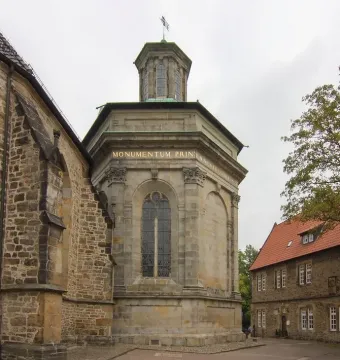
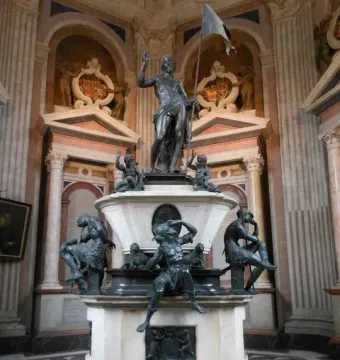
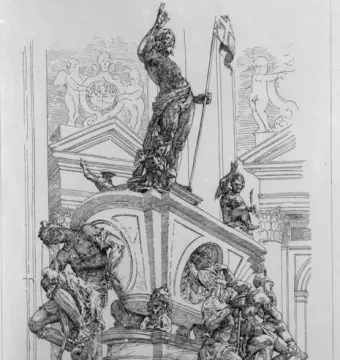
The Mausoleum of Prince Ernst is a Renaissance mausoleum in Stadthagen, Lower Saxony, Germany, built between 1620 and 1627 by Ernst of Schaumburg and his widow Hedwig of Hesse-Kassel. Designed by Giovanni Maria Nosseni, it is a vaulted heptagon attached to the main chapel of St. Martini parish church. Four walls are decorated with Latin epitaphs for Prince Ernst, his parents, and his wife, framed by aedicules with Italian marble columns. The central monument by Adriaen de Vries features a cenotaph for Prince Ernst, conceived as Christ’s tomb, surrounded by sleeping Roman guards and crowned by a triumphant figure of Christ. The painted dome with fourteen musician angels represents heaven.
January 2013 © Mausoleum_(Stadthagen)_IMG_1303.jpg · CC BY-SA 3.0
_IMG_1303.jpg)
May 2013 © Adriaen de Vries · CC BY 3.0
1887 © Unknown authorUnknown author · Public domain
1620 © Anton Boten · Public domain
May 2013 © Rabanus Flavus · CC BY 3.0
Identification | |
| Title | Mausoleum of Prince Ernst |
| Type | mausoleum |
| Original name | Fürstliches Mausoleum |
Location and ownership | |
| Buried family members | Ernst of Schaumburg, his parents Otto IV and Elisabeth Ursula of Brunswick-Lüneburg, and members of the House of Schaumburg-Lippe |
| Reinterred in the crypt | Otto IV and Elisabeth Ursula of Brunswick-Lüneburg |
| Buried elsewhere | Maria of Pomerania-Stettin and Adolf XI remained buried in the crypt under the church |
| Burial use | Used as the burial place of the House of Schaumburg and the House of Schaumburg-Lippe until 1915 |
| Location | Stadthagen, Lower Saxony, Germany |
| Church association | Attached to the parish church of St. Martini in Stadthagen, east of the chancel |
Historical context | |
| Construction began | 1620 |
| Completed by | Hedwig of Hesse-Kassel, a few years after Ernst's death in 1622 |
| Construction | 1620–1627 |
| Commemorative purpose | Memorial place commemorating the life and virtues of those buried there, especially Prince Ernst |
| Planning began | 1607 |
| Founder / commissioners | Prince Ernst of Schaumburg and his widow Hedwig of Hesse-Kassel |
| Prince Ernst death year | 1622 |
| Design context | After Ernst received the title of Imperial Prince in 1619, the mausoleum was intended to reflect that rank |
| Purpose | Planned as a mausoleum for Prince Ernst, his wife Hedwig of Hesse-Kassel, and his parents |
Creator | |
| Central monument artist | Adriaen de Vries |
| Execution and painting | Anton Boten |
| Sculptor | Adriaen de Vries |
| Designer | Giovanni Maria Nosseni |
Discovery and provenance | |
| Original burial context | Several members of the House of Schaumburg had already been buried in the former Franciscan church, later St. Martin's parish church |
Physical characteristics | |
| Exterior walls | Three wall surfaces have windows and four have blind arches |
| Material | Obernkirchen sandstone |
| Horizontal articulation | Cornices divide the building into a low base storey, a tall main structure, an inscription band, and the roof zone |
| Corners | Marked by pilasters with Corinthian capitals |
| Plan | Heptagonal |
| Entrance | The entrance faces the church and is connected to it by a low passage or corridor |
| Roof | Flat copper-covered dome with a lantern |
| Dimensions | 24 m high; 10 m diameter |
| Form | Domed heptagonal structure |
| Structure | Seven wall surfaces continue into seven dome segments and the crowning lantern |
Style | |
| Architectural style | Italian Renaissance style with strict forms; later described as Mannerism with elements pointing toward the Baroque |
Appearance | |
| Floor | A multicolored mosaic floor with a white heptagonal central field and a black pedestal step |
| Cenotaph back | Chronos with hourglass and sickle |
| Figure atop monument | A larger-than-life resurrected Christ with raised right hand and victory banner in the left |
| Putti | Four putti, partly identified by writing quills and partly by gesture as heralds of the Resurrection |
| Dome decoration | Painted with fourteen musical angels |
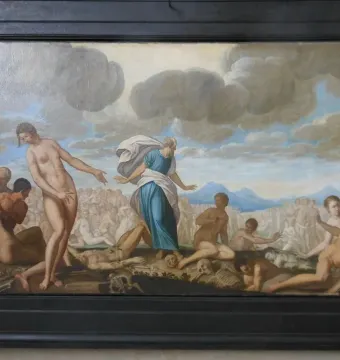
| Paintings under the windows | The Revivification of the Bones of the Dead of Israel and The Raising of Lazarus by Anton Boten |
| Vault decoration | The seven vault segments are painted with two musically performing angels each against a sky-blue, clouded background |
| Angels' instruments | Theorbo, dulcian, and pommer, among other contemporary instruments |
| Lantern decoration | The ceiling shows the Schaumburg Nesselblatt coat of arms in a seven-pointed star with seven angel heads |
| Lighting | Indirect daylight enters through the lantern windows |
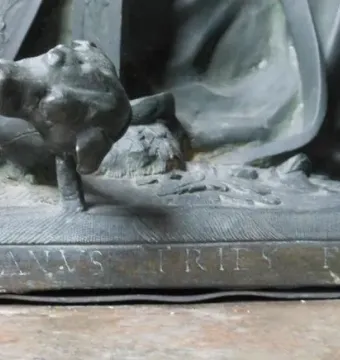
| Figures around cenotaph | Four sleeping Roman guards seated in front of the cenotaph, holding weapons and rank insignia |
| Inscription language | Latin |
| Cenotaph front | Portrait medallion of Prince Ernst |
| Interior wall decoration | Plain inscribed epitaph plaques for Prince Ernst, his wife Hedwig, and his parents Otto and Elisabeth |
| Exterior decoration | Four walls are decorated with Latin epitaphs framed by aedicules with Italian marble columns |
| Inscription band | A Latin inscription in gold majuscules runs around the building |
| Wall treatment | The four windowless wall surfaces are furnished with high aedicules and epitaph plaques; above the pediments are coats of arms held by putti |
| Commemorated in epitaphs | Prince Ernst, his parents, and his wife Hedwig |
| Number of epitaph plaques | Four |
| Family coats of arms | Mounted above the pediments and held by putti |
| Central monument | A large pedestal supporting the cenotaph of Prince Ernst |
Materials | |
| Column material | Italian marble |
| Cenotaph material | Alabaster sarcophagus on four bronze lions |
| Bronze works | 13 bronze sculptures and 6 bronze reliefs |
Iconography and meaning | |
| Symbolism of the number seven | Seven is treated as a symbol of perfection and completion in Christian tradition; it also has special significance in Rosicrucianism, with which Prince Ernst had contact |
| Religious meaning | A witness to Christ-centered belief in resurrection |
| Dome symbolism | Represents heaven |
| Cenotaph interpretation | Conceived simultaneously as the tomb of Christ, so that Christ rises from Ernst's cenotaph in the Easter scene |
History and restoration | |
| War damage | The building and furnishings survived the Thirty Years' War undamaged despite severe fires and looting in Stadthagen |
| Later preservation | It remained unharmed during later wars and periods of hardship |
| Restoration | Restored true to the original between 2006 and 2010 with public and private funds |
Significance | |
| Architectural significance | Its unusual architecture and the resurrection monument by Adriaen de Vries make it a site of European rank with international significance |
| Artistic assessment | The mausoleum's paintings and expressive sculptures are considered an outstanding example of Mannerism |
Other | |
| Interpretations of the shape | Various interpretations have been attempted |
| Historical context represented | It provides an authentic picture of the style and worldview of a ruling prince in Protestant northern Germany between the Reformation and the Thirty Years' War |