
Kakiemon Elephants
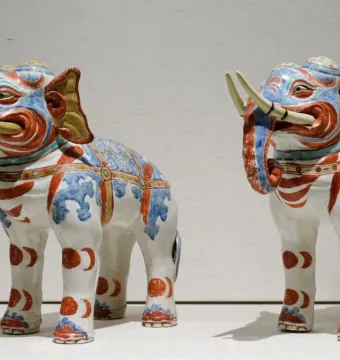
Kakiemon elephants are a pair of Japanese porcelain elephant figures from the 17th century, now held by the British Museum. They entered the collection as part of a gift donated to the museum by Sir . The figures were probably made between 1660 and 1690, at a time when elephants could not yet be seen in Japan. They were created in one of the Kakiemon-style pottery workshops near the settlement of Arita on the island of Kyushu. This region was important in the early production of Japanese glazed porcelain, much of it made for export in the early years of the Dutch East India Company.
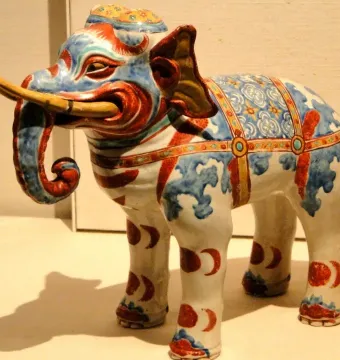
February 2010 © Rex Harris · CC BY 2.0
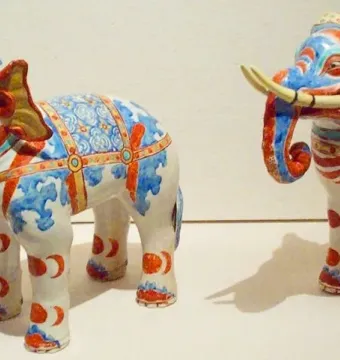
© Unknown authorUnknown author. · Public domain
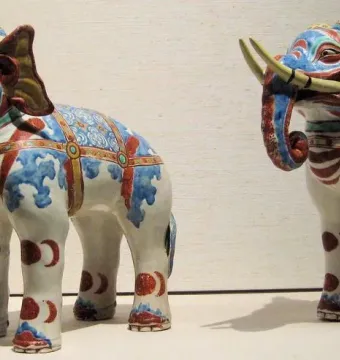
· CC0
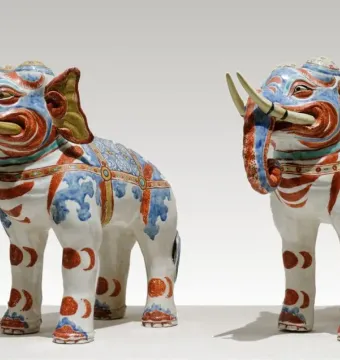
December 2012 © Marie-Lan Nguyen · CC BY 2.5
December 2012 © Marie-Lan Nguyen · CC BY 2.5
Identification | |
| Title | Kakiemon elephants |
| Type | Pair of elephant figurines |
| Subject | Elephants |
Historical context | |
| Style history | Kakiemon ware emerged during the decline of Chinese porcelain production in the late Ming and early Qing transition, when Japanese potters filled the gap and the style later influenced European porcelain, especially Meissen |
| Technique history | Nigoshide and Kakiemon porcelain were developed in 17th-century Japan; the style later fell into disuse, was rediscovered in 1953 by Sakaida Kakiemon XII and XIII, declared an Important Intangible Cultural Property of Japan in 1971, and continued under Sakaida Kakiemon XIV until 2013 |
| Historical significance | An important type of Japanese export porcelain during the growth of Dutch East India Company trade and early European trade with Japan |
| Historical significance | Among the first Japanese glazed porcelain exports at the beginning of the Dutch East India Company's activities |
| Context | Made at a time when elephants had not yet been seen in Japan |
| Related trade note | England attempted to establish a trading post in Japan in 1613 under King James I and Tokugawa Hidetada, but the initiative was abandoned in 1623 |
| Date | 17th century, probably made between 1660 and 1690 |
Creator | |
| Style | Kakiemon |
| Maker | One of the Kakiemon kilns/workshops, associated with Sakaida Kakiemon and Higashijima Tokuemon |
Discovery and provenance | |
| Export route | Exported to Europe by the Dutch East India Company via Imari and Amsterdam |
| Place of manufacture | Near Arita, Saga, on Kyushu, Japan |
| Collection history | Entered the British Museum as part of Sir Harry Garner's donated collection |
Physical characteristics | |
| Dimensions | Each figurine is 35.5 cm high, 44 cm long, and 14.5 cm wide |
| Number of objects | 2 |
Materials | |
| Material | Japanese glazed porcelain |
Technique | |
| Glaze | Nigoshide, a near-white glaze named by allusion to the residue left after washing rice |
| Decoration technique | Overglaze enamel decoration |
| Manufacturing method | Probably cast in molds |
Appearance | |
| Colors | White ground decorated with red, green, yellow, and blue enamels |
Iconography and meaning | |
| Source for depiction | The makers had never seen a real elephant and worked from drawings and sketches, possibly from Buddhist sources |
| Depicted animal | Asian elephants, with some details based on indirect sources rather than direct observation |
Location and ownership | |
| Current location | The British Museum |
| Display status | On display at the British Museum |
History and restoration | |
| Manufacturing evidence | Fragments of broken elephant molds were found in modern excavations in Arita |
| Comparable objects | A similar elephant dated around 1680 is in the Groninger Museum, and another similar elephant is in the Fitzwilliam Museum, Cambridge |
Other | |
| Rarity | Few artifacts like this pair survive |
| Media mention | Mentioned in a 2010 BBC and British Museum radio series |
| Media adaptation | Enlarged versions appear in the 2014 film Night at the Museum: Secret of the Tomb |