
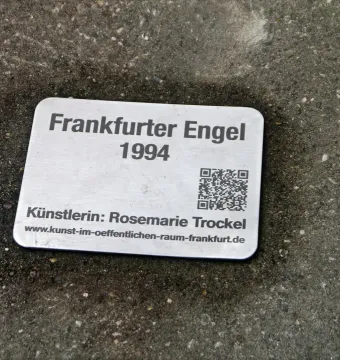
Frankfurter Engel
Frankfurter Engel is a memorial in Frankfurt am Main dedicated to homosexual men and women persecuted in Germany, especially under Nazi rule. Opened in 1994, it was the first memorial of its kind in Germany. The project was conceived by Rosemarie Trockel. The sculpture shows an angel holding a scroll, based on one of the figures that once decorated the western portal of Cologne Cathedral. It is made at life size, with the angel’s head separated and reattached so that a scar is visible on the neck. The statue stands on an octagonal bronze pedestal with an inscription remembering those who were persecuted, killed, and later denied recognition.
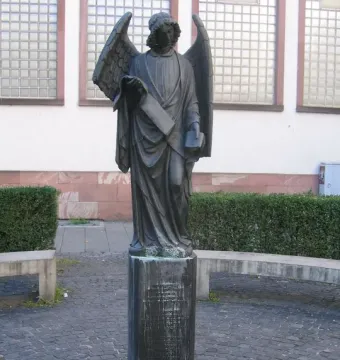
September 2007 © Reinhard Dietrich · CC BY-SA 3.0
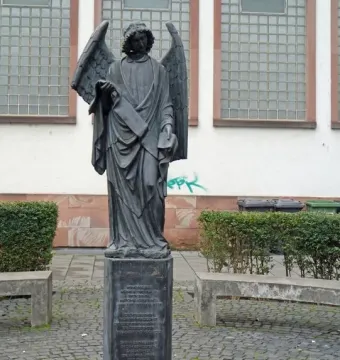
January 2014 © Simsalabimbam · CC BY-SA 3.0
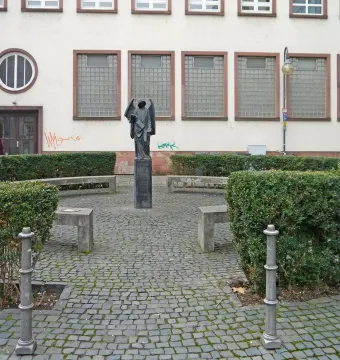
January 2014 © Simsalabimbam · CC BY-SA 3.0
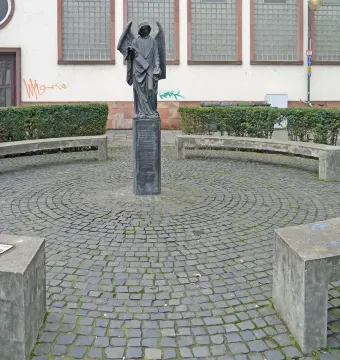
January 2014 © Simsalabimbam · CC BY-SA 3.0
January 2014 © Simsalabimbam · CC BY-SA 3.0
Identification | |
| Title | Frankfurter Engel |
| Type | memorial statue |
| Meaning of title | Angel of Frankfurt |
| Alternative names | Angelo di Francoforte; L'Ange de Francfort; Frankfurt Engel; Mahnmal Homosexuellenverfolgung |
Historical context | |
| Significance | the first monument and first fully sculptural memorial in Germany commemorating the persecution of homosexuals |
| Related comparative monuments | earlier related memorial plaques existed at Neuengamme and Dachau in 1985, in Berlin in 1989, and at Sachsenhausen in 1992; later, the Kölner Rosa Winkel in Cologne (1995) and the Memorial to Homosexuals Persecuted Under Nazism in Berlin (2008) were inaugurated |
| Persecution context | persecution was especially severe during the Nazi period and continued after the fall of the Third Reich |
| Dedicated to | homosexual people persecuted and killed in Nazi Germany and later persecuted under Paragraph 175 in the 1950s and 1960s |
| Historical context | Paragraph 175 of the German Criminal Code criminalized homosexual acts from 15 May 1871 to 11 June 1994; in East Germany it remained in force until 1968 and was reformed in 1969 and fully repealed in 1973 |
Creator | |
| Designer | Rosemarie Trockel |
Discovery and provenance | |
| Initial temporary memorial | On 1 December 1990, gay activists erected wooden crosses with the names of the dead in a park near the Old Opera House |
| Municipal approval | approved by the city council and magistrate in 1992, with Socialists and Greens voting in favor; no city funding was provided |
| Design competition | announced on 20 July 1992 and decided by a jury on 25 January 1993 at the Museum für Moderne Kunst; the selected design was Engel |
| Funding | estimated cost 361,000 DM; 105,000 DM from Hessische Kulturstiftung; 10,000 DM from Hannchen-Mehrzweck-Stiftung; the remaining amount was raised through donations, including a nationwide campaign |
| Donations raised | 360,000 Deutsche Marks by the end of 1994 |
| Initiative | Initiative Mahnmal Homosexuellenverfolgung e. V. (IMH), founded in 1990 |
| Public presentation | the initiative presented a memorandum in 1990 calling for a memorial for homosexual victims of National Socialism |
Physical characteristics | |
| Pedestal | octagonal bronze pedestal |
| Pose | the angel has its head bowed; the head is detached and reattached slightly offset, leaving a visible scar on the neck |
| Form | an angel holding an unfurled scroll or banner |
| Scale | 1:1 |
Materials | |
| Original work status | the original sculpture did not survive; only a damaged plaster model remains |
| Main material | black-patinated bronze |
| Casting and foundry | cast on 29 November 1993 at Glockengießerei Rincker, Sinn, Germany |
| Original date | late 19th century |
| Original sculptor | Peter Fuchs |
| Original source of figure | one of the 11 statues that decorated the pediment of the west portal of Cologne Cathedral |
History and restoration | |
| Reproduction method | the damaged plaster model was reproduced at 1:1 scale as a wax casting |
| Opening date | 11 December 1994 |
| Inauguration date | December 1994 |
Location and ownership | |
| Current location | Schäfergasse and Alte Gasse, Klaus-Mann-Platz, Frankfurt am Main, Germany |
| Country | Germany |
| Square dedication | Klaus-Mann-Platz is named after Klaus Mann and was a meeting place for homosexuals |
Iconography and meaning | |
| Inscription language | German |
| Inscription | Homosexual men and women were persecuted and murdered in Nazi Germany. The crimes were denied, the dead concealed, the survivors scorned and condemned. The memorial warns that men who love men and women who love women may again be persecuted. Frankfurt am Main. December 1994. |
| Inscription origin | formulated by the memorial's initiators and naming the crimes of the National Socialists against homosexual men and women |
| Meaning / interpretation | a warning that men who love men and women who love women could again be persecuted |