
Equestrian statue of Marshal Mannerheim
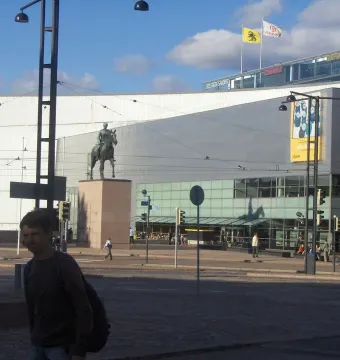
The Equestrian statue of Marshal Mannerheim is a bronze equestrian monument in the centre of Helsinki, Finland. Made by Aimo Tukiainen and erected in 1960, it depicts Field Marshal Gustaf Mannerheim on horseback on a granite plinth. Plans for the statue began in 1937, and fundraising was relaunched after Mannerheim’s death in 1951 by the Helsinki University Students’ Union. Public donations in 1952 raised enough not only for the statue but also for buying Louhisaari mansion, Mannerheim’s birthplace, which became a museum. The realistic statue was controversial at its unveiling, and later debate also surrounded the nearby Kiasma museum.
© Skorpion87 · Public domain
August 2008 © Jean-Pierre Dalbéra · CC BY 2.0
© Helsinki Pride · CC BY 2.0
© Cecil · CC BY-SA 4.0
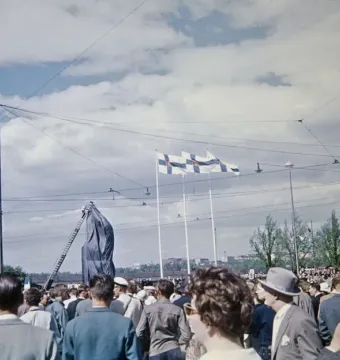
© Arvo Kajantie · CC BY-SA 4.0
Identification | |
| Title | Equestrian statue of Marshal Mannerheim |
| Type | Bronze equestrian statue |
| Alternative title | Mannerheim Monument |
| Original Russian title | Конный памятник маршалу Маннергейму |
Iconography and meaning | |
| Subject | Marshal Gustaf Mannerheim |
| Depiction | Mannerheim as Marshal of the Finnish Armed Forces and sixth President of Finland |
Historical context | |
| Commemorative purpose | A memorial to Mannerheim |
| Historical significance | Mannerheim had been a symbolic figure in Finland since the Finnish Civil War in 1918, and his position grew stronger during the Second World War as a field marshal |
Creator | |
| Assistants | Heikki Häiväoja, Kain Tapper, and Osmo Sipari |
| Sculptor's life dates | 1917–1996 |
| Sculptor | Aimo Tukiainen |
Discovery and provenance | |
| First proposal | 1930 |
| Project resumed | After Mannerheim's death in 1951 |
| Design competition | Held in 1952 |
| Selected sculptor | Aimo Tukiainen |
| Foundation | A private foundation founded in 1952 to enable the erection of the memorial |
| Funding | Raised through donations and a public collection |
| Public donations | 737,503 members of the public donated over 78 million marks |
| Additional funds used for | Louhisaari mansion in Askainen, Mannerheim's birthplace, was bought and turned into a museum |
| Planning began | 1937 |
Physical characteristics | |
| Pedestal shape | Rectangular |
| Height | 5.4 m |
| Pedestal dimensions | 6.3 m long, 6.3 m high, 2.72 m wide |
| Total height | 11.7 m including the granite pedestal |
Materials | |
| Figure material | Bronze |
| Pedestal material | Granite |
Appearance | |
| Style | Realistic and detailed |
| Pose | Mounted on horseback |
| Horse reference | Tukiainen studied Mannerheim's last horse, Käthy, while working on the statue; the horse is not a portrait of Käthy as such, and which horse it represents has been much discussed |
Location and ownership | |
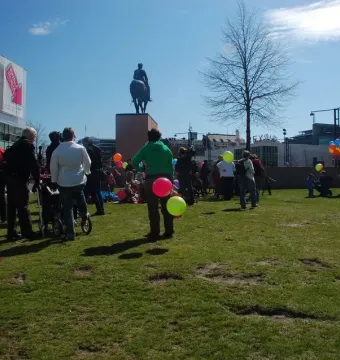
| Location | Mannerheimintie, in front of the Museum of Contemporary Art Kiasma, Helsinki, Finland |
| Nearby landmark | Museum of Contemporary Art Kiasma |
History and restoration | |
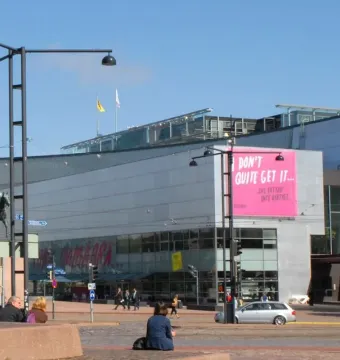
| Construction context | The construction of the Kiasma museum next to the statue was debated during the museum's construction in the 1990s |
| Fence color change | When the construction fence was painted red in 1996, it had to be repainted gray near the statue after an uproar |
| Relocation proposal | During construction of Kiasma, Steven Holl proposed moving the statue a few meters, but the proposal failed because of fierce public resistance |
| Erected | 1960 |
| Artist's stylistic development | By the time of the unveiling, Tukiainen had already moved on from realism in his contemporary works |
| Contemporary reception | At its unveiling in 1960, the art world considered it outdated |
| Inauguration occasion | The 93rd anniversary of Marshal Mannerheim's birth |
| Unveiled | 4 June 1960 |
Other | |
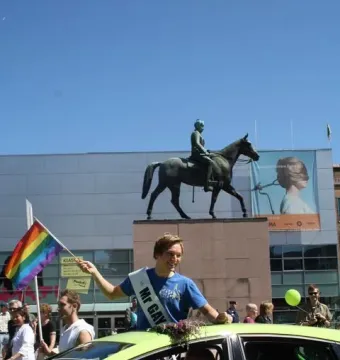
| Photographic documentation | The statue was photographed at its opening in 1960, during the 100th anniversary celebration of Mannerheim's birth in 1967, and in 2008 with Kiasma in the background |