
Louis XIV Equestrian Statue
The equestrian statue of Louis XIV, known as the Monument to Louis XIV, is a bronze sculpture by François-Frédéric Lemot on Place Bellecour in Lyon. It was inaugurated in an unspecified year and has been listed as a historic monument since an unspecified date. The statue replaced an earlier work by Martin Desjardins, installed in 1713 and later melted down during the French Revolution. At its base were two allegorical statues by the Coustou brothers, which were permanently transferred to the Museum of Fine Arts in 2021. The marble pedestal and Lemot’s statue completed a year-long restoration in 2024.
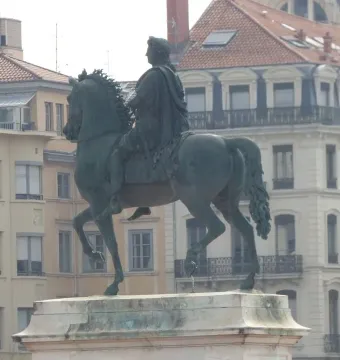
June 2017 © Elliott Brown · CC BY-SA 2.0
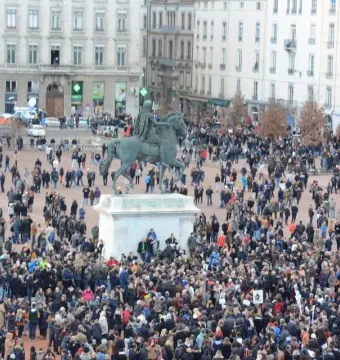
January 2015 © Jitrixis · CC BY-SA 4.0
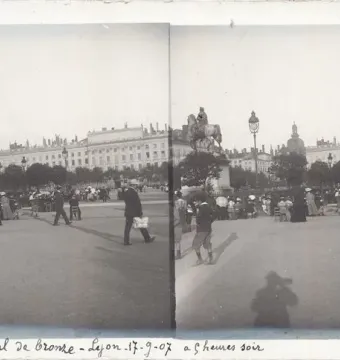
September 1907 © Unknown autorUnknown autor · Public domain
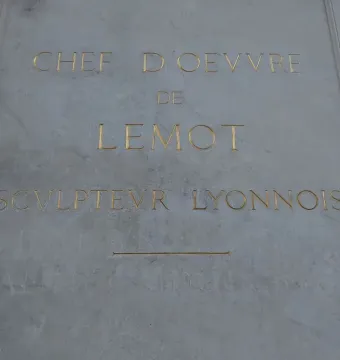
December 2024 © Romainbehar · CC0
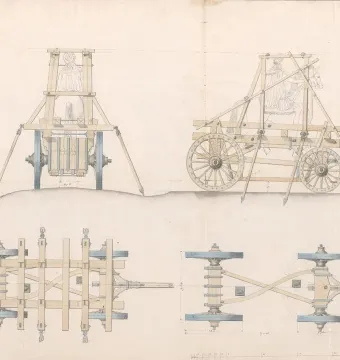
1821 © Unknown authorUnknown author · Public domain
Identification | |
| Title | Equestrian statue of Louis XIV |
| Original French title | Statue de Louis XIV |
| Original German name | Reiterstandbild Ludwig XIV. |
| Type | Equestrian statue; monument |
| Nickname | Le Cheval de Bronze ("Bronze Horse") |
| Nickname meaning | Refers to the horse, not to the king |
| Alternative title | Monument to Louis XIV |
Historical context | |
| Transfer to Lyon authorities | 20 July 1700, in Paris |
| Decision to replace the monument | Announced in 1820 with the restoration of the monarchy |
| First statue fate | Destroyed in 1792 or 1793 during the French Revolution and melted down to make cannons |
| Original installation date | 28 December 1713 |
| Arrival in Lyon | 25 July 1701 |
| New statue cast date | 1825, in Paris |
| First statue erected | 1691 |
| First statue artist | Martin Desjardins |
| Original commission date | 1688 |
| Historical note | Louis XIV is said to have visited Lyon only once, but he is believed to have favored the city’s acquisition of the square, which was given as the reason for the tribute |
| Purpose | Homage to Louis XIV |
| Subject | Louis XIV, King of France |
| First statue artist nationality | Dutch |
Creator | |
| Sculptor | François-Frédéric Lemot |
| Artist nationality | French |
Discovery and provenance | |
| Cast in | Paris |
| Transport to Lyon | Overland and by water from Paris; the barge was pulled by 24 horses, and the overland fardier was pulled by 20 horses arranged in five rows of four abreast; transport took 12 days |
| Transport incident | A worker named Muguet died during transport in Paris |
| Compensation to widow | Muguet’s widow, Claudine Desvignes, received compensation from the Rhône prefect on an unspecified date |
Physical characteristics | |
| Horse pose | Light trot, with the right foreleg and left hind leg raised |
| Height | Approximately 5.7 meters |
| Weight | About 15 tons |
Appearance | |
| Depiction style | Louis XIV is shown "à la romaine" / in the Roman style, without saddle or stirrups |
| Horse tack | No saddle; the king sits on a fringed blanket decorated with fleurs de lys |
| Headwear | Laurel wreath |
| Clothing | Paludamentum, as worn by Roman emperors |
| Weapon | Short sword in a decorated scabbard at the left hip |
| Footwear | Sandals with thin soles and a decorated foot strap |
| Right hand attribute | Marshal’s baton decorated with fleurs de lys |
| Left hand position | Holding the reins |
Materials | |
| Composition of current ensemble | Bronze statue on a marble pedestal |
| First pedestal material | Stone |
| Structural material | Iron structure |
| First version material | Bronze |
| Statue material | Bronze |
| Pedestal material | Carrara marble |
Location and ownership | |
| Location | Place Bellecour, Lyon, France |
| Site context | Historic Presqu'île district; the square was Lyon’s main ceremonial square |
| Position in square | Center of the square, on the axis of the Émile Zola and Victor Hugo streets |
| Orientation | Facing north in the original installation; a south-facing relocation was proposed but not carried out |
| Nearby landmark | Near the Basilica of Notre-Dame de Fourvière |
| Original location | Place Bellecour, Lyon |
| First statue location | Place Bellecour, Lyon |
History and restoration | |
| Hidden cache discovery | During works for a future underground parking lot, a small box was found under the statue, confirming archival records of a hidden commemorative cache laid at the first stone of the new monument |
| Lettering treatment | Gilded |
| Removal for restoration | The statue was removed by crane during restoration works; this was the first time since 1825 that it left Place Bellecour |
| Reinstallation on pedestal | The statue was put back on its pedestal after the restoration |
| Heritage listing | Listed as a historic monument; registration number PA69000054; by the French Ministry of Culture; listing includes the statue and its pedestal |
| Hidden cache contents | Gold coins, medals, a medallion of Louis XVIII, and the commemorative plaque for the re-erection of the statue |
| Cache opening witnesses | Opened in the presence of Louis Pradel, mayor of Lyon, and historians |
| Restoration funding | Financed by the Lyon metropolitan area, the city of Lyon, and the DRAC |
| Listed as historic monument | 25 March 2016 |
| Conservation treatment | Cleaned, brushed, sandblasted, patinated, and coated with protective wax |
| Pedestal restoration | One pedestal slab was replaced; the other was cleaned and its cracks filled |
| Restoration period | 2023–2024 |
| Restoration workshop | Fonderie de Coubertin repaired the bronze |
| Restoration duration | Nearly one year |
| Reason for 2023–2024 restoration | Numerous cracks, oxidation of the iron structure, and weakening of the marble pedestal |
| Allegorical statues restoration and relocation | The Rhône and Saône figures were removed on 22 March 2021, completely restored, and permanently installed at the Musée des Beaux-Arts in February 2022 |
| Allegorical statues installed on pedestal | Two allegorical river statues were mounted on both sides of the pedestal in 1826 |
| Second installation date | 29 October 1825 |
| New statue inauguration | 1825 |
| Preserved elements from first monument | The allegorical statues were preserved and stored at the city hall / Hôtel de Ville |
| First statue destruction | Destroyed during the French Revolution and melted down for cannon |
| Original pedestal decoration | Two bronze allegorical river figures, the Rhône and the Saône |
| Original monument configuration | Stone pedestal with the statue originally flanked by bronze allegorical figures of the Rhône and the Saône; the first monument was surrounded on three sides by trees |
Significance | |
| Related works | Other equestrian statues of Louis XIV are in Versailles, Paris, and Montpellier |
| Comparison | Compared to the equestrian statue of Marcus Aurelius |
| Local tradition | It is traditional in Lyon to meet "under the horse’s tail" |
| Urban legend | A legend says Lemot committed suicide out of shame for forgetting the stirrups, but in fact he died naturally in 1827; another legend says he was made a Knight of the Legion of Honour for this work, but he actually received the distinction in 1816 |
| Artist note | Lemot was a sculptor from Lyon |