
Tetrahedron in Bottrop
Tetrahedron in Bottrop, officially Haldenereignis Emscherblick, is a walkable steel structure shaped as a tetrahedron with a side length of sixty metres. It stands on four nine-metre-tall concrete pillars on top of the mine dump Halde Beckstraße in Bottrop, Germany. Opened on German Unity Day, 3 October 1995, it serves as the town’s landmark. The sculpture is one of several Halden sculptures in the Ruhrgebiet region, built atop slag piles from the area’s industrial past. Its design recalls the Sierpinski tetrix, with a recursive tetrahedral form built from smaller shapes.
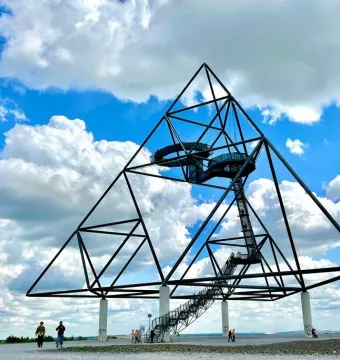
May 2022 © Berthold Kleine-Vorholt · CC BY-SA 4.0
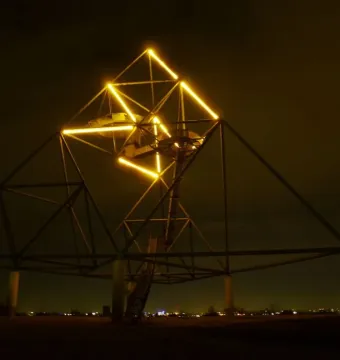
October 2013 © Mirek Claßen · CC BY-SA 3.0
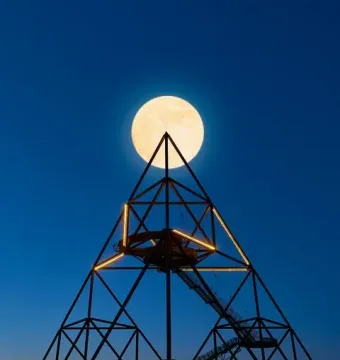
June 2022 © Anil Öztas · CC BY-SA 4.0
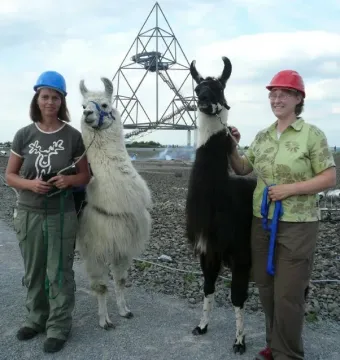
June 2008 © Prachtlamas · CC BY-SA 2.0
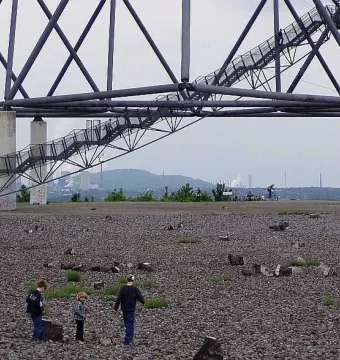
© Diplo · CC BY-SA 3.0
Identification | |
| Name | Tetrahedron in Bottrop |
| Official name | Haldenereignis Emscherblick |
| Short name | Tetraeder |
| Type | Walkable steel tetrahedron viewing platform and landmark sculpture |
| German name | Bottrop Tetraeder |
Physical characteristics | |
| Elevation | About 120 metres above sea level |
| Steps to upper platform | 387 steps |
| Third viewing platform | 38 metres high; a ring 8 metres in diameter, inclined at 8° to the horizontal; reached by a spiral staircase |
| Second viewing platform | 32 metres high; reached by a steep straight staircase |
| First viewing platform | 18 metres high; reached by a staircase designed as a suspension bridge |
| Interior layout | Stairs and viewing platforms suspended within the main structure |
| Relative height | About 90 metres above the surrounding level |
| Edge length | 60 metres |
| Shape | Tetrahedron |
| Support structure | Resting on four reinforced-concrete pillars, 9 metres high |
Materials | |
| Total tube length | 1,500 metres |
| Main material | Steel and tubes |
| Stairs and platforms materials | Grated decking, light grids, and perforated plates |
| Steel quantity | 210 tonnes |
Creator | |
| Top light sculpture | Fraktal, by Jürgen LIT Fischer (Düsseldorf) |
| Structural engineer | Klaus Bollinger (Bollinger + Grohmann, Frankfurt) |
| Architect | Wolfgang Christ |
| Built by | Rüter GmbH, Dortmund |
Historical context | |
| Opening occasion | German Unity Day |
| Landscape effect | From the center of the depression, the industrial and urban landscape of the northern Ruhr area is no longer visible |
| Opening date | 3 October 1995 |
| Historical background | The slag heaps are remnants of the region's industrial era |
| Context | One of the Halden sculptures on slag heaps in the Ruhrgebiet; part of the Route of Industrial Culture and an IBA Emscher Park landmark |
| Site | On top of the Halde Beckstraße spoil heap, the former Beckstraße mine dump of the Prosper-Haniel mine |
| Location | Halde Beckstraße, Bottrop, North Rhine-Westphalia, Germany |
Appearance | |
| Night appearance | Illuminated at night and appears to float |
| View through structure | Open view downward |
| Design resemblance | Reminiscent of the Sierpinski tetrix |
Location and ownership | |
| Landmark status | A landmark of Bottrop and an important regional landmark due to its exposed location and height |
| View | Wide panoramic view over the Ruhr area; Bottrop, Essen, Oberhausen, Gladbeck, and the Rheinturm in Düsseldorf can be seen in good weather, up to about 40 km away |
| Function | Town landmark and viewing platform |
Technique | |
| Wind behavior | The stairs and platforms can sway slightly in strong winds |
| Suspension system | Stairs and platforms are flexibly suspended on steel cables |
History and restoration | |
| Associated ground design | The summit of the spoil heap was shaped as a lens-shaped depression according to a design by Wolfgang Christ |
| Associated installation removal | Removed on 18 February 2009; the figures were dredged up and buried under gravel by the Regionalverband Ruhr after a legal opinion said the unauthorized modifications were not permitted |
| Associated installation restoration | Restored in August 2011 with permission from the Regionalverband Ruhr, based on an agreement with Fred Fischer after no alternative site could be found; a temporary action with textile panels at the original site was agreed |
Other | |
| Associated installation | "Aliens" stone arrangement below the Tetrahedron |
| Associated installation creator | Fred Fischer (Bottrop) |
| Associated installation materials | Differently colored gravel stones |
| Associated installation subject | Aliens |
| Associated installation period | 2004 to early 2009 |
| Associated installation controversy | The unauthorized citizen modifications prompted a passionate public and media debate |
Significance | |
| Cultural uses | Shown in Dietrich Brüggemann's film Renn, wenn du kannst, and in the music videos Surrender by Ad Infinitum and Monument by Remode |