
Alma Mater
Alma Mater is a bronze sculpture by American artist Daniel Chester French, located on the steps of Low Memorial Library at Columbia University in Morningside Heights, Manhattan, New York City. Conceived in 1901 and installed in September 1903, it personifies the alma mater as a nurturing mother of learning and has become closely tied to Columbia’s visual identity. The work was commissioned through a donation from Harriette W. Goelet in memory of her husband, Robert Goelet. French refined the design through several versions before the final bronze was approved. Its unveiling in 1903 marked the start of the academic year, and a plaster replica later appeared at the 1904 St. Louis World's Fair.
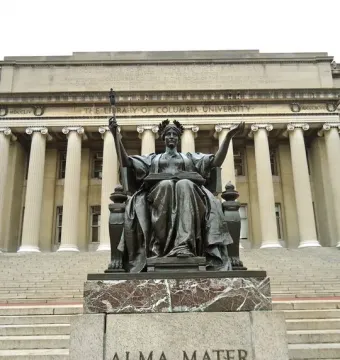
September 2013 © Foreveronstage · CC BY-SA 3.0
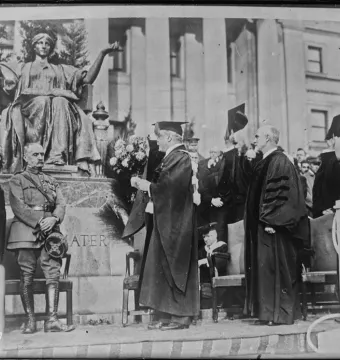
© Agence Rol. Agence photographique (commanditaire) · Public domain
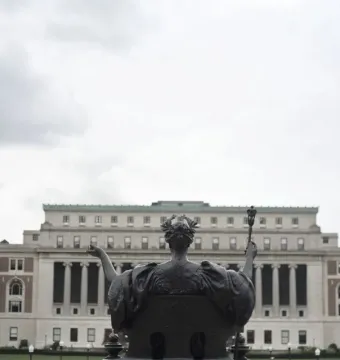
© Government of Thailand · CC BY 2.0
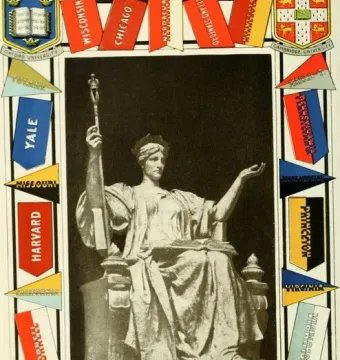
1909 © Congress of Arts and Science (1904 : Saint Louis, Mo.) · No restrictions

November 2023 © BoasHurstonFreyreSaid · CC BY-SA 4.0
Identification | |
| Title | Alma Mater |
| Type | Bronze sculpture |
Creator | |
| Artist | Daniel Chester French |
| Model | Mary Lawton, an actress and friend of French |
| Related earlier works by artist | The Minute Man (1874), John Harvard (1884), and The Republic for the 1893 World's Columbian Exposition |
| Artist nationality | American |
| Artist's aim | To create a gracious, kind, and welcoming figure for students choosing Columbia as their college |
| Possible model | Audrey Munson was speculated as a possible model, but this is uncertain |
Historical context | |
| Commissioned on recommendation of | Charles Follen McKim |
| Designed | 1901 |
| Commissioned by | The Trustees of Columbia University |
| Commission funding | Up to $25,000 offered by Harriette W. Goelet on behalf of herself and her children in memory of Robert Goelet, a Columbia College alumnus who died in 1899 |
| Commission origin | Conceived after completion of Low Memorial Library in 1897 |
| Completion delay cause | Delays in French's work, partly due to criticism from Augustus Saint-Gaudens and mainly due to strikes at the Jno. Williams, Inc. foundry |
| Expected completion | In time for Columbia University's 1902 commencement ceremony |
| Agreed price | $20,000 |
| Final design approved | 4 March 1901 |
Physical characteristics | |
| Placed on | An empty granite pedestal at the center of the Low Memorial Library staircase |
| Pose | Seated on a throne, extending her hand in welcome and looking up from an open book in her lap |
| Attire | Academic gown |
| Head adornment | Laurel crown |
| Right-hand attribute | A scepter made of four stalks of wheat topped by a royal crown |
| Book | An open book symbolizing learning rests on her lap |
| Throne | The statue has a throne with arms ending in lamps |
| Location | On the steps of Low Memorial Library, Columbia University campus, Morningside Heights, Manhattan, New York City |
Materials | |
| Primary material | Bronze |
| Base material | Granite |
Iconography and meaning | |
| Owl symbolism | A symbol of knowledge and learning; Margaret Cresson said it had no hidden enigma |
| Identity clarification | Margaret Cresson stated the sculpture was not a representation of Athena or Minerva, but simply a personification of the university |
| Owl | An owl is placed in the folds of the robe near her left leg |
| Subject | A personification of Columbia University's alma mater, representing the university as a nurturing mother and educational institution |
| Lamp symbolism | Sapientia et Doctrina (Wisdom and Learning) |
Appearance | |
| Style | Classical, dignified, majestic, stately, Greek-inspired |
| Surface finish | Originally presented in a golden tone |
Location and ownership | |
| Associated university | Columbia University |
| Function | Welcomes students to Columbia University |
History and restoration | |
| 1928 prank | The crown on the scepter was stolen and later returned |
| Previous restored coloration | Uniform green patina before 2002 |
| Current coloration | A mixture of green and brown patina |
| Late 1920s proposal | Daniel Chester French suggested regilding the statue, but it was not carried out |
| 1962 treatment | A more modern bronze coating was applied, then removed shortly afterward and the earlier patina restored |
| 1950 treatment | Remaining traces of gold were removed to speed the patination process |
| 2002 restoration | The sculpture was restored again in 2002 |
| Retaliation | Soon after the 1984 return, the Ezra Cornell statue at Cornell was spray-painted with Columbia blue |
| 1984 prank | In October 1984, Cornell students removed the scepter entirely; it was returned two months later and handed back by a Cornell professor the next day |
| 1978 restoration | The statue was removed from Columbia, the throne was recast, the sculpture was cleaned, repatinated with a new patina, and returned to the Low steps |
| 1970 protest context | During student protests in 1970 over the Cambodian campaign and the Kent State shootings, the statue came to represent failures of the university administration, including continued gentrification of Morningside Heights |
| 1968 protests | During the Columbia University protests of 1968, the statue was routinely vandalized and a sign reading 'Raped by the cops' was placed on her lap |
| Plaster reproduction | A four-foot plaster reproduction was loaned by French to the university in 1904, displayed in the Sculpture Court of the 1904 Louisiana Purchase Exposition in St. Louis, later rediscovered in the basement of Low Library, and sent to Margaret French Cresson in 1950 |
| Donor attendance at unveiling | The Goelets did not attend because they had gone to Europe |
| Unveiling ceremony | Henry C. Potter gave the prayer, and Dean John Howard Van Amringe formally presented the statue to President Nicholas Murray Butler |
| Unveiled | 23 September 1903, the first day of classes for the 1903–1904 academic year |
| Installed | September 1903 |
| 1970 bombing | In the early morning of 15 May 1970, a bomb caused significant damage to the throne |
Significance | |
| Columbia Daily Spectator description | Described the statue as characterized by queenly dignity and repose and as expressing the highest type of intellectual womanhood |
| Placement praise | Its placement in front of Low Memorial Library has been praised for welcoming students and emphasizing Columbia's relationship with New York City |
| The Catholic Union comparison | Compared the figure to the Virgin Mary and incorrectly claimed it imitated a 'Mother of Christ' statue in Bonn, Germany |
| Cultural significance | Since its installation, it has become closely associated with Columbia University's image and distinctive visual identity |
| Charles Henry Caffin assessment | Praised it as beautiful and described it as distinguished by pure and poignant serenity, monumental feeling, and gentle sprightliness |
| Frank Leslie's Illustrated Newspaper assessment | Called the work 'French's masterpiece of sculpture' |
| New York Times assessment | Described as technically extraordinarily difficult; later called the 'grand old lady' of Columbia University, reigning in queenly splendor in front of Low Library |
| Critical reception at unveiling | Largely praised upon its unveiling |
| Symbolic reading | The site has been interpreted as a 'stairway to knowledge'; from the top of the stairs, members of the Columbia community could look out over New York City |