
Column of Antoninus Pius
The Column of Antoninus Pius was erected in honor of the Roman emperor Antoninus Pius by his adopted sons and successors, Marcus Aurelius and Lucius Verus. It once stood not far from the site of his cremation on the Campus Martius in Rome. The base, made of marble and created by the artist Heraclides, shows the emperor and his wife Faustina being carried to heaven by the winged Genius Aion. The shaft was made of red granite and was already produced in 106 CE, according to a quarry inscription. The base was discovered in 1703 on Piazza Montecitorio and is now displayed in the Vatican Museums.
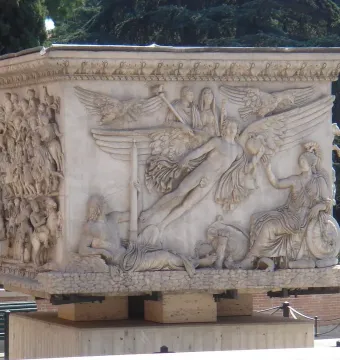
© Lalupa · CC BY-SA 3.0
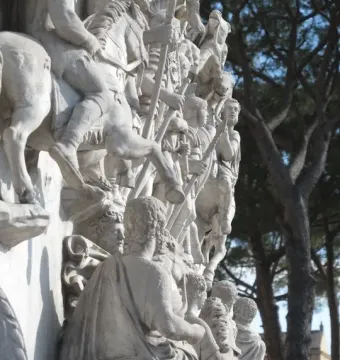
March 2012 © Institute for the Study of the Ancient World · CC BY 2.0
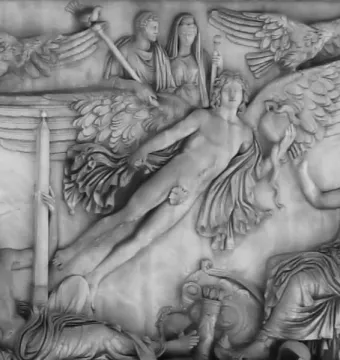
© User:Lalupa · CC BY-SA 3.0

1889 © s:Stevenson, Seth William (DNB00) · Public domain
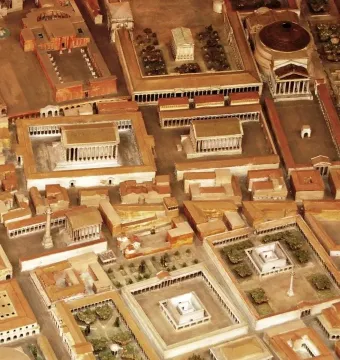
March 2014 © Cristiano64 · CC BY-SA 3.0
Identification | |
| Title | Column of Antoninus Pius |
| Original Latin name | Columna Antonini Pii |
| Italian name | La colonna di Antonino Pio |
| Alternative name | Column of Antonine |
| Type | Roman honorific column |
Historical context | |
| Dedicated to | Antoninus Pius, the deified Roman emperor; also his wife Faustina the Elder |
| Date erected | AD 161 |
| Original location | Campus Martius, Rome, near the Ustrinum Antoninorum (cremation site), at the edge of Monte Citorio hill |
| Commissioned by | Marcus Aurelius and Lucius Verus, the emperor's successors and adoptive sons |
Creator | |
| Base sculptor | Heraklides |
Discovery and provenance | |
| Evidence for date of manufacture | A quarry inscription on the shaft/base indicates it was already made in AD 106 |
| Discovery date | 1703 |
| Discovery place | Piazza Montecitorio, Rome |
| Discovery circumstances | Found during demolitions and excavations in the Montecitorio area, alongside the Ustrinum Antoninorum |
| Early evidence | Before the base was discovered, the column was known only from a sestertius minted by Marcus Aurelius at the time of erection |
| Sestertius obverse | Portrait of Antoninus Pius with the inscription DIVUS ANTONINVS |
| Sestertius reverse | The column with a statue of Antoninus and the inscription DIVO PIO |
Physical characteristics | |
| Estimated total height | about 23 m including the pedestal and statue |
| Base width | 3.38 m |
| Base height | 2.47 m |
| Column diameter | 1.90 m |
| Column height | 14.75 m |
Materials | |
| Column material | Red Egyptian granite |
| Base material | White Italian marble |
Technique | |
| Shaft form | Smooth, undecorated shaft |
Appearance | |
| Crowning element | Statue of Antoninus Pius |
Iconography and meaning | |
| Base reliefs | Apotheosis of Antoninus Pius and Faustina, carried into heaven by the winged genius Aion; funeral procession of soldiers (decursio funebris); dedicatory inscription |
| Main relief orientation | The apotheosis scene faced toward the Ustrinum Antoninorum |
Location and ownership | |
| Current location of shaft fragments | Vatican Museums |
| Current location of base | Courtyard outside the entrance to the Vatican Pinacoteca, Vatican Museums |
| Preserved remains | Only the base and fragments of the granite shaft survive |
History and restoration | |
| Medieval condition | The base was buried; only about 6 m of the lower shaft projected above ground |
| Post-discovery condition | The remains were fully uncovered and left lying on the ground under tents or sheds |
| Base restoration | Restored by Vincenzo Felici in 1706–1708 |
| Base installation | Placed in the centre of Piazza di Montecitorio in 1741 by Ferdinando Fuga |
| Later transfer of base | Moved to the Vatican Museums in 1787; later installed in Michelangelo's niche in the Cortile della Pigna, then moved to its present location |
| Damage and destruction | The shaft fragments were damaged by a fire in 1759, and later crumbled; further repair attempts in 1764 were unsuccessful |
| Reuse of fragments | Fragments of the shaft were reused in 1789 to restore the Montecitorio obelisk |
| Historical misidentification | In the 17th century the monument was incorrectly identified as the Column of Marcus Aurelius |