
Grunwald Monument
The Grunwald Monument is an equestrian statue in Matejko Square, Kraków, depicting King Władysław II Jagiełło on horseback with Vytautas before him. On either side of Jagiełło are soldiers raising their arms in celebration, while Ulrich von Jungingen lies dead at the base of the statue. Created in 1910 to mark the 500th anniversary of the Battle of Grunwald, it commemorates the victory of the Crown of the Kingdom of Poland and the Grand Duchy of Lithuania over the Teutonic Order. The monument was destroyed by German soldiers in 1939 and reconstructed in 1976 from a design by Marian Konieczny.
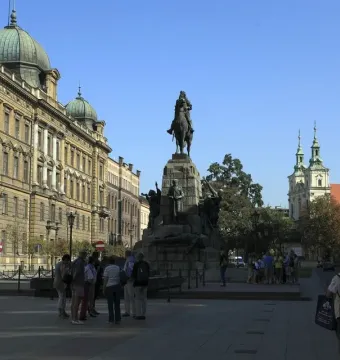
September 2012 © Falk2 · CC BY-SA 4.0
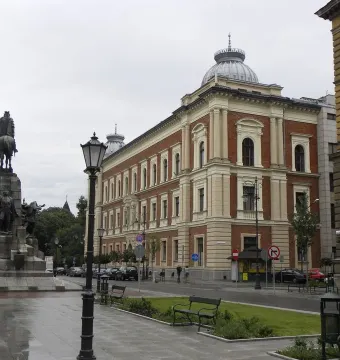
August 2009 © Szlomo Lejb · CC BY-SA 3.0
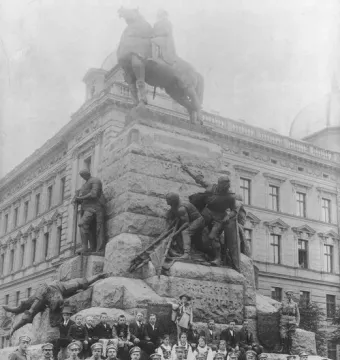
© A. Walaszek · Public domain
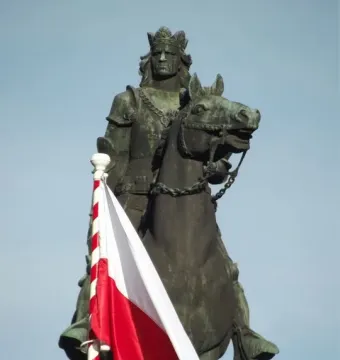
November 2012 © Piotr Drabik · CC BY 2.0
March 2017 © Mach240390 · CC BY 4.0
Identification | |
| Title | Grunwald Monument |
| Original name | Pomnik Grunwaldzki |
| Alternative name | Monument de Grunwald |
| Type | Monument; equestrian statue |
Historical context | |
| Commemorated event | The Battle of Grunwald (15 July 1410); the 500th anniversary was the monument's original dedication |
Creator | |
| Designed by | Antoni Wiwulski and Franciszek Black |
| Reconstruction designed by | Marian Konieczny |
Discovery and provenance | |
| Original location | Matejko Square, Kraków, Poland |
| Founded by | Ignacy Jan Paderewski |
| Funded by | Ignacy Jan Paderewski |
Location and ownership | |
| Current location | Matejko Square, Kraków, Poland |
| Nearby feature | The Tomb of the Unknown Soldier is located in front of the monument and incorporated into the stairs/pedestal area |
| Associated nearby landmark | St. Florian's Church |
History and restoration | |
| Last restoration | Comprehensive renovation and cleaning in 2016 |
| Stored fragments during occupation | Hidden under the floor in the cellar of the locksmith workshop of the Factory and Precision Grinding of Glass Products Spectrum sp. z o.o. at 63 Grzegórzecka Street |
| Postwar temporary memorial | Surviving granite blocks from the original pedestal were set up at the former site with a plaque |
| Fragment relocation | Some remains were transferred to the Grunwald battlefield; some fragments were used for a small monument at the ZBoWiD section in Grębałów cemetery; the most damaged fragments were turned into a rock garden in front of the Nowa Huta Cultural Centre in the Zgody housing estate |
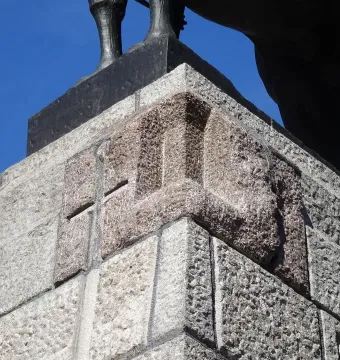
| Original fragment incorporated into rebuilt monument | A small fragment of the original monument was integrated into the rebuilt pedestal at the southeast corner |
| 2010 commemoration | Ceremonial reenactment held on 10 September 2010 for the 600th anniversary of the Battle of Grunwald and the 100th anniversary of the monument's unveiling |
| Destroyed | November 1939 to April 1940 by German occupation forces |
| Reconstruction committee | Komitet Odbudowy Pomnika Grunwaldzkiego; established in 1972 in Kraków |
| Reinstalled | 16 October 1976 |
| Rebuilt | 1976 |
| Destruction details | The pedestal was blown up with dynamite; the dismantled figures were looted and taken to Germany |
| Built in secrecy | The project was carried out in secrecy during the Austrian partition of Poland |
| Cornerstone laid | April 1910 |
| Unveiling attendance | About 150,000 people |
| Unveiled | 15 July 1910 |
| Constructed | 1910 |
| Saved fragments | Some targes and swords were saved by Feliks Dziuba, Józef Mika, Adam Klocek, and Tomasz Perski |
Physical characteristics | |
| Height | Just over 13 meters |
| Original pedestal material | Granite |
| Current pedestal material | Granite from the area near Szklarska Poręba |
| Original figures material | Bronze |
| Current figures cast in | Gliwice |
Materials | |
| Original pedestal granite source | Vänevik, Sweden |
| Original pedestal granite supplier owner | Le Granit, a company from Abainville near Gondrecourt, France |
| Current pedestal granite source | The area near Szklarska Poręba |
| Figures casting foundry | Malleset, a French foundry |
Technique | |
| Reconstruction of Jagiełło figure | Transported and mounted by Mi-6 helicopter |
| Transport wagons | Seven specially constructed wagons with lowered floors |
| Transportation of original granite | By rail from Sweden, then by sailing ship across the Baltic to Szczecin, then by rail to Kraków |
| Transportation of bronze elements | By train from France through Switzerland to Kraków |
| Reconstruction basis | A miniature model preserved in the Historical Museum of the City of Kraków and pre-war photographs |
Appearance | |
| Main figure | King Władysław II Jagiełło on horseback |
| Inscription | Praojcom na chwałę – braciom na otuchę |
| Pedestal decoration | Three sides are surrounded by shields with the coats of arms of Poland and its historical provinces |
| Jagiełło's pose in reconstructed monument | Legs straightened as if standing in the stirrups; left hand on the bridle and right hand holding a sword |
| Jagiełło's pose in original monument | Sitting in the saddle with bent knees; left hand on the bridle and right hand holding an unsheathed sword pointed downward |
| Monument composition | Jagiełło crowns the monument; Vytautas stands in front of him; Ulrich von Jungingen lies at his feet; side groups flank the pedestal; a peasant figure appears on the rear/northern side |
| Secondary figures | Vytautas; Ulrich von Jungingen; a Polish knight and his squire; a Lithuanian warrior blowing a horn and leading a Teutonic prisoner; a peasant breaking free from bonds |
Iconography and meaning | |
| Meaning | Commemorates the victory of Poland and the Grand Duchy of Lithuania over the Teutonic Order and serves as tribute and encouragement to descendants |
| Historical significance | Considered one of the greatest military victories in Polish history |
Other | |
| Unveiling attendance | About 150,000 residents of Kraków and visitors |
| Dignitaries at unveiling | Stanisław Badeni, Juliusz Leo, and Ignacy Jan Paderewski |
| Construction cost | 500,000 Austro-Hungarian krones |
| Location proposals | Wawel; Holy Spirit Square; the square in front of St. Bernard's Church; Matejko Square |