
Holocaust Memorial, Montevideo
Holocaust Memorial, Montevideo is an outdoor memorial dedicated to victims of the Holocaust. It is located at the junction of Rambla Presidente Wilson and Artigas Boulevard in Punta Carretas, Montevideo, on the shores of the River Plate in Uruguay. The memorial is around 120 metres long and is mostly made of pink granite, with a central window looking out at the sea. Its approach includes a pair of railway rails, and the central section features two wooden bridge crossings. The memorial also includes several inscribed stele, including one signed by Elie Wiesel. It was designed by Gastón Boero, Fernando Fabiano and Sylvia Perossio, with landscaping by Carlos Pellegrino, and opened in 1994.
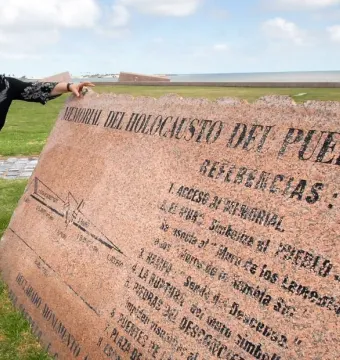
December 2011 © Embajada de los Estados Unidos en Uruguay · Public domain
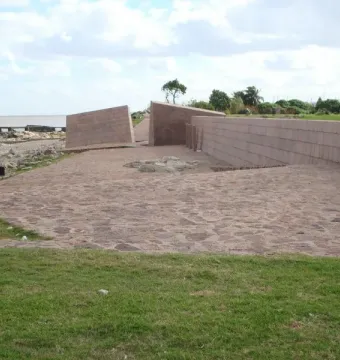
June 2010 © Hoverfish · CC BY-SA 3.0
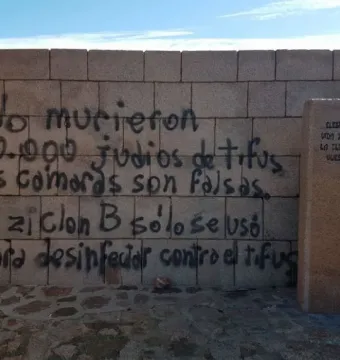
October 2017 © Juden253 · CC BY-SA 4.0
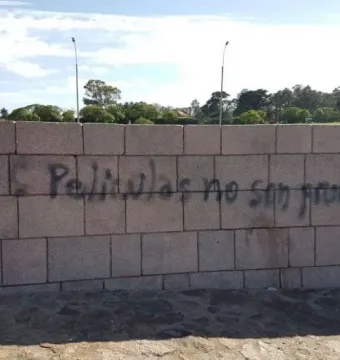
October 2017 © Juden253 · CC BY-SA 4.0
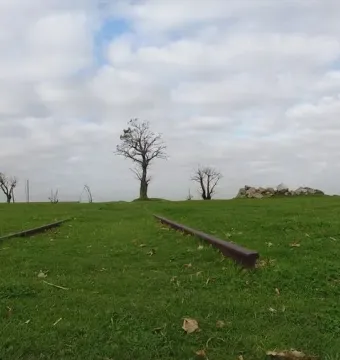
August 2017 © Fedaro · CC BY-SA 4.0
Identification | |
| Title | Holocaust Memorial, Montevideo |
| Type | Outdoor memorial |
| Alternative name | Memorial to the Holocaust of the Jewish People |
| Italian translation | Memoriale dell'Olocausto del popolo ebraico |
| Original name | Memorial del Holocausto del Pueblo Judío |
Iconography and meaning | |
| Dedicated to | Victims of the Holocaust |
| Symbolic meaning | The wall represents the history of the Jewish people; the central opening alludes to the tragedy of the Holocaust |
Location and ownership | |
| Location | Intersection of Rambla Presidente Wilson and Artigas Boulevard, Punta Carretas, Montevideo, Uruguay |
| Setting | On the shores of the Río de la Plata |
| Opening date | 1994 |
Physical characteristics | |
| Structure | A 120-metre-long wall running along the rambla, parallel to the river |
| Length | About 120 metres |
Materials | |
| Material | Pink granite |
Appearance | |
| Central feature | A central opening with a window overlooking the sea |
| Entrance feature | A pair of railway tracks at the approach to the memorial |
| Middle section feature | Two wooden bridge crossings |
| Inscriptions | Several inscribed stelae, including one signed by Elie Wiesel and three carved plaques with texts from the Bible and from thinkers of Jewish origin |
Creator | |
| Designers | Gastón Boero, Fernando Fabiano, and Sylvia Perossio |
| Landscape designer | Carlos Pellegrino |
Historical context | |
| Competition year | 1992 |
| Competition result | First prize awarded to the Uruguayan architects Gastón Boero, Fernando Fabiano, and Sylvia Perossio |
| Commissioning body | Intendencia de Montevideo |
History and restoration | |
| Heritage designation | Declared a National Historic Monument by the Ministry of Education and Culture |
| Vandalism | In October 2017, the memorial was vandalized with graffiti from Holocaust denial groups |
| Security measure | Cameras were installed at the site after the 2017 vandalism |
| Renovation | Renovated after several acts of antisemitic vandalism; the work included cleaning antisemitic graffiti and adding lights and staircases |
| Rededication date | June 2016 |
| Renovation funding | Funded by the Central Israelite Committee of Uruguay |
| Subsequent vandalism | About a year after the renovation, the memorial was again vandalized with antisemitic slurs |
Significance | |
| International representation | Selected to represent Uruguay at the 1995 World Architecture Biennale |
| Other exhibitions | Exhibited at the Chile Biennale and at the Museum of Modern Art in New York |
| Recognition | Selected among the best Latin American works by the Mies van der Rohe Foundation of Barcelona in 1998 |