
Tomb of Ferdinand van den Eynde
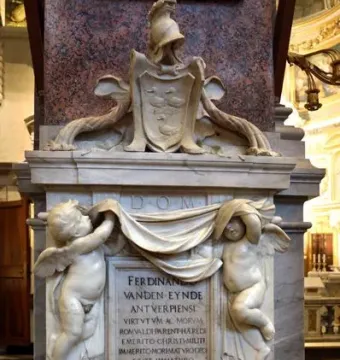
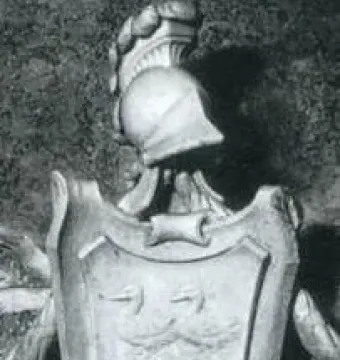
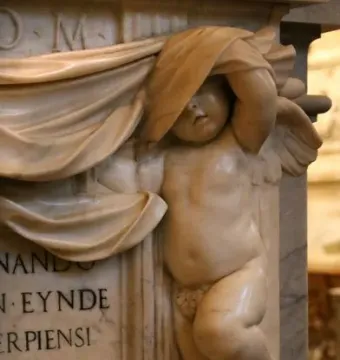
The Tomb of Ferdinand van den Eynde is a funerary monument by François Duquesnoy in the church of Santa Maria dell'Anima in Rome. The commission was secured through Pietro Pescatore, also known as De Visschere or Pieter Visscher, a Flemish merchant, and the site for the epitaph was granted on 3 August 1633. Visscher and Baldoin Breyel supervised the execution of the tomb, for which both had been friends of the deceased, a member of the Dutch community at Santa Maria dell'Anima. The monument was completed between 1633 and 1640. Its putti, especially the one on the right, were widely admired and became models for artists in Rome and northern Europe.
December 2017 © Sailko · CC BY 3.0
February 2018 © Unknown authorUnknown author · CC BY-SA 4.0
December 2017 © Sailko · CC BY-SA 4.0
December 2017 © Sailko · CC BY 3.0
December 2017 © Sailko · CC BY-SA 4.0
Identification | |
| Title | Tomb of Ferdinand van den Eynde |
| Type | funerary monument / epitaph / tomb |
Historical context | |
| Person commemorated | Ferdinand van den Eynde |
| Subject's identity | Netherlandish merchant and art collector from Antwerp |
| Subject's community in Rome | member of the Dutch / Netherlandish expatriate community of Santa Maria dell'Anima in Rome |
| Family relation | brother of Jan van den Eynde, a Flemish merchant established in Naples and one of the richest men in the city and its most important art collector |
| Death | died prematurely in Rome in 1630 |
| Commemorated person's son | Marquis Ferdinando van den Eynde, art collector |
| Community connection of supervisors | both were friends of the deceased and part of the Santa Maria dell'Anima milieu in Rome |
Creator | |
| Sculptor | François Duquesnoy |
Discovery and provenance | |
| Supervisors of execution | Pietro Pescatore and Baldoin Breyel, both friends of Ferdinand van den Eynde |
| Commission facilitator | Pietro Pescatore (also known as De Visschere or Pieter Visscher), a wealthy Flemish merchant and art lover who served in the administration of Santa Maria dell'Anima and helped Duquesnoy obtain the commission |
| Site granted by | the church administration |
| Commission date | probably around 3 August 1633, when the church administration granted the site for the epitaph |
Location and ownership | |
| Current location | Church of Santa Maria dell'Anima, Rome, Italy |
| Placement in church | on a pier / wall directly opposite the tomb of Adriaan Vrijburgh, built up against columns on either side |
| Related monument | the tomb of Adriaan Vrijburgh (Vryburch) |
History and restoration | |
| Completion date | between 1633 and 1640; Joachim von Sandrart noted it was finished after he left Rome in 1635 |
Physical characteristics | |
| Material | marble |
| Figures | two putti |
| Form | monumental sculptural tomb with an epitaph |
Appearance | |
| Left putto | raises the drape and holds a long trumpet of Fame, mostly concealed beneath the cloth |
| Right putto | mourns, covers part of its head and face with the drape, and holds an hourglass of death |
| Main decorative feature | two putti composing the epitaph, especially the right-hand putto |
Iconography and meaning | |
| Bellori quotation | Bellori described the right-hand putto with the hourglass as "the most beautiful little putto that Franceso's chisel animated" |
| Estelle Lingo interpretation | the child's posture may reflect a struggle to lift the drape from the tomb and a response to criticism that its youth made it unfit for the monumental task |
| Rubens quotation | Rubens said the marble had been "softened into living flesh" and praised the beauty of the two putti for the epitaph of van den Eynde in the Chiesa dell'Anima |
| Interpretation of meaning | a meditation on death and fame in which the viewer completes the monument’s meaning by discovering its veiled allusions and reading the inscription |
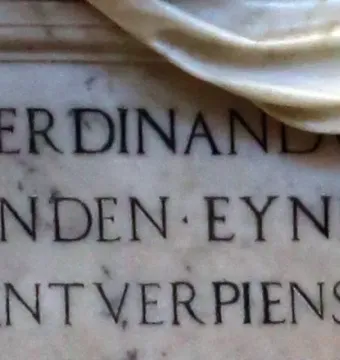
| Inscription feature | the putti raise the cloth to reveal the inscription |
| Cloth symbolism | partly veils the attributes and contributes to the tomb’s hidden allusions |
| Right putto meaning | a childish personification of blind death |
Significance | |
| Artistic assessment | the putti were considered the peak of the evolution of the putto in sculpture and one of Duquesnoy's greatest achievements |
| Critical praise | Giovanni Battista Passeri and Giovanni Pietro Bellori emphasized the fame of the putti |
| Praise by artists | Peter Paul Rubens and Johann Joachim Winckelmann praised the putti |
| Influence | the putti served as models of the ideal infant putto for contemporary artists |
| Copies and reception | copies in plaster and wax were owned by many artists in Rome and Northern Europe, and the tomb was later widely admired and reproduced in drawing and painting |
| Recorded plaster casts | listed in the studio inventories of Peter Verpoorten, Ercole Ferrata, Erasmus Quellinus II, and Peter Paul Rubens |
| Surviving drawings | drawings by Johan Sylvius, Jean-Robert Ango, and Augustin Pajou |