
Kouros of Aristodikos
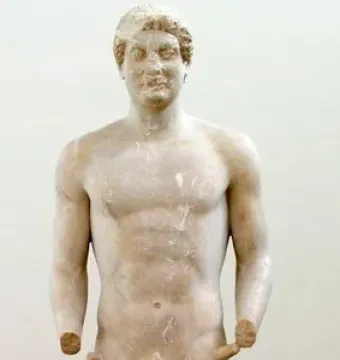
The Kouros of Aristodikos is an ancient Greek marble sculpture from the Archaic period, discovered in 1944 in Mesogeia, Attica. Carved from Parian marble and standing 1.98 m tall, it rests on a low rectangular base made of Pentelic marble. The statue is dated to 510–500 BCE and served as a funerary monument for the aristocrat Aristodikos, whose name is inscribed on the base. Although preserved with losses to the hands and some facial and hair details, the figure shows a move toward a more realistic treatment of the human body, with emphasized musculature, bent arms, and the left leg advanced. It is housed in the National Archaeological Museum in Athens.
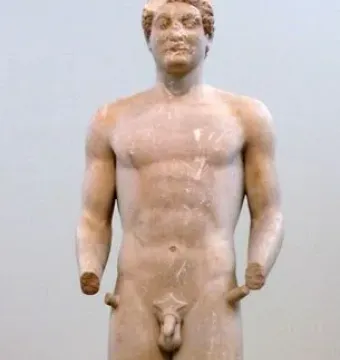
September 2010 © Tilemahos Efthimiadis · CC BY-SA 2.0
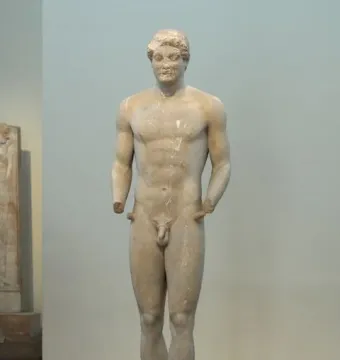
March 2014 © Zde · CC BY-SA 3.0
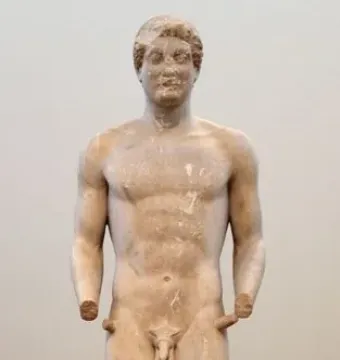
April 2022 © Ismoon · CC BY-SA 4.0
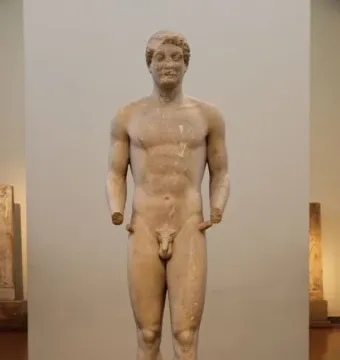
July 2016 © Gary Todd · CC0
· CC BY-SA 3.0
Identification | |
| Title | Kouros of Aristodikos |
| Type | Kouros statue |
Historical context | |
| Period | Archaic period |
| Date | c. 510–500 BC |
| Historical context | Ancient Greece |
Creator | |
| Sculptor | Anonymous artist from Attica |
Discovery and provenance | |
| Date of event | 480 BCE |
| Historical event affecting the monument | Probably knocked down by the Persians during the invasion of Attica in 480 BCE |
| Original location | Erected on Aristodikos's tomb |
| Discovery location | Mesogeia, Attica |
| Discovery year | 1944 |
| Inventory number | 3938 |
Materials | |
| Material | Parian marble |
| Base material | Pentelic marble |
| Paint traces | Traces of reddish paint survive on the hair |
Physical characteristics | |
| Pose | Front-facing with the left leg slightly advanced |
| Anatomical treatment | Musculature is clearly emphasized, with greater attention to the knees and tendons |
| Hair | Short curly hair |
| Arm position | Arms bent away from the body |
| Condition when found | Found almost intact, with the hands missing and chips around the face |
| Current condition | Preserved with losses; the hands are missing below the wrists, with chips on the hair above the forehead, the eyes, the nose, and the mouth |
| Base | Low rectangular base |
| Base height | 29 cm |
| Height | 1.95 m |
Appearance | |
| Body treatment | Still within the archaic kouros type, but with a more naturalistic rendering of the human body and proportions |
| Style | Retains Archaic conventions while breaking with earlier canons through greater realism and more vigorous execution |
| Comparison with earlier kouroi | Differs from earlier kouroi by its shorter hair, freer arm position, and greater realism |
| Head depiction | The short hair reveals the structure of the head and its attachment to the neck |
Iconography and meaning | |
| Depicted figure | Naked young man (kouros) |
| Function | Funerary monument |
| Commemorated person | Aristodikos, a young Athenian aristocrat |
| Inscription | The name Aristodikos is engraved on the base in genitive form: Αριστοδικο(υ) |
Location and ownership | |
| Current location | National Archaeological Museum, Athens |
| Current location | National Archaeological Museum of Athens |
Significance | |
| Art-historical significance | Marks the transition from archaic sculpture toward early Classical Greek sculpture and belongs near the end of the kouroi series |
Other | |
| Female equivalent | Korai (singular: kore) |