
Statue of Yuriy Dolgorukiy, Moscow
The Statue of Yuriy Dolgorukiy is a sculptural monument to Prince Yuri Vladimirovich Dolgorukiy, the Prince of Rostov-Suzdal and Grand Prince of Kiev. It was installed in 1954 on Tverskaya Square, opposite the Moscow City Hall building, which was known in the Soviet period as the Mossovet building. The sculpture was created by S. M. Orlov, A. P. Antropov, and N. L. Shtamm, with architectural design by V. S. Andreyev. It replaced the 1919 Monument to the Soviet Constitution with the statue of Liberty, which had itself been erected on the site of the equestrian statue of General Skobelev demolished in 1918. The monument became one of Moscow’s symbols and inspired a number of legends in local folklore.
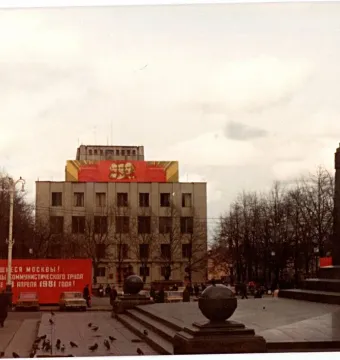
© Sergey Rodovnichenko · CC BY-SA 2.0
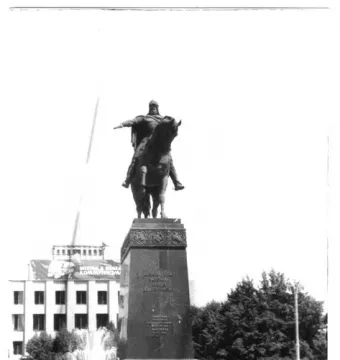
March 2012 © Derzsi Elekes Andor · CC BY-SA 3.0
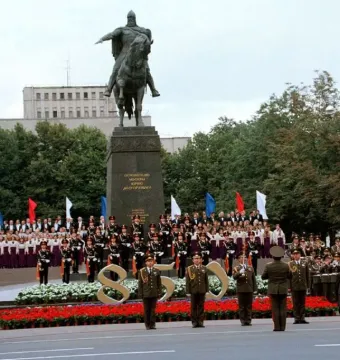
September 1997 © Главархив Москвы · CC BY 4.0
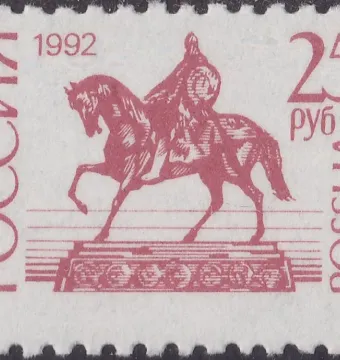
July 1992 © Ю. Н. Арцименева · Public domain
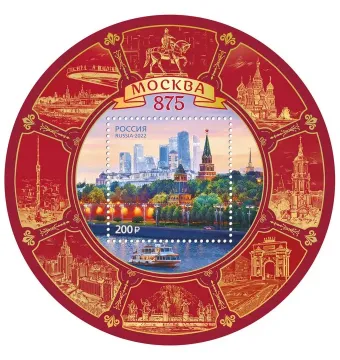
September 2022 © Савина О. · Public domain
Identification | |
| Title | Statue of Yuriy Dolgorukiy, Moscow |
| Type | Equestrian monument |
| Subject | Yury Vladimirovich Dolgorukiy, Prince of Rostov-Suzdal and Grand Prince of Kiev |
Historical context | |
| Commemorated event | 800th anniversary celebrations of Moscow, based on the traditional founding year 1147 |
| Historical significance of subject | Under his rule, Moscow was first mentioned in the chronicles in 1147 |
| Historical context of founding | By the mid-20th century historians knew the settlement at the site of Moscow had existed at least 200 years before Yuriy Dolgorukiy's reign, so he could not have founded it in the strict sense; it is also unclear whether a fortress was built there under him or earlier |
| Purpose | Commemorative monument for the 800th anniversary of Moscow |
Creator | |
| Sculptors | Sergey Mikhailovich Orlov, A. P. Antropov, and Nikolai Lvovich Shtamm |
| Architectural design | Viktor Semenovich Andreev |
Discovery and provenance | |
| Cost | 5.5 million rubles |
| Installation date | 6 June 1954 |
| Ceremonial foundation date | 6 September 1947 |
| Commissioning initiative | Joseph Stalin ordered Mikhail M. Gerasimov to search in Kyiv for Yuriy Dolgorukiy's remains for a ceremonial reburial during the anniversary celebrations, but the expedition failed and the reported burial site was false |
| Competition winner | S. M. Orlov |
| Design competition date | September 1946 |
| Planning date | 1946 |
| Award received | Stalin Prize in 1946 |
Location and ownership | |
| Location | Tverskaya Square, Moscow, Russia |
| Position | Opposite the Moscow City Hall building, formerly the Mossovet building |
| Former square name | Sovetskaya Square (1918–1993) |
| Funding source | Paid by the city of Moscow |
| Producer | Mytishchi Factory of Artistic Casting named after People's Artist E. F. Belashova |
Materials | |
| Material | Bronze |
Physical characteristics | |
| Pedestal decoration | Ornamental carving based on the relief motifs of St. George Cathedral in Yuryev-Polsky |
| Pedestal motifs | Centaur, Sirin bird, basilisk, Phoenix bird, griffins, and stylized lion and deer |
| Clothing and armor | War armor, shishak helmet with mail aventail (barmitsa), and byadana armor on the torso |
| Horse harness | Rendered in careful detail |
| Depiction | Yury Dolgorukiy shown as an idealized Russian bogatyr on a warhorse, with his horse stopped, the rider half-standing in the stirrups and making an authoritative gesture as if indicating a place for a new fortress |
| Shield | Round shield fixed on the prince's left arm, decorated with the ancient heraldic symbol of Moscow, Saint George the Victorious |
Iconography and meaning | |
| Depiction basis | No images of the prince survived, so the sculptors created an idealized collective image rather than an exact portrait |
| Symbolic note | Yury shares his name with Saint George |
| Historical-cultural interpretation | Intended to illustrate the rich cultural soil of Vladimir-Suzdal Rus, the cradle of Moscow's culture |
Appearance | |
| Style | Detailed, portrait-like, and historically oriented, with a grand heroic gesture |
| Artistic style | Stalinist Empire style |
| Artistic assessment | Reflects late 1940s to early 1950s Soviet tendencies toward superficial lifelikeness, excessive detail, and ornamentation |
History and restoration | |
| Predecessor monument | The original 1912 monument to General Mikhail Skobelev in Tverskaya Square, known as 'The White General' and removed after the October Revolution decree against monuments to tsars and their servants |
| Later use | During perestroika and under Yuri Luzhkov it became closely associated with Moscow Day, with official events held against its backdrop and its image used on festive posters |
| Later reception | Initially caused an ambiguous reaction and was criticized by old Bolsheviks, cosmopolitan intelligentsia, and some foreign communists as ideologically alien and poorly matched to a semi-legendary figure |
| Destroying/preceding monument details | Skobelev was depicted mounted on a white horse, wearing a white parade tunic; the monument was removed as part of Lenin-era propaganda through monuments |
| Inscription issue | Orlov opposed the proposed inscription 'To the Founder of Moscow from the Soviet Government,' and the monument was unveiled without mention of the Soviet Government |
| Replaced monument | The equestrian statue of General Mikhail Skobelev, demolished in 1918 |
| Stalin anecdote | According to a legend, Stalin asked why Dolgorukiy was seated on a mare and suggested replacing it with a stallion; later versions say the horse was modified accordingly |
| Funding issues | Progress was slowed by insufficient funding because Moscow's anniversary coincided with several major projects, including the Stalin skyscrapers |
| Competition and construction issues | There were repeated disagreements among the co-authors, and Orlov's usual small-scale sculptural techniques were questioned for a monumental work |
Significance | |
| Cultural status | One of the symbols of Moscow |
| Ideological significance | The first monument in Soviet Moscow to a person not connected with communist ideology or the revolutionary movement |
| Folklore | A number of legends developed around it in Moscow urban folklore |
| Public perception | By the years of stagnation Muscovites often saw it as a foreign element, though attitudes improved during perestroika |
Other | |
| Attribution note | Some details are presented as possibly apocryphal |