
Seagull Monument
The Seagull Monument is located in the Temple Square area, the center of downtown Salt Lake City, Utah. It commemorates an event in Mormon history from the spring of 1848, when early settlers in the Salt Lake Valley were struggling to save their crops after a hard winter, late frost, drought, and a cricket infestation. According to Mormon accounts, numerous seagulls came from the nearby Great Salt Lake and fed on the crickets for about two weeks, helping preserve much of the harvest. The monument was erected in память of this event. The California gull is now the state bird of Utah.
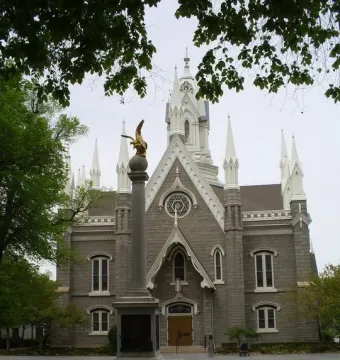
© Rich jj · CC BY-SA 3.0
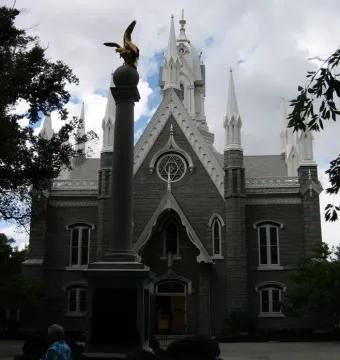
September 2004 © Bobjgalindo · CC BY-SA 4.0
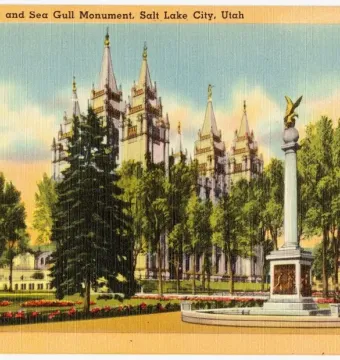
© Carpenter Paper Co., Salt Lake, Utah · Public domain
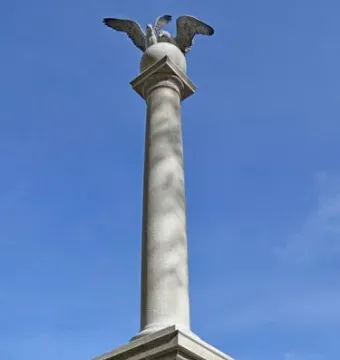
April 2025 © Beneathtimp · CC0
April 2025 © Beneathtimp · Public domain
Identification | |
| Title | Seagull Monument |
| Alternative title | Monument des Mouettes / Monument de la Mouette |
| Type | monument |
| Location | Temple Square, Salt Lake City, Utah, United States |
| German name | Möwendenkmal |
Historical context | |
| Commemorated event | The 1848 “miracle of the gulls,” when seagulls ate Mormon crickets that were destroying the Salt Lake Valley crops of Mormon pioneers |
| Event date | 1848 |
| Event location | Salt Lake Valley |
| Historical setting | Mormon pioneers were living in their first spring season in the Salt Lake Valley, after a hard winter and following prayers for divine help |
| Birds involved in the event | Probably California gulls (Larus californicus) |
| Related state bird | The California gull is now the state bird of Utah |
Creator | |
| Family relation | Mahonri M. Young was a grandson of Brigham Young |
| Artist training | Studied in France |
| Proposed by | George E. Carpenter, editor at the Deseret News |
| Commissioned by | The Church of Jesus Christ of Latter-day Saints |
| Designer | Mahonri M. Young |
| Artist | Mahonri M. Young |
Discovery and provenance | |
| Placement on Temple Square | 1913 |
| First monument dedicated to birds | Believed to be the first monument dedicated to birds in the United States |
| Original dedication plan | 24 July 1913 (Pioneer Day in Utah) |
| Estimated dedication attendance | 5,000 people |
| Unveiled by | Joseph F. Smith |
| Dedication presider | Bishop Nibley |
| Dedication date | 1 October 1913 |
| Bronze pieces installed | Late September 1913 |
| Foundation excavation began | April 1913 |
| Model exhibited | Fall 1907 Utah State Fair |
| Site choice reason | Young felt the temple would dwarf the monument; the open sky near the Assembly Hall was a better background |
| Final site choice | A spot near the Assembly Hall on Temple Square |
| Original proposed site | Just south of the Salt Lake Temple |
| Church signatory | Presiding Bishop Charles W. Nibley |
| Contract signed | July 1912 |
| Site planning | Temple Square and Liberty Park were among the proposed locations |
| Funding history | Young first sought church funding but none was available; a subscription list was started in 1908; after further appeals, church funding was approved |
| Design completed | Within ten days of conception |
| Idea conceived | July 1907 |
Physical characteristics | |
| Base components | Eight pieces of granite stone made up the base, shaft, and capital |
| Relief panels | Four bronze relief panels around the pedestal |
| Top sculpture | Two bronze seagulls eating insects |
| Top sculpture size | Wingtip to wingtip measurement not provided |
| Structure type | small monument |
| Base form | Pedestal with a column topped by a large granite ball |
Materials | |
| Base material | Granite |
| Top sculpture material | Bronze |
| Granite source | A quarry in Mount Airy, North Carolina |
Appearance | |
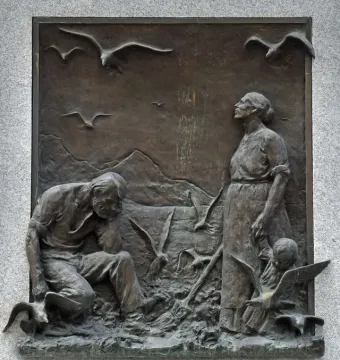
| Second panel | The Arrival of the Sea Gulls: a disheartened pioneer man; a woman holding a child and looking toward the seagulls; the northern end of the Oquirrh Mountains |
| Top sculpture size note | Measured from wing tip to wing tip; measurement not provided |
| Fourth panel | A dedicatory inscription |
| Third panel | The First Harvest: harvesting the preserved crops; a man with a scythe; others binding sheaves; a nursing mother with a child and dog; the first home built in the valley; Ensign Peak |
| Pool diameter | Measurement not provided |
| First panel | The Founding of the Commonwealth: early cultivation and settlement of Salt Lake Valley; two oxen pulling a plow; a sower; a woman preparing food near a temporary wagon-box home; Mount Olympus and the Twin Peaks; a seated Native American |
| Relief panel theme | The story of the miracle of the gulls |
| Former pool contents | Water lilies and goldfish |
| Former surrounding feature | A circular pool of water surrounded the pedestal when first installed |
| Original surface treatment | The seagulls were gilded with gold leaf when first installed |
Iconography and meaning | |
| Animals mentioned | Native seagulls; Mormon crickets |
| People associated with the event | Mormon pioneers; pioneer settlers; Latter-day Saints |
| Associated historical event | The 1848 miracle of the gulls, in which Mormon pioneers' crops in the Salt Lake Valley were saved when seagulls ate Mormon crickets |
| Subject | Two seagulls devouring insects |
| Purpose | Created to commemorate the event in which seagulls saved part of the Mormon settlers' crops |
| Religious interpretation | Latter-day Saints regard the event as an answer to prayers and call it the “miracle of the seagulls” |
Location and ownership | |
| Original location | In front of the Assembly Hall at Temple Square, Salt Lake City, Utah |
| Country | United States |
| Current location | Temple Square, Salt Lake City, Utah, United States |
| Originally planned location | Just south of the Salt Lake Temple |
History and restoration | |
| Temporary removal | In early 2024, the monument was temporarily removed for new landscaping during the multi-year renovation of Temple Square and the Salt Lake Temple |
| Condition after return | The gold leafing on the seagull sculpture had been removed |
| Condition after return | The pool had been replaced with flower beds |
| Returned to site | Later in 2024 |
| Fish problem | Live seagulls ate the goldfish; the trout were later poisoned on multiple occasions by an unknown perpetrator or perpetrators; the fish were eventually removed |
| Coins in pool | Coins tossed into the water were periodically collected and donated by the church to Primary Children's Hospital |
| Pool replaced | 2008, with a cascading water feature |
| Pool alteration | Circular fountains were added in 1968 |
| Replacement fish | Larger rainbow trout were installed in 1944 |
| Original water feature | A pool of water around the monument |
Significance | |
| Cultural significance | Remembered by Latter-day Saints as a miracle |
| Featured in film | Brigham Young (1940) |