
Monument to Lenin in Zaporizhzhia
Monument to Lenin in Zaporizhzhia was a bronze sculpture on a granite base, erected in 1964 on the former Lenin Square at the start of Sobornyj Avenue in Zaporizhzhia, Ukraine. Standing 19.8 meters high, it was for a time the largest Lenin monument in Ukraine after the one in Kharkiv was destroyed. Lenin’s arm pointed toward the DniproHES dam, visible from the site. The figure was created by sculptors Mykhailo Lysenko and Mykola Sukhodolov, with the monument designed by architects Boris Pryimak and Vadym Ladny. It was removed by crane on 17 March 2016 and taken to the water management area.
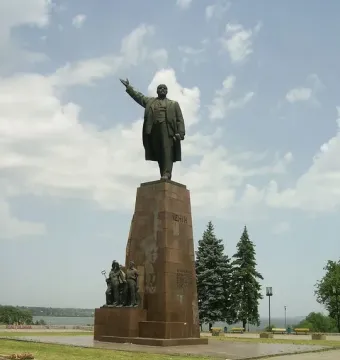
January 2005 © Voky89 · CC BY-SA 4.0
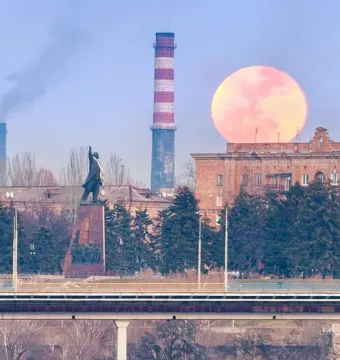
March 2015 © Alexey Tolmachov · CC BY-SA 4.0
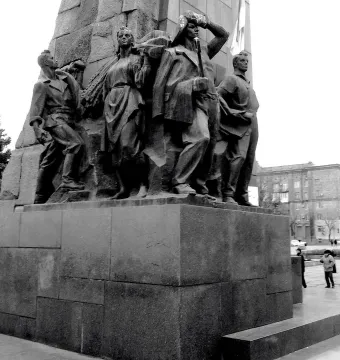
February 2014 © Nina Neumyvaka · CC BY-SA 4.0
May 2004 © Post of the Soviet Union. · Public domain
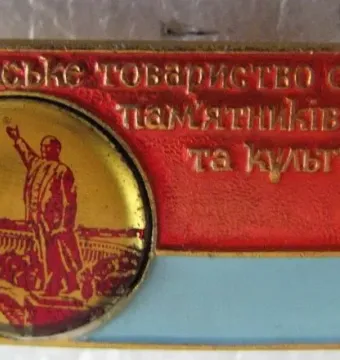
September 2010 © Movses · CC BY-SA 4.0
Identification | |
| Title | Monument to Lenin in Zaporizhzhia |
| Alternative names | Lenin monument in Zaporizhzhia |
| Type | monument |
| Sculpture type | Lenin monument |
| Subject | Vladimir Lenin |
Historical context | |
| Installed | 6 November 1964 |
| Removed | 17 March 2016 |
| Years at location | 1964–2016 |
Creator | |
| Sculptors | Mykhailo Lysenko and Mykola Sukhodolov |
| Architects | Boris Prijmak and Vadim Ladny |
| Design basis | Designs by Boris Prijmak and Vadim Ladny |
Discovery and provenance | |
| Estimated value | 10–15 million hryvnias |
| Sale lot | The bronze Lenin sculpture plus additional elements: a steelmaker, collective farm woman, builder, and scientist |
| Sale decision | On 4 June 2024, the Zaporizhzhia City Council decided to sell the monument |
| Auction history | The dismantled monument and related sculptures were offered at auction at the end of February 2025 and again on 3 April 2026; both attempts failed due to no bids or participants |
| Starting price | 10,477,214.36 hryvnias in the 2025 auction; just over 5.2 million hryvnias excluding VAT in the 2026 auction |
| Original location | Lenin Square, later renamed Zaporizhzhia Square, near the entrance to DniproHES in Zaporizhzhia, Ukraine |
| Current location | Stored in a warehouse of the Vodokanal municipal enterprise in Khortytsia District, Zaporizhzhia |
| Former status | For a time after the destruction of the Lenin monument on Freedom Square in Kharkiv, it was the largest Lenin monument in Ukraine |
Physical characteristics | |
| Weight | 12,310 kg |
| Height | 19.80 m including the granite pedestal |
Materials | |
| Main material | Bronze |
| Base material | Granite |
| Internal structure | Reinforced concrete with two metal rails and a very strong steel internal structure |
Appearance | |
| Depicted pose | Lenin's arm points toward the DniproHES dam |
| Nearby landmark | The DniproHES dam is visible from the monument |
Iconography and meaning | |
| Pedestal inscription | Communism is Soviet power plus electrification of the whole country |
Other | |
| Environmental concern | According to some sources, elevated radioactive values were measured in the monument's material |
| Oleksandr Roitburd proposal | He suggested not demolishing Lenin but replacing his head with that of a deer, elephant, or other animal |
| Kostyantyn Mamrosenko proposal | He suggested turning former Lenin Square into a Park-Museum of Solidarity, modeled on Grūtas Park, Memento Park, and the Museum of Socialist Art in Sofia; he said such a Soviet-era museum would not contradict the decommunization law |
| Proposals for the site | Proposals included an open-air museum of totalitarianism, a recreation area, a shopping center, an entertainment venue, and a shopping and entertainment center |
Location and ownership | |
| Location details | On the bank of the Dnieper River in Zaporizhzhia, Ukraine; at the square near the Dnipro Hydroelectric Station (DniproHES) |
| Original square | Lenin Square, later renamed Zaporizhzhia Square |
History and restoration | |
| Demolition cost | Approximately 200,000 hryvnias |
| Dismantling date | 17 March 2016 at 13:15 Kyiv time |
| Political context | The monument survived earlier attempts to topple it during the Leninopad campaign, partly because of its strong internal steel structure and partly because local authorities did not want to participate in its removal |
| Public response | In 2014–2015, supporters and opponents of Euromaidan held rallies near the monument; local communists kept almost round-the-clock watch to guard against vandals |
| Decorative interventions | In early October 2014, the monument was dressed in a vyshyvanka made of banner fabric on the initiative of Yurii Hudymenko; in 2015, it was dressed in the Ukrainian national football team uniform with number 12, and a scarf with symbols was attached to its hand |
| Decommunization context | After the Verkhovna Rada passed decommunization legislation in spring 2015, communist monuments in Ukraine were to be dismantled |
| Municipal leadership change | In November 2015, city head A. Sin was replaced by V. Buryak, who supported Kyiv's decommunization course |
| Demolition duration | About 30 hours |
| Demolition difficulty | The main difficulty was cutting the pedestal reinforcement; after the granite layer was removed, reinforced concrete with two metal rails was discovered |
| Demolition method | The monument was scaffolded; the inscription was removed; a crane and diamond saws were used to separate the bronze figure from the pedestal; the figure was lifted off with a double sling attached to the torso and neck |
| Demolition start date | 14 March 2016 |
| Demolition decision | On 19 February 2016, the Zaporizhzhia City Council decided to dismantle the monument under Ukraine's decommunization law, with a one-month deadline |
| Monument status | Listed in the register of monuments of monumental art of local significance until autumn 2015 |
| Removed to | The territory of a Vodokanal warehouse |
Significance | |
| Status as largest | At one time, after the destruction of the Lenin monument on Freedom Square in Kharkiv, it was the largest Lenin monument in Ukraine |