
Holy Trinity Monument, Timișoara
Holy Trinity Monument, also known as the plague column, is a Baroque monument located in Union Square in Timișoara, Romania. It was installed in 1740 in the city’s central square, then called Domplatz, as an ex voto by the chamber councillor Johann Anton Deschan von Hansen. The monument belongs to the typology of plague columns, which spread during the Baroque period across southern Germany, Bohemia, and Hungary. Timișoara also has another plague column in Liberty Square, known as the Monument to Saint Mary and Saint John of Nepomuk.
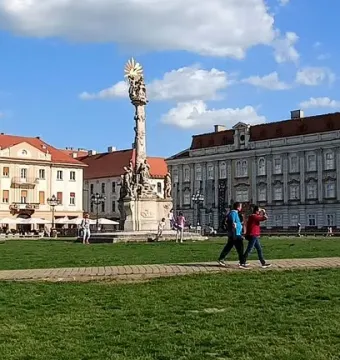
May 2025 © Miomir Magdevski · CC BY-SA 4.0
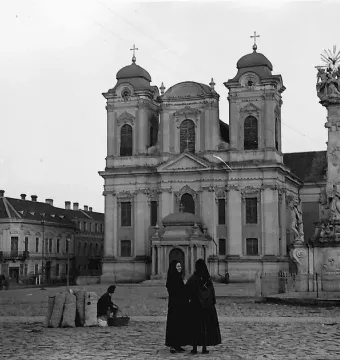
© Willy Pragher · CC BY 4.0
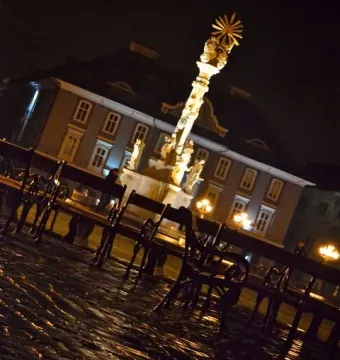
February 2013 © Gratziela Ciortuz · CC BY-SA 4.0
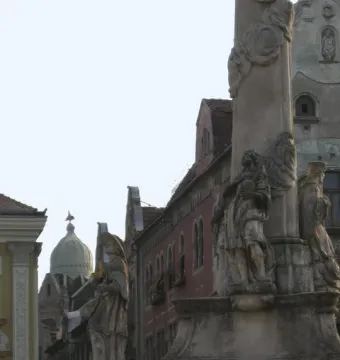
October 2006 © Zsolt Dudás · CC BY 2.5
© Fred Romero · CC BY 2.0
Identification | |
| Title | Holy Trinity Monument, Timișoara |
| Type | Baroque plague column monument |
| Alternative names | Monument to the Holy Trinity; Coloana Ciumei; Pestsäule; Dreifaltigkeitssäule; Pest Column; Trinity Column; Plague Column |
Historical context | |
| Historical context | Commemorates the end of the plague epidemic in Banat, especially Timișoara, between 1731 and 1738; more than 1,300 people died in Timișoara alone, about one-sixth of the city’s population, including six mayors; the epidemic reached Banat via Austrian imperial troops |
| Typological context | A plague column type widespread in the Baroque era in southern Germany, Bohemia, and Hungary |
Creator | |
| Sculptor | Georg Raphael Donner |
| Place of creation | Vienna |
| Date created | 1739–1740 |
Discovery and provenance | |
| Commissioned and funded by | Johann Anton Deschan von Hansen, chamber councillor |
| Dedication | Ex voto |
| Reason for patronage | Given in gratitude for surviving the plague epidemic of 1738–1739; his wife died during the epidemic |
| Transport to Timișoara | Transported by water via the Danube River, the Tisza River, and the Bega Canal |
| Initial display location | In front of Deschan Palace, on the site of the present Bega Shopping Center |
| Initial display duration | 12 years |
Location and ownership | |
| Current location | Union Square (Piața Unirii, also called Cathedral Square), Timișoara, Romania |
History and restoration | |
| Restoration | Restored by Ion Oprescu in 1994–1995 |
| Installed at current location | 1755 |
| Relocation condition | Dismantled into pieces before being moved |
| Relocation reason | At the insistence of Empress Maria Theresa |
Physical characteristics | |
| Style | Baroque |
| Main subject | The Holy Trinity |
Materials | |
| Materials | Stone; wrought iron |
Appearance | |
| Central group | Stone-carved figures of God the Father, Jesus seated on a throne, and the Virgin Mary kneeling with hands joined in prayer; the Father and Son are preparing to place a crown on Mary's head, with a wrought-iron dove of the Holy Spirit above |
| Column decoration | Clouds on the column surfaces; a simple empty Baroque shield with a crown on the central part of the main side; Ionic capital decorated with garlands; complex cornice with a simple floral decoration in its central part |
| Base decoration | Volutes at the corners of the base |
| Base reliefs | Three bas-reliefs; interpreted either as allegorical personifications of plague, war, or despair, or as scenes from the plague epidemic in Timișoara |
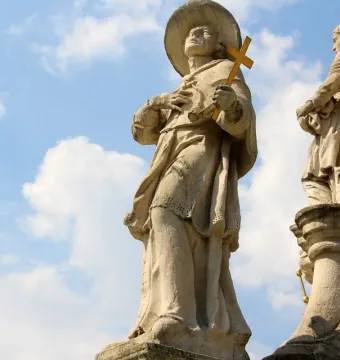
| Saint statues | Saint Sebastian, Saint Roch, Saint Charles Borromeo, Saint John of Nepomuk, Saint Barbara, and probably Saint Francis Xavier |
Iconography and meaning | |
| Iconographic significance | The Holy Trinity group is one of the most widespread variants of plague columns |
| Historical theme | Anti-plague / plague protection imagery |
| Depicted calamities | Plague, war, and hunger |
Other | |
| Related monument | Another plague column in Timișoara stands in Liberty Square: the Monument to Saint Mary and Saint John of Nepomuk |