
John Paul Jones Memorial
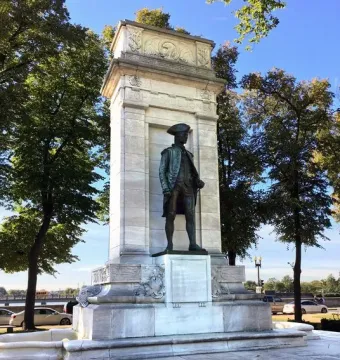
The John Paul Jones Memorial, also known as Commodore John Paul Jones, is a monument in West Potomac Park, Washington, D.C. It honors John Paul Jones (1747–1792), the United States’ first naval war hero and the only naval officer to receive the Congressional Gold Medal for his Revolutionary War service. Designed by architect Thomas Hastings and sculptor Charles H. Niehaus, the memorial was dedicated on April 17, 1912. The bronze statue shows Jones in military uniform watching a battle from a tall marble pylon, with inscriptions and carved eagles and dolphins used in small fountains. It stands at the terminus of 17th Street SW and Independence Avenue SW, near the Tidal Basin.
© NPS · Public domain
1925 © National Photo Company Collection · Public domain
1920 © National Photo Company Collection · Public domain
April 2013 © Daderot · CC0
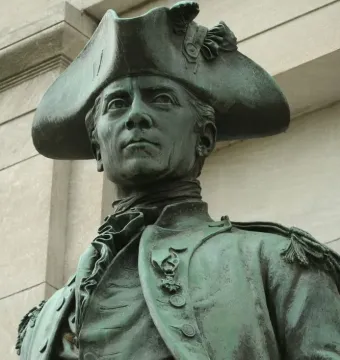
April 2007 © David · CC BY 2.0
Identification | |
| Title | John Paul Jones Memorial |
| Type | memorial statue |
| Alternative name | Commodore John Paul Jones |
| Original-language name | Le Mémorial John Paul Jones |
Historical context | |
| Honoree | John Paul Jones (1747–1792) |
| Description of honoree | the first naval war hero of the United States; the father of the Navy; the only naval officer to receive a Congressional Gold Medal during the American Revolutionary War |
| Commemorates | John Paul Jones and his service in the American Revolutionary War |
| Associated quotation | "I have not yet begun to fight!" |
| Quotation context | said during the Battle of Flamborough Head |
Creator | |
| Foundry | Gorham Manufacturing Company |
| Pedestal ornamentation carver | John Grignolai |
| Architectural firm | Carrère and Hastings |
| Sculptor | Charles H. Niehaus |
| Architect | Thomas Hastings |
Discovery and provenance | |
| Congressional authorization year | 1909 |
| Earlier proposed authorization year | 1902 |
| Funding approved by Congress | $50,000 for installation |
| Related historical event | the memorial was proposed after John Paul Jones's remains were brought back to the United States |
| Grave discovery year | 1905 |
| Burial and reburial information | He was buried in the Saint Louis Cemetery, brought back to the United States in 1905, and entombed in the Naval Academy Chapel in 1913. |
Physical characteristics | |
| Pylon height | 15 feet (4.6 m) |
| Design | bronze statue standing in front of a marble pylon |
| Main sculpture depth | 3.6 feet (1.1 m) |
| Main sculpture height | approximately 10.8 feet (3.3 m) |
| Main sculpture width | 3.2 feet (1 m) |
Materials | |
| Main sculpture material | bronze |
| Pylon material | marble |
Appearance | |
| Depiction | Jones standing and watching a naval battle from the deck of Bonhomme Richard |
| Pose | left leg slightly ahead of the body; left hand resting on a sword; right hand in a fist, relaxed by his side |
| Attire | colonial military uniform, including a three-pointed hat, a coat, and a vest |
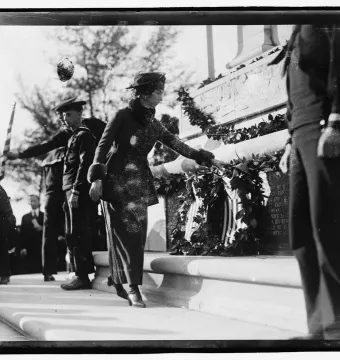
| Decorative elements | inscriptions, carved eagles, carved dolphins, wreaths, anchors, helmets, battle instruments, and foliage |
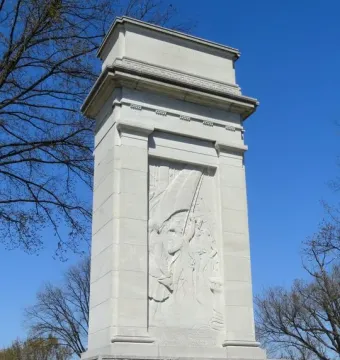
| Reverse relief | A bas-relief on the back of the monument shows Jones hoisting the United States flag on the Bonhomme Richard |
| Water feature | Carved dolphins on the north and south faces spout water into basins |
| Inscriptions | JOHN PAUL JONES; C.H.NIEHAUS Sc. 1911; Gorham Co. Founders; 1747. 1792. FIRST TO COMPEL FOREIGN MAN-OF-WAR TO STRIKE COLORS TO THE STARS AND STRIPES; SURRENDER? I HAVE NOT YET BEGUN TO FIGHT!; IN LIFE HE HONORED THE FLAG. IN DEATH THE FLAG SHALL HONOR HIM |
| Historical dates on inscription | 1747 and 1792 |
Location and ownership | |
| Nearby marker information | A nearby marker contains a biographical sketch of John Paul Jones and the history and features of the monument |
| Location | West Potomac Park, Washington, D.C., United States |
| Specific site | at the intersection of Independence Avenue SW and 17th Street SW, near the Tidal Basin, south of the World War II Memorial on the National Mall |
History and restoration | |
| Dedication date | April 17, 1912 |
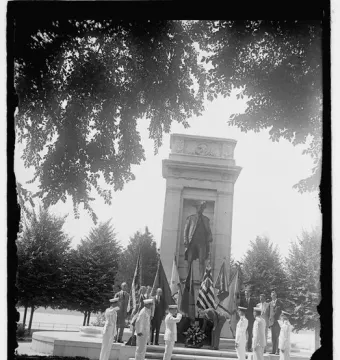
| Dedication ceremony | The dedication was held in rain and drew thousands of people; Navy Secretary George von Lengerke Meyer presided, Reverend Charles Wood gave the invocation, Horace Porter spoke, Admiral George Dewey unveiled the monument, President William Howard Taft gave remarks, Niehaus was introduced afterward, Reverend William T. Russell gave closing remarks, and the ceremony ended with a procession |
| Dedication attendees | President William Howard Taft, First Lady Helen Herron Taft, Navy Secretary George von Lengerke Meyer, Horace Porter, Admiral George Dewey, Reverend Charles Wood, Reverend William T. Russell, and British Ambassador James Bryce, 1st Viscount Bryce, who was absent because of the Titanic crisis |
| Procession | 2,500 members of the Navy and Army marched past the memorial, reviewed by President Taft, First Lady Helen Herron Taft, and Colonel Spencer Cosby; Brigadier General Robert K. Evans served as grand marshal, and the contingent included midshipmen, Marines, seamen, soldiers in the United States Cavalry, Army National Guard, and Field Artillery Branch |
| Unveiling salute | 21-gun salute |
| First monument erected in Potomac Park | yes |
Significance | |
| Subject significance | the United States' first naval war hero |
| Historical recognition | one of 14 sculptures in the American Revolution Statuary |
| National Register of Historic Places | listed as part of the American Revolution Statuary group in Washington, D.C., on July 14, 1978 |
| District of Columbia Inventory of Historic Sites | listed as part of the American Revolution Statuary group on March 3, 1979 and as part of the East and West Potomac Parks Historic District on November 8, 1964; also listed as part of the L'Enfant Plan on January 23, 1997 |
| Contributing property to | the East and West Potomac Parks Historic District and the L'Enfant Plan |