
Ali and Nino
Ali and Nino is a sculpture by Georgian artist Tamara Kvesitadze. It is located in the city of Batumi, Georgia, on the shore of Batumi Bay on the Black Sea. The work consists of two eight-metre-high figures that move slowly in a circle, drawing closer, merging into one form, and then separating again. The full cycle lasts ten minutes, and the monument is illuminated after nightfall. After the sculpture was installed, its original name, Man and Woman, was changed to Ali and Nino.
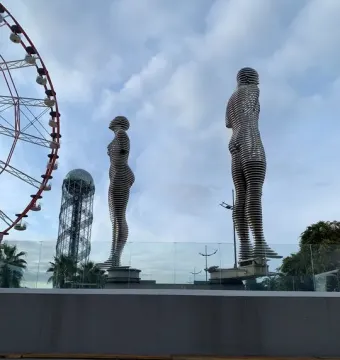
© Robot8A · CC BY-SA 4.0
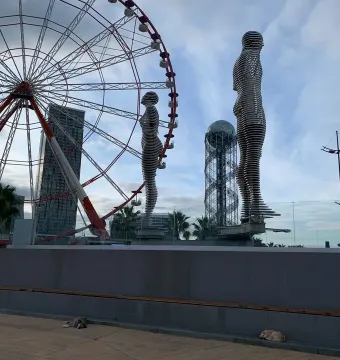
© Robot8A · CC BY-SA 4.0
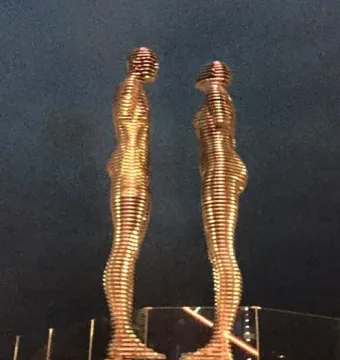
© Ekkatterrinna · CC BY-SA 4.0
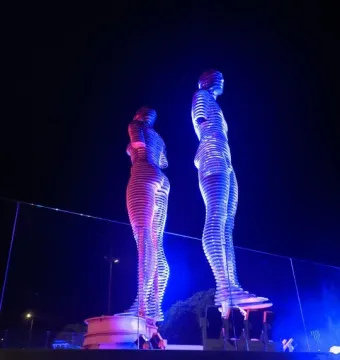
© ???? · CC BY-SA 4.0
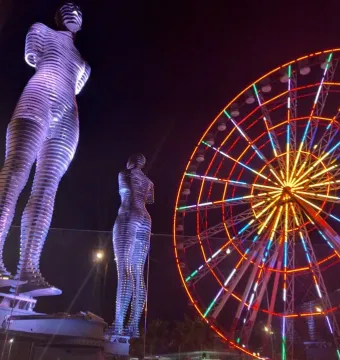
© Vicuna R · CC BY-SA 2.0
Identification | |
| Title | Statue of Ali and Nino |
| Original title | Homme et Femme (Man and Woman) |
| Type | Moving metal sculpture / monument |
| Alternative names | Ali et Nino; Nino-and-Ali Statue; Statue of Love |
Creator | |
| Artist | Tamara Kvesitadze |
| Additional artist | Paata Sanaia |
| Artist nationality | Georgian |
Discovery and provenance | |
| Installation year | 2011 |
| Original title change | After installation, the original name was changed from Homme et Femme (Man and Woman) to Ali et Nino |
| Installation site | Batumi waterfront, Batumi, Georgia |
| First public presentation | Venice Biennale, Italy, 2007 |
| Subsequent presentation | London |
| Creation period | About two years |
| Date created | 2007 |
Physical characteristics | |
| Number of figures | Two |
| Height | 7.9 metres (26 feet); each figure is about 8 meters tall |
Materials | |
| Material | Metal |
Technique | |
| Lighting | Illuminated at nightfall with expressive neon lighting for the monument and its surroundings |
| Movement schedule | Every evening, starting at 19:00 |
| Cycle duration | About 10 minutes |
| Movement | The figures slowly move in a circle, approach each other, merge into one form, then move apart |
| Movement mechanism | Mechanism, solar-powered |
Appearance | |
| Visual effect | At night, the sculpture resembles a dance of love |
Iconography and meaning | |
| Symbolism | A symbol of love and tolerance in a complex world |
| Interpretation | Reflects the problems associated with European rule over an oriental society |
| Story location | Baku |
| Historical setting in source story | Baku during World War I and the period of the Azerbaijan Democratic Republic, before Soviet rule |
| Narrative outcome | Despite obstacles, they marry; Ali dies, leaving Nino with their baby daughter |
| Narrative sequence | The lovers meet, are drawn to each other, embrace, and eventually separate |
| Theme | Love between people from different cultures, East and West; the tragedy of life conveyed in iron images |
| Inspiration | Inspired by reading the novel Ali and Nino |
| Source novel authorship | The true identity of Kurban Said is not definitely established and may be a pseudonym |
| Source novel author | Kurban Said |
| Source work | The novel Ali and Nino (1937) |
| Characters depicted | Ali Khan Shirvanshir, an Azerbaijani Muslim man; Nino Kipiani, a Georgian Christian woman |
| Subject | The tragic love story of Ali and Nino |
Location and ownership | |
| Location | Batumi, Georgia |
| Specific site | On the shore of Batumi Bay, on the Black Sea |
History and restoration | |
| Completion status | Completely finished |
Significance | |
| Public reception | Highly appreciated by the public |