
The Spire of Dublin
The Spire of Dublin, officially called Monument of Light and in Irish An Túr Solais, is a 120-meter stainless-steel monument and landmark in the center of O’Connell Street. Completed in 2003, it stands on the site of the former Nelson’s Pillar, which was destroyed in 1966. Designed by Ian Ritchie Architects with structural engineering by Arup, the sculpture is made of eight steel sections joined by 204 bolts and two kilometers of welds. It rises from a concrete foundation, narrows from a three-meter base to a 15-centimeter tip, and is illuminated at night. Its internal damping limits movement at the top to 1.5 meters.
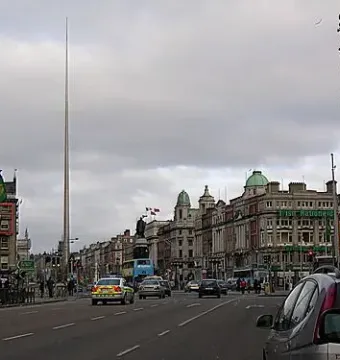
January 2006 © Dublinhj · CC BY-SA 3.0
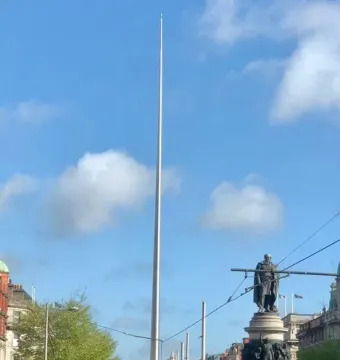
May 2018 © Sonse · CC BY 2.0
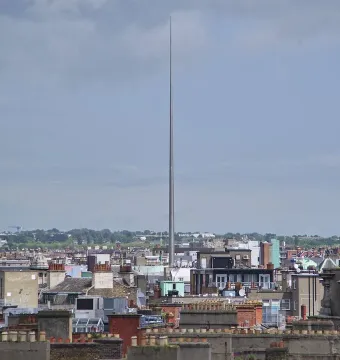
© Andrew Mcmillan · CC BY 3.0
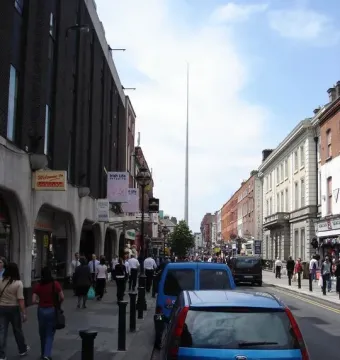
June 2005 © Russell Yarwood · CC BY-SA 2.0
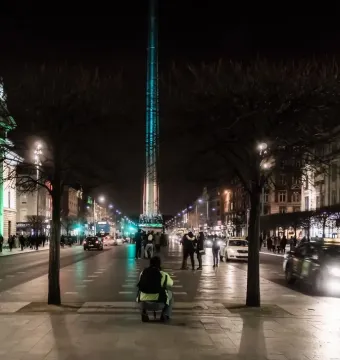
© William Murphy · CC BY-SA 2.0
Identification | |
| Title | Spire of Dublin |
| Official name | Monument of Light |
| Irish name | An Túr Solais |
| Alternative names | Millennium Spire; Spire of Light; Monument to Light; The Monument; The Colossus; The Spike; Stiletto in the ghetto; Stiffy by the Liffey |
| Type | Monument / public sculpture |
| Form | Needle-shaped spire; elongated cone |
| Common name | The Spire |
Historical context | |
| Completion year | 2003 |
| Planned completion | Around the turn of the millennium; originally aimed for 2004 |
| Delay | Completed three years late; missed the Millennium celebrations in 2000 |
| Construction period | 18 December 2002 to 21 January 2003 |
| Purpose | Replacement monument for Nelson's Pillar; part of the regeneration of O'Connell Street and a memorial to the new millennium |
| Context | Linked to Dublin Millennium celebrations and Ireland's Celtic Tiger era; promoted as part of a city urban renewal project |
Creator | |
| Manufacturer / fabricator | Radley Engineering of Dungarvan, County Waterford |
| Erected by | SIAC Construction Ltd and GDW Engineering Ltd |
| Designer | Ian Ritchie / Ian Ritchie Architects |
| Contractor | SIAC-Radley JV |
| Structural engineer | Arup |
Discovery and provenance | |
| Design selection | Chosen from a large number of entries in an international competition chaired by Lord Mayor of Dublin Joe Doyle |
| Approval | Approved on 28 December 2000 by Minister for the Environment Noel Dempsey after an Environmental Impact Study |
| Provenance of site | Built on the former site of Nelson's Pillar, which stood until 1966; the site was later occupied by the Anna Livia monument, which was moved in 2001 to make way for the Spire |
| Previous structure on site | Nelson's Pillar |
| Related monument | Anna Livia monument |
Physical characteristics | |
| Sway control | Dampers and a tuned mass damper inside limit sway at the top to 1.50 metres |
| Foundation depth | 30 metres underground |
| Number of sections | 6 |
| Section length | 20 metres each |
| Top diameter | 15 centimetres |
| Height | 120 metres |
| Base diameter | 3 metres |
| Weight | 126 tonnes |
Materials | |
| Main material | Stainless steel |
| Base material | Concrete foundation |
| Nearby site material | Granite plaza |
Technique | |
| Construction method | Made of eight parts held together by 204 bolts and about two kilometres of welds |
| Surface treatment | Shot peened stainless steel |
Appearance | |
| Lighting | Illuminated at night by a light at the top |
| Surface appearance | Highly polished, reflective metal surface |
| Color effects | Reflects light so that the surface appears metallic by day and pink or red at dusk depending on the sky |
| Visual effect | The tip appears to merge with the sky |
Iconography and meaning | |
| Meaning of name | The name means 'The Light Tower' and is also glossed as 'Dublin cusp' |
| Symbolic meaning | Represents the struggle for Irish independence between Irish and English |
| Base motif | Based on a sample of rock and the double helix of DNA |
Location and ownership | |
| Country | Ireland |
| Location | O'Connell Street, Dublin, Ireland |
| City | Dublin |
| Specific site | Northern end of O'Connell Street; on the former site of Nelson's Pillar |
History and restoration | |
| Construction delays | Work was slowed by problems obtaining building permission and meeting environmental standards; the plan was appealed to the High Court |
| Associated regeneration project | Planned multi-million redevelopment of O'Connell Street |
| Planned streetscape changes | New granite plaza, fewer trees in the central reservation, cleaned and in some cases relocated statues, upgraded shopfronts and signage, redirected traffic, and reduced lanes to improve pedestrian appeal |
| Controversy | The plan was controversial; critics objected to the height and cost, and the reduction of century-old trees |
| Former monument destroyed on site | Nelson's Pillar was destroyed in 1966 by an IRA bomb and later demolished |
| Temporary installation | In December 2015 a large temporary lightsaber hilt was installed at the base to light it blue at night for the Irish premiere of Star Wars: The Force Awakens |
| 2024 event | In May 2024 The Portal created a live videostream of the Spire to New York as part of a visual bridge between Dublin and New York |
| 2025 incident | In September 2025 a large Palestinian flag appeared atop the spire, apparently dropped by a drone; there were no claims of responsibility, and it remained as of mid-2026 |
Significance | |
| Rank by height | Considered one of the tallest sculptures in the world; one source says the tallest sculpture in the world, though this may refer only to the reliefs on the cone |
| Public perception | A popular meeting place for young people in Dublin |
| Awards and nominations | Nominated for the RIBA National Award and Stirling Prize (2004), the British Construction Industry International Award (2003), and the Mies van der Rohe Award for European Architecture (2005) |
| Selection committee chair | Lord Mayor of Dublin Joe Doyle |