
Solovetsky Stone
Solovetsky Stone is one of the oldest and most significant memorials to victims of political repression in the USSR. Installed in Moscow on 30 October 1990 by the Memorial initiative group, it is a granite boulder brought from the site of the former Solovetsky camp, a symbol of the Gulag and Soviet state terror. The monument stands on Lubyanka Square, opposite the headquarters of the Soviet security agencies that carried out repression. It became an important focus of public discussion about the history of repression and remembrance of its victims. The site is still used for commemorative events and civic actions, and in 2008 it was designated a cultural heritage site of Russia.
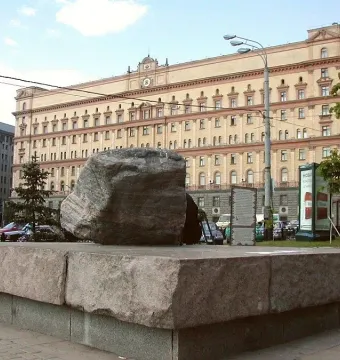
© Foma · CC BY-SA 3.0
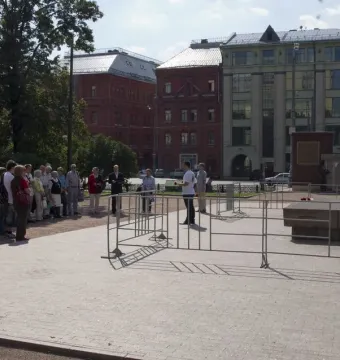
August 2011 © Zac allan · CC BY-SA 3.0
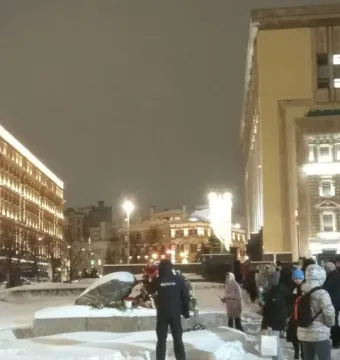
February 2024 © Акутагава · CC0
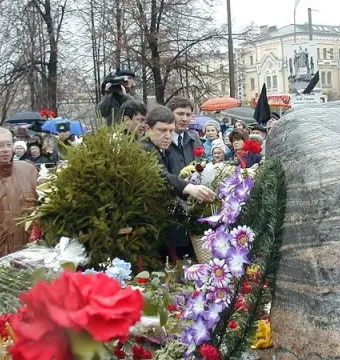
October 2000 © Сергей Локтионов · CC BY 4.0
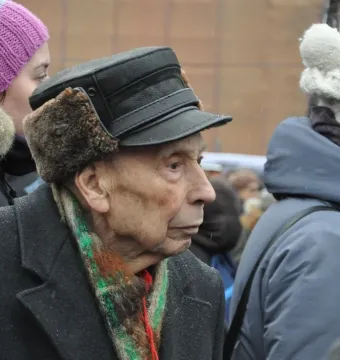
October 2016 © David Krikheli · CC BY-SA 4.0
Identification | |
| Title | Solovetsky Stone |
| Alternative names | Pedra Solovetsky; Kamień Sołowiecki; Solowezki-Stein; Piedra Solovetski; La pietra Soloveckij |
| Type | Memorial monument |
| Subject | Victims of political repression in the Soviet Union |
| Native name | Соловецкий камень |
Historical context | |
| Purpose | To honor the victims of political repression in the Soviet Union, especially during the Stalin era |
| Commemorative date | 30 October, the Day of Remembrance of the Victims of Political Repression in the USSR / Day of the Political Prisoner in the USSR |
| Historical significance | Part of the public discussion and commemoration of Soviet political repression; the installation ceremony was the first official recognition of the Day of the Political Prisoner |
| Installation permit | Granted by the Moscow Soviet on 10 September 1990 |
| Installed by | Memorial society and activists of Memorial |
| Erected | 30 October 1990 |
Creator | |
| Designers | S. I. Smirnov; V. J. Korsi; Yevgeny Ukhnalyov; Yuli Rybakov |
Discovery and provenance | |
| Stone source | The Solovetsky Islands, White Sea |
| Original location of stone | Solovetsky Special Purpose Camp / Solovki prison camp area, including Tamarin wharf near Solovki |
| Historical association of source | Site of the Solovetsky camp, considered a symbol of the Gulag system and Soviet state terror; the first permanent camp of the Soviet penal system, established in 1923 |
| Transport route | From Bolshoy Solovetsky Island by the merchant ship Sosnovec to Arkhangelsk, then by train to Moscow |
| Stone selection | Chosen by Mikhail Butorin and Gennady Lyashenko |
| Original provenance detail | Taken from the territory of the Solovetsky Special Purpose Camp; one account says it was taken 50 meters from the place of the mass execution of prisoners |
Physical characteristics | |
| Pedestal size | 3.1 × 3.7 m; 0.4 m high |
| Style | Minimalist |
| Character | Non-religious, secular |
| Base / pedestal | Set on a granite pedestal of nine square marble or granite slabs, with a stone-clad base |
| Height | About 1.75 meters |
| Material | Granite boulder |
| Weight | 10 tonnes (also reported as 10,400 kg) |
Appearance | |
| Orientation | The sides are oriented toward the borders of the square/garden |
| Inscription | "This stone was delivered from the territory of the Solovetsky Special Purpose Camp by the Memorial society and installed in memory of millions of victims of the totalitarian regime // 30 October 1990, on the Day of the Political Prisoner in the USSR" |
| Inscription location | Carved on the central slab of the pedestal facing the Polytechnic Museum |
| Information stand | A vertical stand nearby, decorated with arrest photos of repressed people, gives information in English and Russian about executions and burial sites in Moscow |
Location and ownership | |
| Nearby building history | The Lubyanka Building housed the Cheka, GPU, OGPU, NKVD, KGB, and now the FSB; it also contained an Internal Prison until 1957 |
| Setting | A garden/square opposite the Polytechnic Museum |
| Heritage status | Cultural heritage object of Russia; also designated a landmark / point of interest in 2008 |
| Reason for site | Chosen because the state security organs were headquartered there and orders for repression were signed there |
| Spatial relation to nearby landmark | Located very close to and opposite the Lubyanka Building |
| Nearby landmark | Lubyanka Building / former KGB headquarters |
| Location | Lubyanka Square, Moscow, Russia |
History and restoration | |
| Demolition of nearby monument | The Dzerzhinsky statue on the square was dismantled on 23 August 1991 using two cranes |
| Related later memorial | A memorial stone from the Solovetsky Islands was installed in Saint Petersburg on 4 September 2002 on the initiative of Memorial |
| Flowers laid by | Bronisław Komorowski in May 2010 |
| Recent tributes | Since 16 February 2024, following reports of Alexei Navalny's death in prison |
| Public use | Focus of annual and occasional gatherings, ceremonies, tributes, and civic actions; often a site of political protests |
| Annual commemoration | 30 October, with "Restoring the Names" held the day before since 2007 |
| Funding | Funded with money allocated by the Moscow government |
| Unveiling attendance | Thousands of people, including former political prisoners Oleg Volkov, Anatoly Zhigulin, and Sergei Kovalev |
| Unveiling organization | Memorial |
| Unveiling date | 30 October 1990 |
Significance | |
| Symbolic meaning | A symbol of the struggle for freedom and a witness to tragic events |
| Interpretation | Presented as embodying continuity and inheritability of being, and the spirit of place and ancestors |
| Associated annual events | Annual events in memory of state terror are held in the memorial square |