
Vaillancourt Fountain
Vaillancourt Fountain is a large fountain at Embarcadero Plaza in San Francisco, designed by Québécois artist Armand Vaillancourt with landscape architect Lawrence Halprin and completed in 1971. Constructed from precast concrete square tubes, it was originally a striking modernist work and long remained controversial for its stark appearance. Over the years, several proposals to demolish it were unsuccessful. In October 2025, San Francisco determined the fountain was a historic resource eligible for the California Register of Historical Resources. The following month, the San Francisco Arts Commission approved an emergency disassembly and removal, citing structural deterioration. Removal began in April 2026, with storage for up to three years estimated to cost $4.4 million.
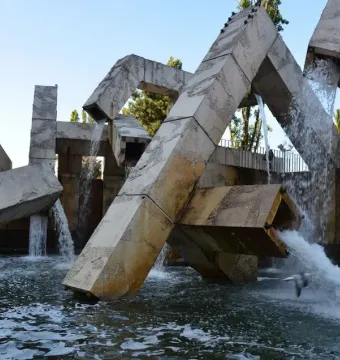
June 2011 © Ernest McGray, Jr. · CC BY-SA 2.0
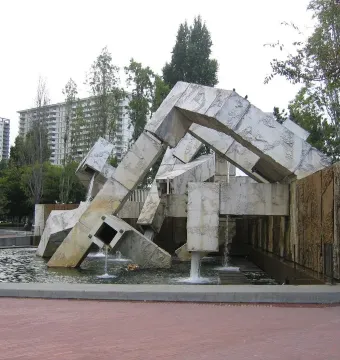
August 2005 © eric molina · CC BY 2.0
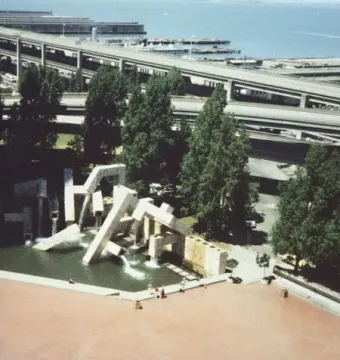
© Dng2000 · Public domain
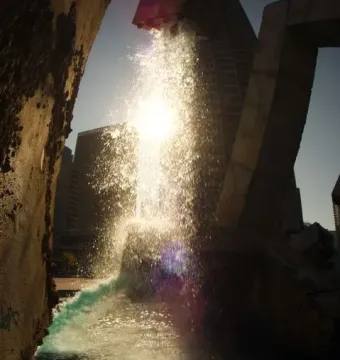
September 2017 © mliu92 · CC BY-SA 2.0
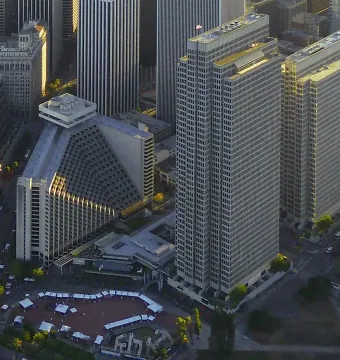
September 2010 © Craig Howell · CC BY 2.0
Identification | |
| Title | Vaillancourt Fountain |
| Alternative names | Québec libre!; Québec-Libre!; Embarcadero Fountain |
| Type | fountain; monumental abstract sculpture |
Historical context | |
| Date created | 1971 |
| Dedication date | April 22, 1971 |
| Context | A product of the redevelopment of San Francisco in the 1950s and 1960s, designed for the freeway environment then present along the Embarcadero |
Creator | |
| Artist | Armand Vaillancourt |
| Artist nationality | Québécois Canadian |
| Collaborator | Lawrence Halprin, plaza landscape architect |
Discovery and provenance | |
| Selection process | In August 1966 a committee invited six sculptors to submit models for a loosely defined monumental abstract sculpture; by December five had responded, and Vaillancourt was selected at age 38 |
| Commissioning and planning | The fountain was strongly advocated by Lawrence Halprin and planned by Mario Ciampi, John Savage Bolles, and Lawrence Halprin |
Physical characteristics | |
| Shape | An irregular pentagonal pool with several square pillars or cubed tubes forming a semicircle inside it |
| Dimensions | about 61 m long, 43 m wide, and 12 m high |
Materials | |
| Material | Precast concrete square tubes; concrete |
Technique | |
| Construction | Up-and-down, diagonally running square concrete tubes with platforms and walkways allowing public entry into and behind the falling water |
Appearance | |
| Style | Modernist; Brutalist; industrial |
| Appearance | Stark, monumental, rough-textured, and often described as unfinished; it was said to look like it was growing out of the street |
| Visual design | Natural-colored pillars jutted out and crisscrossed from the corner of the plaza like the tentacles of an immense geometrical octopus |
Iconography and meaning | |
| Artist's intent | Vaillancourt conceived it as a confrontational work meant to attract protest and conflict and to express 'power to the people' |
| Inauguration inscription | Vaillancourt wrote 'Québec libre!' in red letters on the fountain the night before dedication; city workers erased it the next day and he rewrote it several times |
| Meaning of inscription | Support for Quebec sovereignty and, more broadly, the freedom of all peoples |
| Public statement | Vaillancourt said the fountain was dedicated to all freedom, including 'Free Quebec! Free East Pakistan! Free Viet Nam! Free the whole world!' |
Location and ownership | |
| Public ownership context | Built as part of the Embarcadero Plaza redevelopment and later integrated into the surrounding public realm |
| Accessibility | Publicly accessible at all times and in all weather; visitors were allowed to climb on the structure and walk through the water |
| Nearby landmarks | Hyatt Regency Hotel, Embarcadero Center, Ferry Building, and the eastern end of the California Street cable car line |
| Specific site | Where Market Street meets The Embarcadero, facing the waterfront in the heart of the financial district |
| Current location | Embarcadero Plaza (formerly Justin Herman Plaza), downtown San Francisco waterfront, San Francisco, California, United States |
History and restoration | |
| Damage during removal | In May 2026 the fountain caught fire during demolition works |
| Post-removal status | Components are to be placed in storage |
| Removal cost | US$4–4.4 million |
| Removal process | Disassembly and removal began in April 2026; the artist was given 90 days to remove it before the city dismantles it and stores the components for up to three years |
| Removal reasons | Structural deterioration and project redesign concerns |
| Removal proceedings | On August 18, 2025 the Recreation & Parks Department requested deaccessioning and removal; after three hearings the Arts Commission approved emergency removal on November 3, 2025 |
| 2025 condition assessment | The consultant concluded in June 2025 that the fountain showed deterioration that had to be addressed for safe public enjoyment; it was fenced off that month |
| 2025 historic-resource finding | An independent consultant found the fountain to be a historic resource in May 2025, the Planning Department concurred in October 2025, and San Francisco later determined it eligible for the California Register of Historical Resources |
| Recent condition | In June 2024 a pump failed, with replacement estimated at US$3 million |
| Operating costs | Early estimates cited annual electricity costs of about US$200,000 to pump 30,000 gallons of water, later revised to US$76,000 in operating costs plus US$20,000 in maintenance per year |
| Rehabilitation and restoration | The fountain was reopened after a 2017 test run on August 15, 2017; Blue Lagoon was used to control algae and tint the water blue |
| Water shutoffs | Turned off during 2001–2004 drought-related shutdowns, reopened on August 2, 2004, shut off again in November 2007 and reopened on January 21, 2008, and was turned off again in 2014 during the 2011–17 California drought |
| Later use | The surrounding plaza became a gathering place for skaters in the 1980s and 1990s |
| Artist response to U2 incident | Vaillancourt supported Bono, later wrote 'Stop the Madness' on U2's stage, and defended graffiti as a necessary evil |
| Art and public events | Site of a free U2 concert on November 11, 1987, when Bono climbed onto the fountain and sprayed 'Rock N Roll Stops The Traffic'; the act was condemned by Mayor Dianne Feinstein, issued a misdemeanor citation, and later apologized for by U2 |
| Freeway context | The adjacent elevated Embarcadero Freeway stood beside it at construction; after the 1989 Loma Prieta earthquake it was demolished and replaced by a boulevard |
| Demolition proposals | It has been the subject of several unsuccessful proposals to demolish it |
| Opening praise | Alfred Frankenstein wrote that public entry into the fountain's interior was central to the idea and that it succeeded as a fountain-like public work rather than a great sculpture |
| Opening criticism | At the dedication it was denounced as an obscenity and eyesore; Allan Temko compared it to a giant concrete dog with square entrails |
| Reception | Long controversial; widely criticized at opening, though appreciated by some |
Significance | |
| Cultural significance | It has been described as a highly publicized and enduringly controversial work that links Vaillancourt's political and social convictions to his art |