
Fountain
Fountain is a 1917 readymade by the Dada artist Marcel Duchamp. It consists of a white porcelain urinal displayed upside down and marked on the side with the black ink signature "R. Mutt." Duchamp submitted it to the inaugural exhibition of the Society of Independent Artists in New York, but it was not placed in the display area. He said the work showed that everyday objects can be elevated to art through the artist’s choice. Although the original is lost, Alfred Stieglitz photographed it, helping make it one of the most famous works of Dada and an important landmark of 20th-century art.
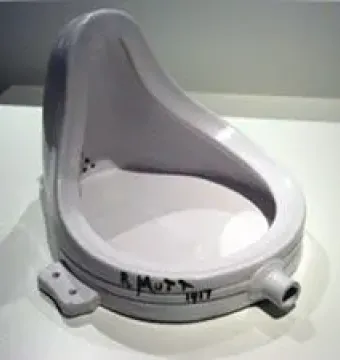
August 2008 © 24oranges.nl · CC BY-SA 2.0
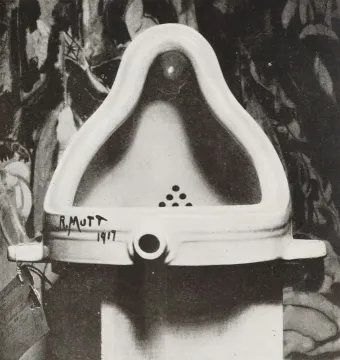
© Marcel Duchamp · Public domain
April 2016 © Tim Evanson · CC BY-SA 2.0
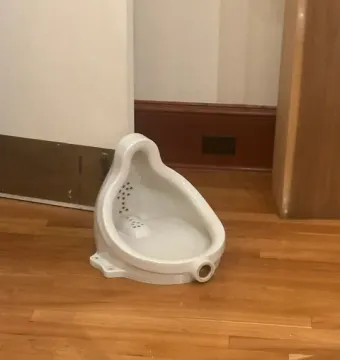
August 2024 © An undesired fidelity · CC BY-SA 4.0
1917 © Alfred Stieglitz, Beatrice Wood, Walter Conrad Arensberg · Public domain
Identification | |
| Title | Fountain |
| Type | Readymade sculpture |
| Alternative titles | Fonte; A Fonte; Fuente; Фонтан |
Historical context | |
| Date | 1917 |
| Movement | Dada; readymade art |
Creator | |
| Artist | Marcel Duchamp |
| Attribution dispute | Some researchers and art historians have suggested Elsa von Freytag-Loringhoven as the true author or a co-author, while the traditional attribution remains to Marcel Duchamp |
Discovery and provenance | |
| Creation context | Submitted in April 1917 as an ordinary plumbing fixture chosen by Duchamp |
| Possible alternate origin | One account says a female friend sent the urinal to Duchamp under the pseudonym "Richard Mutt"; another proposes Elsa von Freytag-Loringhoven as the source |
| Source object | A standard Bedfordshire model urinal purchased from J. L. Mott Iron Works at 118 Fifth Avenue, New York City |
| Purchase context | Joseph Stella and Walter Arensberg were present at the purchase |
| Object form | Commercial porcelain urinal |
Physical characteristics | |
| Orientation | Rotated 90 degrees and exhibited upside down or at an inverted angle |
| Signature | Signed "R. Mutt" or "R. Mutt 1917" in black ink |
Materials | |
| Material | White porcelain |
Technique | |
| Type of work | Found object / ready-made |
Appearance | |
| Representation | An ordinary urinal |
Iconography and meaning | |
| Interpretations | Interpreted in many ways, including as sexually suggestive, as female sexual organs, or as a sitting Buddha |
| Concept | A mundane object presented as art through the artist's choice, renaming, and changed context |
Location and ownership | |
| Exhibition | Submitted to the Society of Independent Artists' inaugural exhibition at Grand Central Palace, New York City |
| Exhibition rules | The exhibition rules stated that works by artists who paid the fee would be accepted |
| Exhibition outcome | It was not shown in the exhibition; accounts differ on whether it was formally rejected, hidden from view, or suppressed |
History and restoration | |
| Damage and alteration | The work has been altered and vandalized on some occasions; a replica was damaged by Pierre Pinoncelli at Centre Pompidou in 2006 |
| Replica locations | Examples are held in museums and collections in Europe, North America, and Asia, including Indiana University Art Museum, San Francisco Museum of Modern Art, Philadelphia Museum of Art, National Gallery of Canada, Centre Georges Pompidou, MAMAC, Tate Modern, and the Scottish National Gallery of Modern Art |
| Replica materials | Later replicas were made in papier-mâché, porcelain, glazed earthenware, or ceramic/faience, often painted to resemble the original and signed in black paint |
| Replica dates | 1935 onward for Boîte-en-valise miniatures; 1950, 1953, 1963, and 1964 for full-size or editioned replicas |
| Replica history | Duchamp produced or authorized 16 replicas between 1950 and 1964, including miniature Boîte-en-valise versions and full-size copies |
| Probable fate of original | Probably thrown out as rubbish or discarded as trash by Alfred Stieglitz; another account says it was returned to Richard Mutt by Duchamp |
| Original status | The original 1917 work is lost and survives only in photographic documentation |
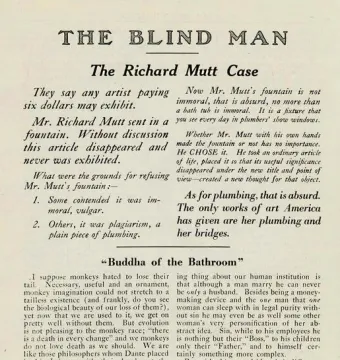
| Documentation details | The photograph appeared in the second issue of The Blind Man, with texts by Alfred Stieglitz, Louise Norton, Beatrice Wood, and Walter Arensberg |
| Documentation | Photographed by Alfred Stieglitz at his studio and published in The Blind Man |
Significance | |
| Historical impact | Considered a major landmark and important milestone in 20th-century art, and a foundational precedent for later conceptual and readymade art |
| Cultural impact | Its documentation and controversy helped increase its fame and establish it as one of the most representative works of Dada |
| Estimated value | About three million euros in 2006; one replica later sold for US$1.7 million |
| Related artists | Francis Picabia, Man Ray, Beatrice Wood, Joseph Stella, Walter Arensberg, Alfred Stieglitz, Louise Norton, Guillaume Apollinaire, Robert J. Coady, Jean Crotti |
| Authorship debate | The authorship and submission history remain disputed; some researchers propose a collaboration or an alternative maker, while art historians generally maintain Duchamp's authorship due to lack of documentary evidence for an alternate submission |
| Related statement | Duchamp defined readymades as everyday objects raised to the dignity of art by the artist's act of choice |