
Cloud Gate
Cloud Gate is a public sculpture by British artist of Indian origin Anish Kapoor, located in the center of AT&T Plaza in Millennium Park, Chicago, Illinois, USA. Built between 2004 and 2006, it is nicknamed “The Bean” for its shape. Made from 168 welded stainless-steel plates, its highly polished outer surface has no visible seams. The sculpture measures 10 m × 20 m × 13 m and weighs about 100 tons. Inspired by liquid mercury, its reflective surface distorts the city skyline, while visitors can walk around it and beneath its 3.7-meter arch. The concave chamber below, called the “omphalos,” multiplies reflections and makes the work especially popular for photographs.
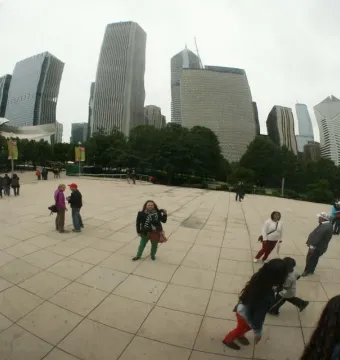
June 2013 © orangemania · CC BY 2.0
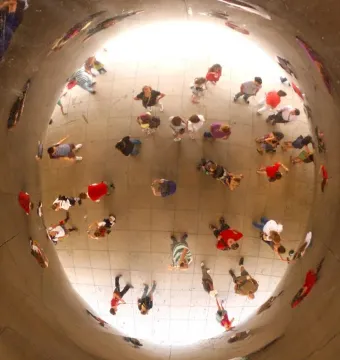
© Kevin Dooley · CC BY 2.0
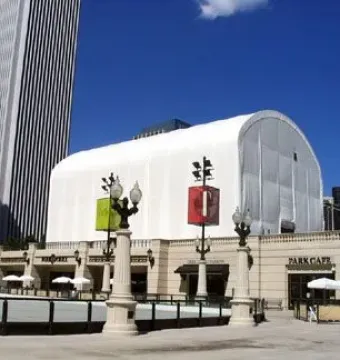
June 2004 © Cmgiulini · CC BY 3.0
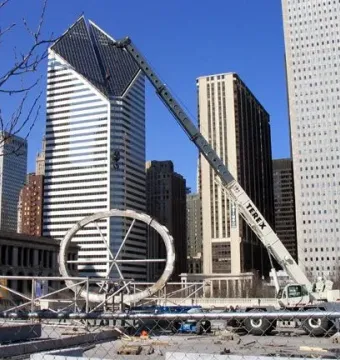
March 2004 © Cmgiulini · CC BY 3.0
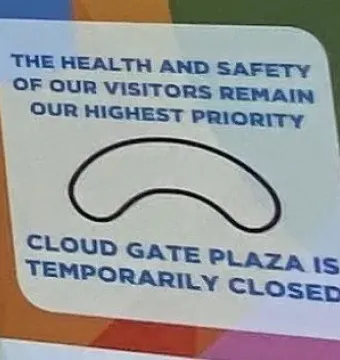
March 2020 © Raed Mansour · CC BY 2.0
Identification | |
| Title | Cloud Gate |
| Type | Public sculpture |
| Literal name meaning | Gateway to the clouds |
| Alternative names | The Bean; Chicago's Bean; Khmarna brama (Хмарна брама) |
Creator | |
| Artist | Anish Kapoor |
| Artist nationality | British artist of Indian origin |
| Artist status | Internationally recognized contemporary artist |
Historical context | |
| Commission year | 1999 |
| Selection process | Chosen through a Millennium Park design competition over a proposal by Jeff Koons |
| Original intended location | The southeast part of the park in Lurie Garden, but park officials felt it was too large for that site |
| Installation period | 2004–2006 |
| Temporary unveiling | Temporarily unveiled incomplete during Millennium Park's opening celebrations in summer 2004 |
| Official dedication date | 15 May 2006 |
| Final presentation date | 15 July 2006 |
Discovery and provenance | |
| Fabrication location | Oakland, California |
| Transport to site | About one third of the plates and all of the internal structure were trucked to Chicago |
| Funding | Privately funded by individuals and companies; no public funds were used |
| Site assembly contractor | MTH Industries |
| Manufacturer | Performance Structures, Inc. (PSI) |
Physical characteristics | |
| Dimensions | 10 m × 20 m × 13 m |
| Weight | About 100–110 tons |
| Shape | Bean-shaped, elliptical |
| Arch height | 3.7 m |
| Omphalos height above ground | 8.2 m |
Materials | |
| Primary material | Stainless steel |
| Exterior cladding | 168 welded stainless-steel plates |
| Internal structure material | Steel |
Technique | |
| Joint behavior | Components were made to allow relative movement without stressing adjacent parts |
| Weld finish | PSI was chosen for its ability to make nearly invisible welds |
| Polishing process | Five-stage polishing process |
| Structural engineering | Built with two steel rings and a crossed tube triangulation, designed to expand and contract with temperature changes |
| Surface finish | Mirror-polished, highly polished, seamless appearance |
| Plate fabrication | Machined using 3D modeling software |
Appearance | |
| Exterior appearance | A smooth, mirror-like stainless-steel shell with no visible seams |
| Reflective effect | Reflects and distorts the Chicago skyline, clouds, and nearby buildings |
| Surface composition | Three quarters of the outer surface reflects the sky |
| Omphalos | A concave chamber on the underside that multiplies and distorts reflections; its cavity creates a chamber above viewers' heads when they stand beneath the arch |
| Omphalos meaning | Greek for "navel" |
| Construction-time appearance | During lower-section construction, it resembled a large sombrero |
Iconography and meaning | |
| Design inspiration | Liquid mercury |
| Design concept | Intended to resemble a falling drop of mercury, as if time had stopped a second before it hit the ground |
| Name interpretation | The name suggests a gateway or bridge between the sky and the observer |
| Under-arch feature | The omphalos is located beneath the arch |
Location and ownership | |
| Nearby features | Between Chase Promenade and McCormick Tribune Plaza & Ice Rink; near Park Grill, Jay Pritzker Pavilion, Crown Fountain, Wrigley Square, and Millennium Hall |
| Structural support location | Supported by reinforced structures beneath and around the plaza, including the Park Grill roof |
| Park context | Millennium Park is in the Loop community area of Chicago and lies within Grant Park |
| Public access | Located in open public space |
| Park setting | Centered in AT&T Plaza in Millennium Park |
| Current location | AT&T Plaza, Millennium Park, Chicago, Illinois, United States |
History and restoration | |
| Cost | Estimated at US$6 million; rose to US$11.5 million at the park opening and US$23 million in the final cost |
| Later maintenance | The lower 80 inches are dusted twice a day with a Windex-like solution and fully cleaned twice a year with more than 1 gallon of liquid Tide detergent |
| Opening-year handling | Because of its popularity, park officials left it visible for several months before completion |
| Construction support details | Side pillars were anchored beneath the plaza and connected inside it by rods; a wall behind the restaurant also helped support the sculpture |
| Construction labor | 24 metallurgists from Ironworkers Local 63 worked on upper polishing; climbing ropes and harnesses were used for hard-to-reach areas |
| Construction sequence | Work began with the omphalos, then plates were attached from below upward and from inside outward |
| Early repairs | In 2005 workers polished the seams to a mirror shine |
| Initial defects | Visible seams appeared after installation, and the sculpture could not initially be photographed |
| Temporary concealment | A large tent was erected around the work and later removed after completion of the upper and side portions |
| Construction outcome | A feasible method was eventually found, but construction fell behind schedule |
| Construction concerns | Technical concerns arose about construction, assembly, maintenance, and upkeep, and some experts thought the design could not be built |
Significance | |
| Popularity | A popular tourist attraction and one of Chicago's best-known landmarks |
| Public reception | Has gained increasing popularity locally, nationally, and internationally |
| Symbolic status | Considered one of the most emblematic symbols of Chicago |
| Artist importance | Kapoor's first outdoor public work in the United States and the work for which he is best known in the United States |
| Photography appeal | Popular with tourists for photo opportunities created by its reflective surface |