
La Vague by Camille Claudel
La Vague, also known as Les Baigneuses, is a sculpture by Camille Claudel made in onyx and bronze around 1903. It depicts a large onyx wave about to break over three small nude bathers, cast in bronze and holding hands. The work was first made in plaster in 1897 and shown at the Salon, then produced in onyx and bronze in several versions from 1898 to 1903. The copy displayed in the Musée Rodin in Paris probably dates from 1903. It is regarded as one of Claudel’s masterpieces, reflecting her creativity, personal aesthetic, and aspects of her own life.
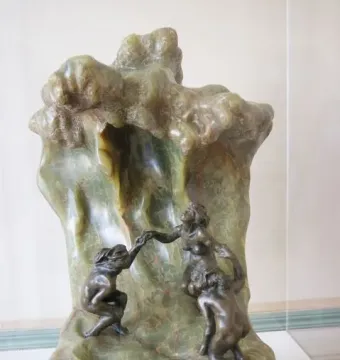
May 2012 © Lomita · Public domain
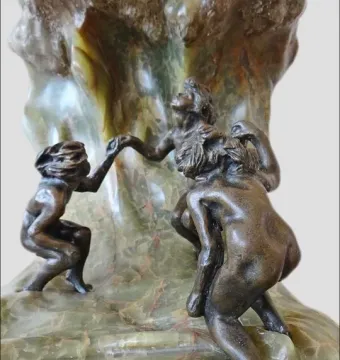
July 2012 © Jean-Pierre Dalbéra · CC BY 2.0
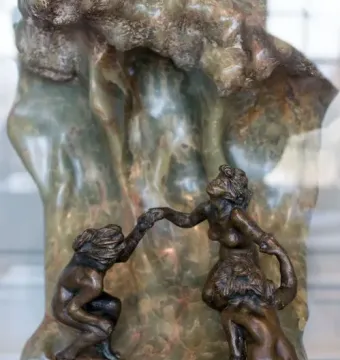
March 2014 © Thibsweb · Public domain
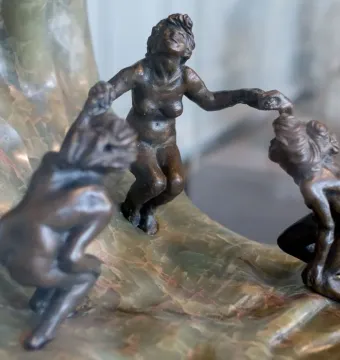
March 2014 © Thibsweb · Public domain
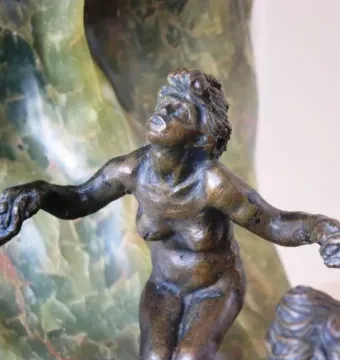
May 2012 © Lomita · CC BY-SA 3.0
Identification | |
| Title | La Vague |
| Alternative titles | Las Bañistas; La Vague o les bagneuses; L'onda |
| Type | Sculpture |
Creator | |
| Artist | Camille Claudel |
| Nationality | French |
| Occupation | Sculptor |
Historical context | |
| Creation date | circa 1903 |
| Creation period | 1897–1903 |
| Artistic context | Made during the period when Claudel had freed herself from Rodin's influence |
| Cycle | Part of an autobiographical cycle begun with Sakuntala / Vertumnus and Pomona |
| Exhibited first at | the Paris Salon in 1897 |
| First version | Plaster version created in 1897 |
| Later versions | Several copies made in onyx and bronze between 1898 and 1903 |
Materials | |
| Material note | Marble is also mentioned in connection with the artist's use of semiprecious materials |
| First version material | Plaster |
| Materials | Onyx and bronze |
Technique | |
| Material use | Onyx was chosen for its suitability to represent water through its color, grooves, and reflections |
| Technique note | Claudel emphasized her creativity, skill, and mastery of different materials in relation to what she wanted to represent |
Appearance | |
| Subject | A large onyx wave about to break over three small nude bathers in bronze, holding hands |
| Figure pose | The bathers are crouching with bent knees; the one closest to the wave is the least hunched and looks most toward the crest |
Iconography and meaning | |
| Interpretation | May represent Camille Claudel herself with two artist friends |
| Symbolic meaning | May be a metaphor for the woman artist about to be overwhelmed by men or by preference for men |
| Artistic meaning | Seen as expressing Claudel's creativity, distinctive aesthetic, and own life |
| Comparative influence | Inspired by and iconographically and chromatically similar to Hokusai's The Great Wave off Kanagawa (1831), the first print in Thirty-six Views of Mount Fuji |
| Japanese influence | Claudel was fascinated by Japan and Japanese art |
Significance | |
| Recognition | Considered one of Camille Claudel's masterpieces |
| Artistic significance | Regarded as a decorative work that fully reflects Claudel's genius and creativity and foreshadows her later andirons (Pensée profonde, Rêve au coin du feu) |
Location and ownership | |
| Current location | Musée Rodin, Paris |
| Other versions located at | Museo Soumaya, Mexico City; La Piscine Museum |
Other | |
| Displayed with | Other works by Camille Claudel |