
Herrería Fountain
Herrería Fountain is a Renaissance granite fountain in Pontevedra, Spain, located in the Casto Sampedro Gardens beside A Ferrería Square. It was financed by Charles V in 1537 to provide drinking water for pilgrims traveling the Portuguese Way to Santiago de Compostela and to help solve local water shortages. The fountain was made by the Portuguese sculptor João Lopes, with the contribution of Domingo Fernández of Santiago de Compostela, and was completed in 1554. It was restored in the eighteenth century, dismantled in 1857, and later recovered through the efforts of Castelao and Casto Sampedro. The fountain was installed in its present location in 1928 and fully restored in 2010.
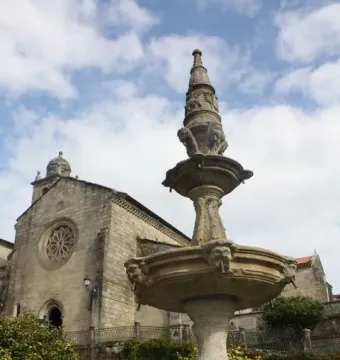
© User:Lameiro · Public domain
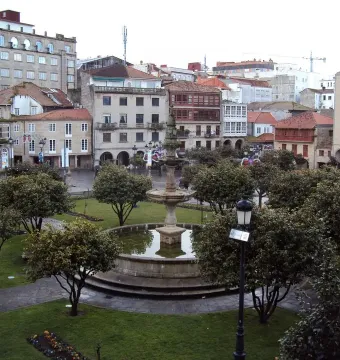
March 2009 © Mariagarcilesa · CC BY-SA 3.0
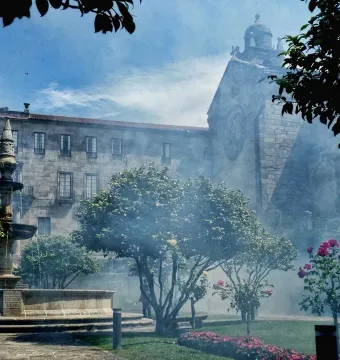
August 2012 © juantiagues · CC BY-SA 2.0
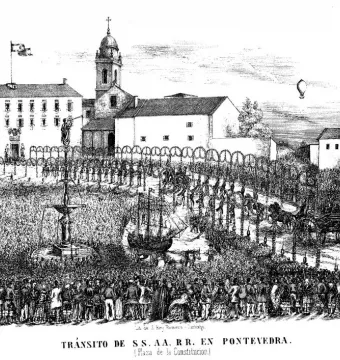
1852 © J. Riestra · CC BY 4.0
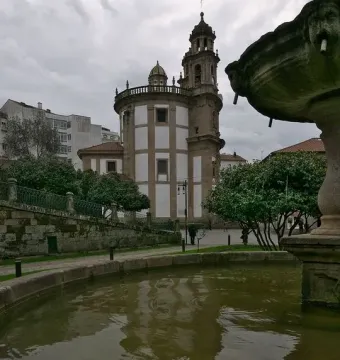
December 2015 © José Luis Filpo Cabana · CC BY 3.0
Identification | |
| Name | A Ferrería Fountain |
| Type | Fountain |
| Original-language name | Fonte da Ferraria |
Historical context | |
| Date of origin | 16th century |
| Commissioned by | King Charles V |
| Financing date | 1537 |
| Completion date | 1554 |
| Historical setting | Pontevedra was the most populous city in Galicia when the fountain was made |
| Purpose | To provide drinking water for pilgrims on the Portuguese Way to Santiago de Compostela and alleviate the city's water shortage, especially in summer |
| Associated pilgrimage route | Portuguese Way of the Camino de Santiago |
Creator | |
| Related comparable works | Fountains in Caminha (1551) and Viana do Castelo (1554), Portugal |
| Model / inspiration | Inspired by Portuguese chafarizes, especially the main fountain in Caminha, which it was meant to match in workmanship, size, height, and execution |
| Builder / designer | João Lopes, a Portuguese from Porto |
| Collaborator | Domingo Fernández of Santiago de Compostela |
Discovery and provenance | |
| Original location | Southwestern part of A Ferrería Square, next to the Trabancas Gate of the Pontevedra city walls |
| Original intended setting | In the city next to the Portuguese Way of the Camino de Santiago, to provide water for pilgrims and alleviate water scarcity |
| Current location | Casto Sampedro Gardens, in front of the Convent of San Francisco, Pontevedra, Spain |
| Custody after dismantling | It remained under the custody of the Sociedad Arqueológica de Pontevedra; its pieces were deposited in the Convent of Santo Domingo |
| Recovery and reinstallation | In 1928, through the interest of Castelao and Casto Sampedro Folgar, the fountain was recovered and installed in the gardens of Casto Sampedro |
Physical characteristics | |
| Second body | Contains a basin that collects water from a smaller upper basin and drains through tubes from four sculpted mythological figures |
| Lighting | Ornamental lighting |
| Inscription | Verses of a popular song dedicated to Pontevedra's hospitality, inscribed on a stone slab attached to the west side of the basin |
| Additional decoration | Four additional mythological heads with tubes emerging from their mouths |
| Third body | Crowned by two coats of arms |
| Spout arrangement | Three levels |
| First body | Rises from a square or quadrangular base |
| Structure | A central shaft with three bodies, topped by a crowning element |
| Number of spouts | 14 |
| Shape of base | Square |
| Shape of basin | Circular |
Materials | |
| Material | Granite |
| Internal piping material | Copper tubes |
Iconography and meaning | |
| Symbolism | Its carved symbolism reflects its function as a fountain for pilgrims |
| Dedication | Dedicated especially to pilgrims on the Portuguese Way of the Camino de Santiago |
| Historical note on city arms | The reverse coat of arms is described as the oldest existing representation of Pontevedra's coat of arms |
| Coat of arms | One shield bears the arms of Emperor Charles V with the Habsburg double-headed eagle; the reverse shows Pontevedra's arms supported by griffins |
History and restoration | |
| Maintenance | The city council made agreements with specialists for upkeep; Francisco Gonçalves is the first known plumber |
| Maintenance payment | 6,000 maravedíes per year in 1597 |
| Usage restrictions | Washing clothes and animal intestines in the fountain was prohibited, and horses were not allowed to drink there |
| Protective structure | The basin was surrounded by a protective circle with four entrances, and a trough was built |
| 18th-century restoration | Restored at the initiative of Félix Raimundo de Soto; the repairs and water supply cost almost ten thousand reales |
| 1857 relocation attempt | In 1857, the city council decided to move the fountain from A Ferrería Square to in front of the Saint Ferdinand barracks for sanitary reasons, but it was dismantled and never moved |
| 2010 restoration | Fully restored in 2010 |
Significance | |
| Historical reception | Ambrosio de Morales was greatly impressed by the fountain; he said that in Saint Francis Square it could rival the fountains of Córdoba for size, height, workmanship, and gilding |