
Robert E. Lee Monument
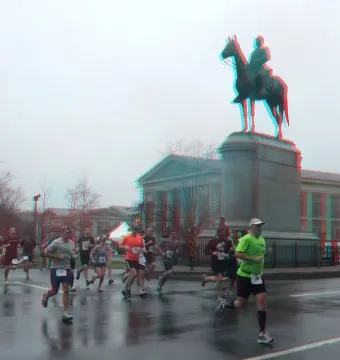
Robert E. Lee Monument was an equestrian statue in Richmond, Virginia, and the first monument installed on Monument Avenue in 1890. It depicted Confederate general Robert Edward Lee on horseback atop a large marble base, reaching a height of 18 meters. Built in France and shipped to Virginia, it remained the largest installation on Monument Avenue for more than a century. The monument was listed on the National Register of Historic Places in 2007 and the Virginia Landmarks Register in 2006. After protests following George Floyd’s death, it became covered in graffiti and was ultimately removed on 8 September 2021, with the empty pedestal dismantled in February 2022.
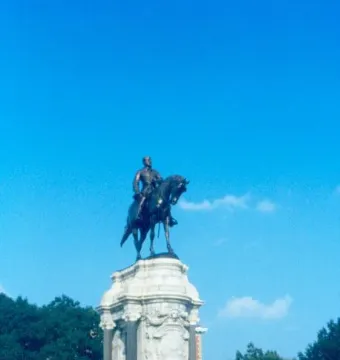
© Carptrash · CC BY-SA 3.0
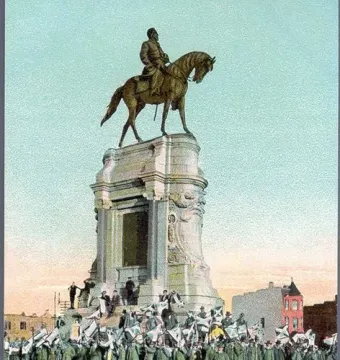
March 2015 © VCU Libraries Commons · No restrictions
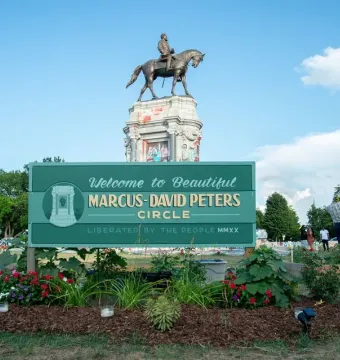
August 2020 © i threw a guitar at him. · CC BY 2.0
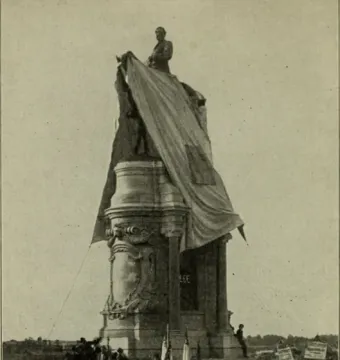
1912 © Internet Archive Book Images · No restrictions
March 2014 © Eli Christman · CC BY 2.0
Identification | |
| Title | Robert E. Lee Monument |
| Type | Equestrian statue; monument |
| Subject | Confederate General Robert E. Lee |
| Alternative name | Monumento a Robert E. Lee |
Historical context | |
| City context | Richmond was the capital of the Confederate States of America |
Creator | |
| Sculptor | Antonin Mercié |
| Sculptor nationality | French |
| Base designer | Paul Pujol |
| Commission leadership | Lee Monument Commission, led by Fitzhugh Lee |
Discovery and provenance | |
| Initial site offer | 1886 |
| Dedication protest | U.S. army veterans in Illinois passed a resolution protesting the display of rebel flags and saying 'treason must be made odious' |
| Dedication attendees | Mary Custis Lee and Mildred Childe Lee |
| Unveiling | May 29, 1890 |
| Arrival in Richmond | May 4, 1890 |
| Cornerstone laid | October 27, 1887 |
| Construction funds | $52,000 |
| Horse depiction | Lee is shown on a stronger-looking thoroughbred rather than Traveller, whose modest size Mercié felt was unsuitable |
| Research and preparation | Mercié researched the American Civil War and Robert E. Lee extensively and bought props such as saddles, stirrups, jackets, and boots for accuracy |
| Final payment to sculptor | $20,000 |
| Construction and transport | Built in France and shipped by rail and sea to Virginia |
| Commission winner | Charles Henry Niehaus won the 1886 competition, but the commission was ultimately awarded to Antonin Mercié |
| Fundraising organizations | Survivors of Lee's Army of Northern Virginia, the Lee Monument Association led by Jubal Early, and the Ladies' Lee Monument Association |
Physical characteristics | |
| Fence | Iron fence around the monument, removed in 1992 |
| Time capsule | A time capsule was reportedly placed in or under the base cornerstone in 1887 |
| Time capsule contents | About 60 items from 30 families and businesses were said to be inside |
| Height | Statue 4.3 meters high; total height 18 meters |
| Material | Bronze statue on a stone base |
| Base material | Marble |
Appearance | |
| Depiction | Robert E. Lee on horseback |
Location and ownership | |
| Former setting | Originally near the main entrance of Virginia Base Ball Park, later standing alone in a tobacco field after Richmond annexed the land in 1892 |
| Allen Avenue name origin | Named after Otway Allen, who donated the land to the association |
| Local significance | A focal point for Richmond; many online maps depicted 'Lee Circle' as the center of the city |
| Site function | Traffic circle/rotary |
| Site ownership | The land around the site was state-controlled |
| Historic district | Monument Avenue Historic District |
| Original location | Traffic circle at Monument Avenue and Allen Avenue, Richmond, Virginia, United States |
History and restoration | |
| Cleaning and repair | Extensive cleaning and repair were completed in December 2006 |
| Replacement monument | The Emancipation and Freedom Monument was installed on 22 September 2021 at Brown's Island |
| New time capsule | On 22 June 2021, Governor Ralph Northam announced plans for a replacement time capsule with 39 items, including COVID-19 vaccination campaign artifacts, a face mask donated by Pamela Northam, items from the Mattaponi and Pamunkey nations, a fragment of the Rumors of War unveiling tarp, and a railroad spike from near the Shockoe Bottom African Burial Ground |
| Second time capsule contents | Banknotes, books, coins, and Civil War memorabilia |
| Time capsule discoveries | On 17 December 2021, a lead box found in the plinth contained mementos from monument-planning commission members dating from after 1889; on 28 December 2021, a copper box containing a second time capsule was found under the northeastern cornerstone |
| Time capsule search | A state-supervised search at the base was unsuccessful and stopped on 9 September 2021 |
| Fence removal effect | After the iron fence was removed in 1992, the stone base became a popular sunbathing spot |
| Legal challenges | A state court initially blocked removal pending a lawsuit, later ruled in Northam's favor in October 2020, and the decision was then suspended pending appeal |
| Current site condition | No trace of the monument remains at the original site; the traffic circle is now a bare patch of grass |
| Pedestal removal | The empty pedestal was dismantled in February 2022 |
| Removal | The bronze statue was removed from the pedestal on 8 September 2021 and sent to storage |
| Virginia Supreme Court decision | On 2 September 2021, the court unanimously ruled that restrictive covenants from 1887 and 1890 were no longer enforceable and that the monument could be removed by the state |
| Removal order | Ralph Northam ordered removal on 4 June 2020 |
| Controversy | After George Floyd's death in 2020, the monument was covered in graffiti and activists called for its removal |
| Largest installation status | It was the largest installation on Monument Avenue for more than a century |
| First installed | 1890 |
Significance | |
| Historical interpretation | Some historians and activists argued that the monument perpetuated the Lost Cause of the Confederacy and represented white supremacy |
| Critical recognition | In October 2020, the graffiti-covered monument was named among the most influential American protest artworks since World War II by The New York Times |
Other | |
| Interpretation note | The source text is truncated after 'considered as a monument' |