
Monument to the Royal Stuarts
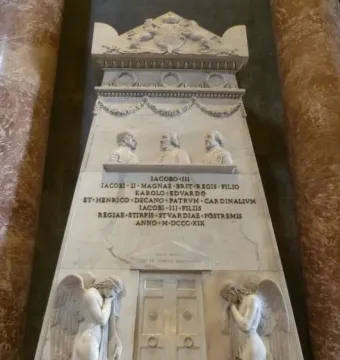
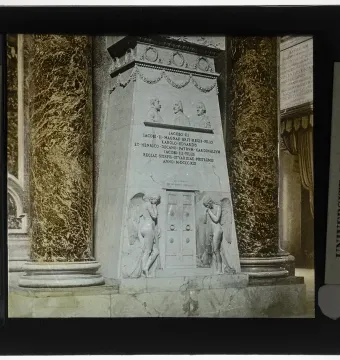
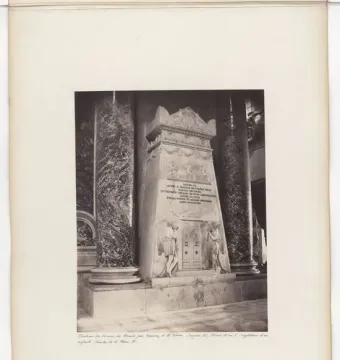
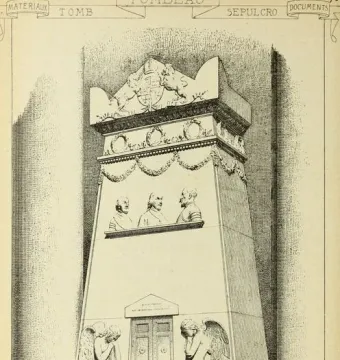
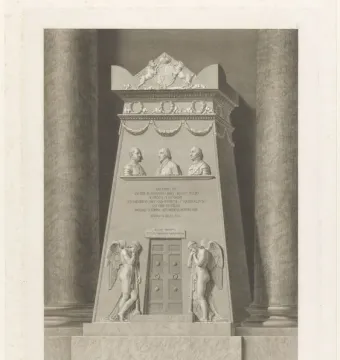
Monument to the Royal Stuarts is a marble funerary monument by Antonio Canova, created after a commission in 1810 and erected between 1816 and 1819. It stands in St. Peter’s Basilica in Vatican City. The monument commemorates the last three members of the Stuart royal house: James Francis Edward Stuart, his eldest son Charles Edward Stuart, and his second son Henry Benedict Stuart. They were recognized by the Jacobite movement as kings of England, Scotland, and Ireland. A plaster model of the work is preserved in the Canova Gipsoteca in Possagno.
July 2012 © Kim Traynor · CC BY-SA 3.0
© Canova, Antonio (Italian Neo-classical sculptor, 1757-1822) (artist) · Public domain
© Anderson, James (1813-1877 ; photographe). Photographe · Public domain
1915 © Internet Archive Book Images · No restrictions
© Rijksmuseum · CC0
Identification | |
| Title | Monument to the Royal Stuarts |
| Alternative names | Cenotaph of the last Stuarts; monument to the Stuarts; Monumento aos Stuarts Reais; improperly called the tomb of the last Stuarts |
| Type | Funerary monument; cenotaph; memorial |
Historical context | |
| Charles Edward Stuart description | the Young Pretender; Bonnie Prince Charlie; died 1788 |
| James Francis Edward Stuart description | the Old Pretender; died 1766 |
| People commemorated | James Francis Edward Stuart (died 1766); Charles Edward Stuart (died 1788); Henry Benedict Stuart (died 1807) |
| Honorees | James Francis Edward Stuart; Charles Edward Stuart; Henry Benedict Stuart |
| Original tombstones status | Recognized as kings (James III, Charles III, and Henry IX) and now kept in the Pontifical Scots College |
| Queen Charlotte of Cyprus historical note | She was illegally deposed in 1464 by her illegitimate half-brother |
| Queen Christina of Sweden historical note | She abdicated in 1654 to convert to Catholicism |
| Associated burial context | Queen Christina of Sweden is the only other monarch with a memorial in the church and is buried in the crypt beneath the basilica |
| Maria Clementina Sobieska relationship | Wife of James Francis Edward Stuart and mother of Charles Edward Stuart and Henry Benedict Stuart |
| Support context | George IV became an admirer of the Stuart legend after the Jacobite threat to his throne ended with the death of Cardinal Stuart in 1807 |
| Henry Benedict Stuart description | the Cardinal Duke of York; died 1807 |
| Commemorates | The last three members of the House of Stuart |
| Historical interpretation | Jacobites recognized James Francis Edward Stuart, Charles Edward Stuart, and Henry Benedict Stuart as the legitimate kings of England, Scotland, and Ireland |
Creator | |
| Artist | Antonio Canova |
| Artist lifespan | 1757–1822 |
| Artist significance | The most celebrated Italian sculptor of his day |
Discovery and provenance | |
| Model | A plaster model is preserved in the Gipsoteca Canoviana in Possagno |
| Commissioned date | 1810 |
| Erected date | 1816–1819; also given as 1819 |
| Commissioned by | Monsignor Angelo Cesarini, executor of the will of Henry Benedict Stuart |
| Supporter | King George IV |
Materials | |
| Material | Marble |
| Sarcophagus decoration material | Bronze |
| Sarcophagus material | Not specified; topped with bronze elements |
Physical characteristics | |
| Form | Truncated obelisk |
Appearance | |
| Sarcophagus top decoration | A bronze cushion with a bronze crown placed on it |
| Relief decoration | Bas-relief profile portraits of the three exiled princes |
| Additional figures | Two weeping angels below the inscription |
| Inscription | The monument bears an inscription below the portraits, but the text is not provided in the fragment |
| Door inscription | BEATI MORTVI QVI IN DOMINO MORIVNTVR |
| Decoration | Often adorned with flowers by Romantic Jacobites |
| Door inscription translation | Blessed are the dead who die in the Lord |
| Censorship | Under Pope Leo XII, plaster draperies were placed over the nude figures as censorship; they were later removed under Pope Leo XIII |
| Sarcophagus inscription | The same inscription as above appears on the front of the sarcophagus |
Iconography and meaning | |
| Symbolism of the angels | They symbolize the lost hopes of the exiled Stuarts |
Location and ownership | |
| Location | St. Peter's Basilica, Vatican City; at the entrance/back of the basilica in the left aisle, opposite the door used by people coming down from the spiral staircase of the dome and roof |
| Related person | Maria Clementina Sobieska |
| Related nearby monument | The monument to Maria Clementina Sobieska stands in front of it |
| Burial location | The three Stuarts are buried in the crypt below St. Peter's Basilica |
History and restoration | |
| Current burial marker | In 1939, a single sarcophagus was erected over the three graves |
| Burial site until 1938 | Until 1938, the bodies of the three Stuarts were buried where the tomb of Pius XI now stands |
| Original grave markers | Three separate tombstones were erected on the site |
| Burial arrangement | James Francis Edward Stuart was buried in the crypt when he died in 1766; Charles Edward Stuart was buried in the Basilica of Saint Peter the Apostle in Frascati when he died in 1788; Henry Benedict Stuart was buried beside his father in the crypt of Saint Peter when he died in 1807 |
| Relocation of remains | In 1938, the bodies were moved slightly eastward on the left side of the crypt to make room for Pius XI's tomb |