
The Hand
The Hand is a sculpture on the beach in Punta del Este, in the Maldonado department of Uruguay, and one of the city’s main tourist attractions. Created by Chilean artist Mario Irarrázabal, it shows the fingertips of five fingers emerging from the sand. The structure is made of cement covered with plastic and protective anti-corrosion materials, supported by a steel frame. It was unveiled in 1982 during the first annual international open-air meeting of contemporary sculptors in Punta del Este. Irarrázabal intended the sinking hand as a warning to swimmers, and its meaning is associated with human presence in nature.
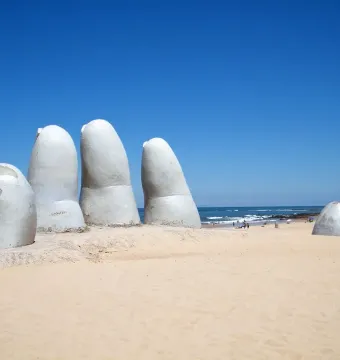
November 2012 © Coolcaesar · CC BY-SA 3.0
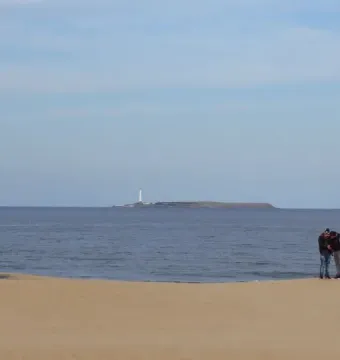
August 2015 © Casaseneleste · CC BY-SA 4.0
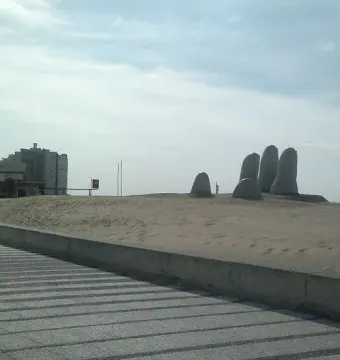
September 2012 © Paola15 · CC BY-SA 3.0
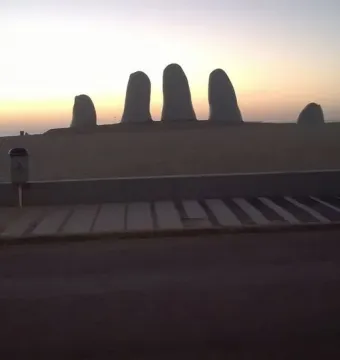
December 2014 © Velocidad Total · CC BY-SA 2.0
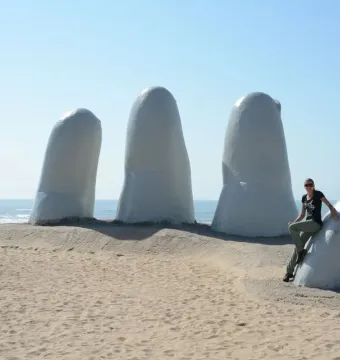
October 2013 © M M · CC BY-SA 2.0
Identification | |
| Title | The Hand |
| Alternative names | La Mano; Los Dedos; Hombre emergiendo a la vida; A Mão; Os Dedos; Homem emergindo à vida; Dedos; Ruka Punta-del-Este |
| Type | Sculpture |
Creator | |
| Artist | Mario Irarrázabal |
| Artist nationality | Chilean |
Historical context | |
| Creation event | The first annual international open-air meeting of contemporary sculptors in Punta del Este in 1982 |
| Number of participating sculptors | Nine |
| Artist's position in the event | The youngest of the nine sculptors |
| Original intended site | A public square in Punta del Este |
| Reason for beach location | After a dispute over the public square locations, Irarrázabal chose to make the sculpture on the beach |
| Intended meaning | A warning to swimmers |
| Artist's interpretation of meaning | Human presence in nature |
| Creation time | Summer 1982 |
| Completion time | The first six days of the summer project |
| Planned duration | The entire summer |
| Weather conditions during creation | Minor delays caused by the strong southeast wind common in Punta del Este |
Physical characteristics | |
| Dimensions | About 5 meters wide and about 3 meters high |
| Depiction | The tips of five human fingers emerging from the sand |
Materials | |
| Materials | Concrete and plastic |
| Structural reinforcement | Steel bars and metal mesh |
| Surface treatment | The plastic exterior was coated with a degradation-resistant solvent and protective anti-corrosion materials |
Location and ownership | |
| Location | Parada 1, Brava Beach, Punta del Este, Maldonado Department, Uruguay |
| Current location | Still at its original location on the beach in Punta del Este |
| Site description | A popular seaside resort and tourist town |
History and restoration | |
| Vandalism | The work was vandalized in January 2025 |
| Condition | Largely intact and still in its original place |
| Damage or alteration | Graffiti on the palm side of the fingers made in 2005 |
| Completion date | February 1982 |
Significance | |
| Status | A symbol of Punta del Este and one of Uruguay's most recognizable landmarks |
| Cultural presence | Featured on postcards and tourist photographs |
| Recognition | Gave Mario Irarrázabal international renown |
| Later related works by the artist | Similar compositions were later built in Madrid (1987), the Atacama Desert in Chile (1992; Mano del Desierto / Hand of the Desert), and Venice (1995) |
Other | |
| Event associations | During the 2010 Punta del Este Grand Prix, organizers placed a glove on the fingers; the 2015 Punta del Este ePrix held the podium ceremony next to the sculpture |
| Longevity | It had stood for about 40 years |